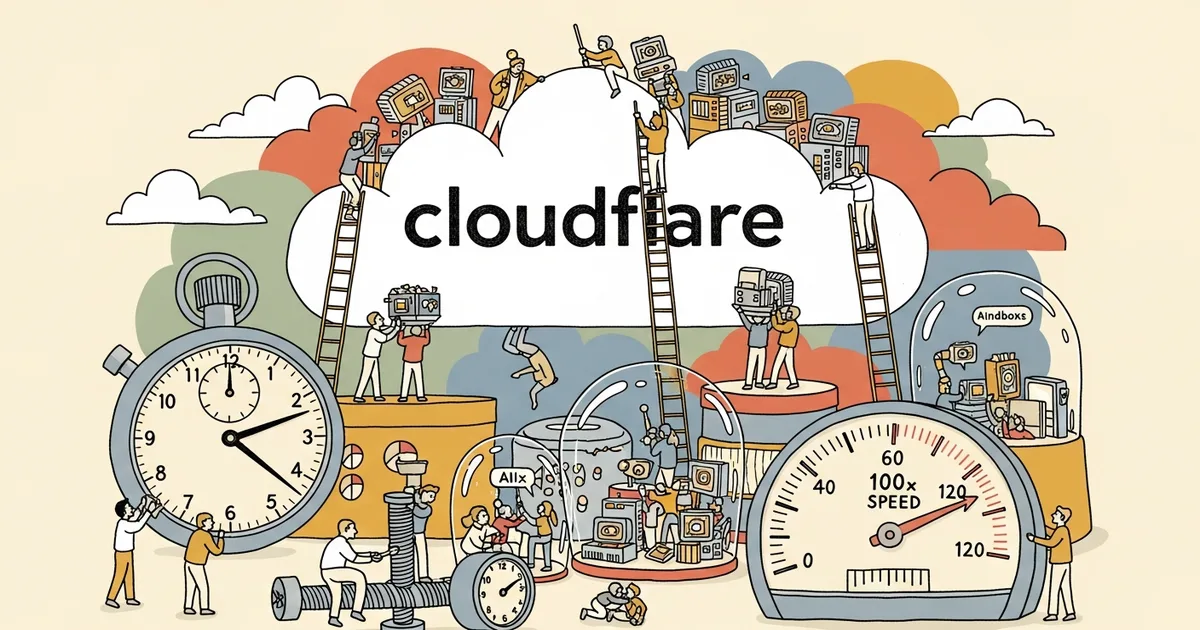
- Cloudflare launched Dynamic Workers in open beta on March 24, 2026, providing sandboxed execution environments for AI-generated code that start in milliseconds
- Dynamic Workers are 100x faster to spin up and 10-100x more memory efficient than Docker containers, using V8 isolates instead of virtualization
- The service runs across Cloudflare’s 600+ global locations with zero-latency local execution and costs $0.002 per unique Worker loaded per day
- Cloudflare is positioning itself as core infrastructure for AI agent platforms, competing with Modal, E2B, and Fly.io
What Happened
Cloudflare launched Dynamic Workers in open beta on March 24, 2026, providing a sandboxing environment specifically designed for AI-generated code execution. The technology enables AI agents to run arbitrary code, generated on the fly by language models, inside secure isolates that start in single-digit milliseconds and use a fraction of the memory required by traditional containers. The service is available to all paid Cloudflare Workers users, with beta period charges waived. Cloudflare’s engineering blog detailed the architecture and performance benchmarks.
Why It Matters
The core problem Dynamic Workers solve is trust. When an AI agent generates code to complete a task, such as querying a database, processing a file, or calling an API, that code needs to run somewhere. Running it directly on a server is a security risk. Running it in a Docker container adds seconds of startup latency and hundreds of megabytes of memory overhead per instance. Cloudflare’s isolate-based approach provides the same security boundary as a container but with startup times measured in single-digit milliseconds and memory footprints of a few megabytes.
This changes the economics of AI agent architectures from memory-bound to compute-bound. An agent orchestrating ten parallel tasks that each require code execution would need ten containers under traditional approaches, consuming gigabytes of memory and taking seconds to provision. With Dynamic Workers, the same ten tasks run in isolates that collectively use tens of megabytes and start nearly instantly.
Technical Details
Dynamic Workers use V8 isolates, the same JavaScript engine technology that powers Google Chrome and Cloudflare’s existing Workers platform, extended to support dynamic code loading at runtime. Each isolate runs in its own memory space with no access to the host system, other isolates, or network resources beyond what is explicitly permitted. The architecture supports JavaScript, Python, and WebAssembly, with JavaScript preferred for small code snippets.
Cloudflare has built three supporting libraries for the platform. The @cloudflare/codemode library simplifies execution of model-generated code. The @cloudflare/worker-bundler handles pre-bundling of module dependencies. The @cloudflare/shell provides a virtual filesystem with persistent storage. Security measures include V8 patches deployed within hours of disclosure, a custom second-layer sandbox with tenant isolation, hardware-leveraging extensions using Memory Protection Keys, and active Spectre defense research. Dynamic Workers run across all 600-plus Cloudflare locations with zero additional latency since they execute on the same machine and thread as the creating Worker.
Who’s Affected
AI agent platform builders are the primary audience. Zite, an early adopter, reported that Dynamic Workers “outperformed all benchmarked platforms” for server-side execution of LLM-generated applications, now “servicing millions of execution requests daily.” The service competes with Modal, E2B, and Fly.io for the workload category of running code that AI writes, a market segment that barely existed two years ago.
Pricing follows Cloudflare’s existing Workers model at $0.002 per unique Worker loaded per day, with additional CPU time and invocation charges. Cloudflare describes the Dynamic Worker cost as “typically negligible” compared to the inference costs of generating the code in the first place.
What’s Next
Dynamic Workers are in open beta with pricing subject to change before general availability. The release positions Cloudflare as infrastructure for the emerging AI agent ecosystem, extending its edge computing platform into a new category of ephemeral, untrusted workloads. Cloudflare has also released an HTTP filtering system with credential injection for outbound requests, allowing agent platforms to control which external services Dynamic Workers can access and with what credentials.
The competitive question is whether Cloudflare’s existing global network and developer adoption provide a durable advantage over purpose-built competitors like E2B, which focus exclusively on AI code execution, or whether this market will consolidate around a different architecture entirely. The V8 isolate approach trades the full Linux environment that containers provide for speed and efficiency, meaning workloads that require system-level access or native binaries will still need traditional container solutions.
Related Reading
- Google Now Rewrites News Headlines in Search Results Using AI
- MiniMax Releases M2.7 with Self-Evolving Training, Scores 56% on SWE-Pro Benchmark
- FlashAttention-4 Achieves 1,613 TFLOPs on NVIDIA Blackwell, 2.7x Faster Than Triton
- TurboQuant Optimization Achieves 22.8 Percent Decode Speedup in llama.cpp by Skipping Redundant KV Dequantization
- California Launches AI Innovation Council and ‘Poppy’ Digital Assistant for State Workers