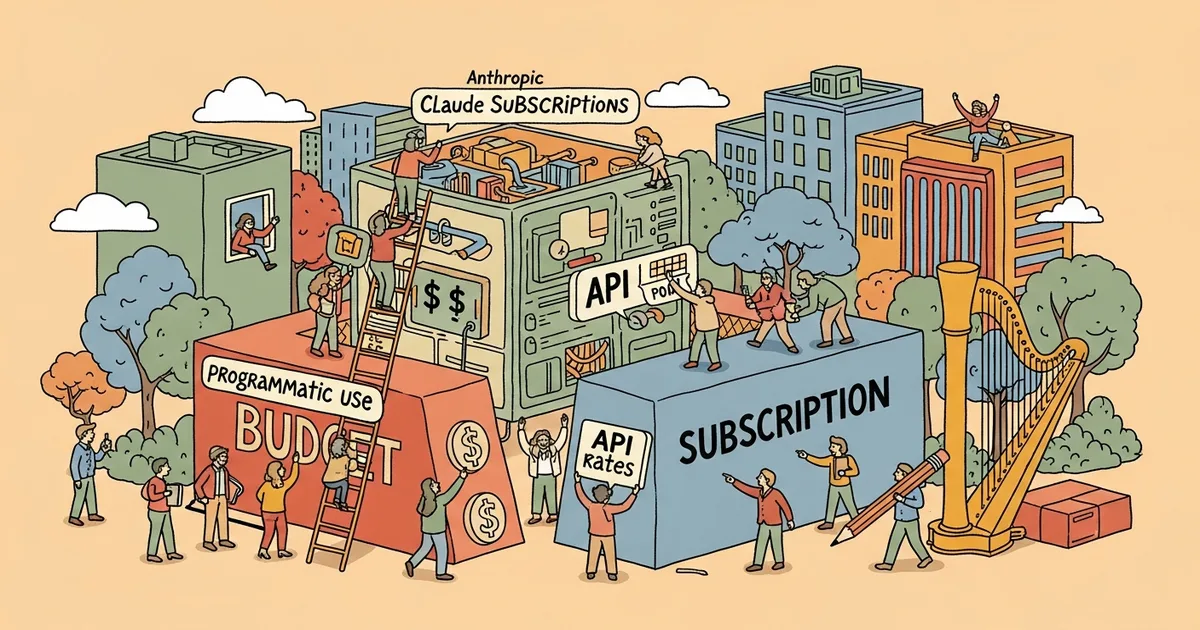
- Starting June 15, 2026, paid Claude subscribers receive a dedicated monthly credit for programmatic use (SDK, CLI, third-party tools).
- Programmatic usage will be billed at full API rates from the new credit, separate from interactive Claude limits.
- The change is a response to heavy usage from third-party Agent SDK tools that previously strained Anthropic’s flat-rate subscription model.
- Anthropic developer Lydia Hallie says “you don’t pay extra,” but heavy programmatic users effectively will, since former subsidised usage now consumes API-priced credit.
What Happened
Anthropic is restructuring how paid Claude subscriptions are billed, The Decoder reported on Thursday. Starting June 15, 2026, users on paid Claude plans will receive a dedicated monthly credit for programmatic use, separate from their interactive usage limits. The new credit covers the Claude Agent SDK, the claude -p command-line tool, Claude Code GitHub Actions, and any third-party applications built on the Agent SDK. Programmatic usage will be charged at full API rates from that credit.
Why It Matters
The restructuring is a direct response to a cost-allocation problem inside Anthropic’s flat-rate consumer subscription model. Until now, programmatic SDK and command-line usage shared the same rate limits as interactive Claude Code and chat sessions. As third-party tools — including Conductor and OpenClaw — began tapping the Claude Agent SDK at scale, individual subscribers were burning through monthly budgets in disproportionately heavy patterns. Anthropic had already introduced a restriction specifically targeting OpenClaw and similar tools during the wave of interest in that project. The new policy is the broader systemic fix.
The change reflects a structural reality of agentic AI economics: agentic workflows generate many more tokens per user-perceived task than chat does. A flat-rate plan optimised for chat usage becomes economically untenable when a single SDK user can consume tokens at chat-user equivalents that are 10x to 100x higher.
Technical Details
The implementation has two distinct credit pools per subscriber. Pool 1, for interactive use, retains the same rate limits as today. Pool 2, for programmatic use, is a new monthly credit billed at API rates. Anthropic developer Lydia Hallie visualised the two-pool structure in a tweet that accompanied the announcement, framing it as “you don’t pay extra.” That framing is technically correct in that the subscription price does not increase, but the second-order effect is that programmatic usage that was previously subsidised under the interactive plan now consumes its own credit at full API price.
For light programmatic users, the included credit will likely cover routine usage. For heavy users — Claude Agent SDK builders, Claude Code Github Actions at scale, OpenClaw, Conductor — the included credit will be exhausted faster, and additional programmatic use will be charged at API rates above the subscription’s value.
Who’s Affected
Heavy programmatic Claude users — solo developers running multiple Claude Agent SDK workflows, small teams using Claude Code GitHub Actions at scale, third-party app developers building on top of the SDK — see the largest practical change. Tool builders such as OpenClaw and Conductor that depend on subscriber-side Anthropic credentials face conversation with their own users about how the new billing structure affects their integrations. Light programmatic users — those using the SDK occasionally or for personal projects — should fit within the included credit. Anthropic’s flat-rate economics improve in the aggregate as the cross-subsidy from chat-only subscribers to programmatic-heavy subscribers is removed.
What’s Next
The June 15 effective date gives subscribers about a month to evaluate their programmatic usage patterns and decide whether to remain on subscription tiers or move to API-only billing. Anthropic has not announced specific included-credit amounts per tier publicly; details are expected in the weeks ahead of the cutover. Competing model providers — OpenAI, Google, Mistral — will be watched for whether they introduce similar dual-pool subscription structures.