- Spotify launched a beta CLI tool on May 7, 2026 that lets users save AI-generated personal podcasts directly to their Spotify library.
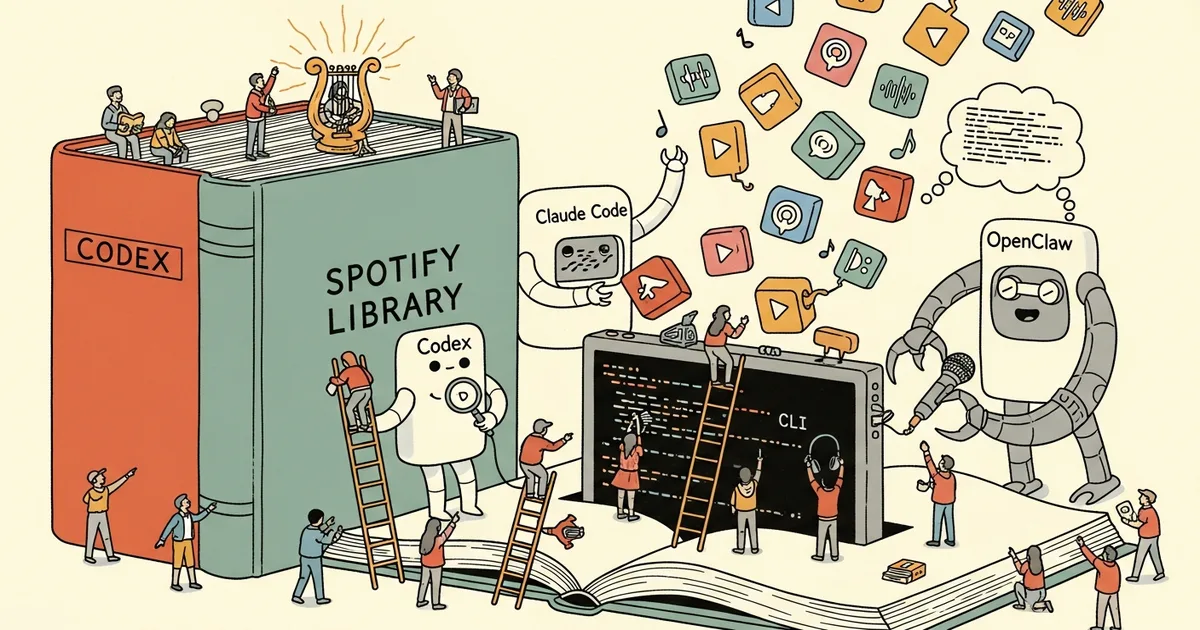
- The tool integrates with OpenAI’s Codex, Anthropic’s Claude Code, and OpenClaw — users issue prompts via these agents to generate podcasts and save them to Spotify.
- Generated podcasts appear in the user’s Spotify library for personal access; they are not visible to other Spotify users.
- Spotify positions the launch as responding to user demand: “People are already starting to use their agents to create personal audio that guides their day.”
What Happened
Spotify launched a beta CLI tool on May 7, 2026 that lets users save AI-generated personal podcasts to their Spotify library. The tool requires existing access to a coding agent — OpenAI’s Codex, Anthropic’s Claude Code, or OpenClaw — through which users issue natural-language prompts to generate the podcast and save it back to Spotify. Spotify’s announcement frames the move as letting users access AI-generated personal audio “where they already listen to everything else.”
Why It Matters
Personal AI-generated audio has been a quietly accelerating product category through 2025-2026. Google’s NotebookLM, Hero, and Adobe Acrobat all let users generate podcast-style audio from documents, schedules, or articles. But these products have lived inside their own apps; transferring AI-generated audio into Spotify — the dominant audio-consumption platform — has required manual upload steps. Spotify’s CLI tool removes that friction for users who already use coding agents. The strategic implication: Spotify is positioning itself as the consumption-layer endpoint for AI-generated personal audio, regardless of which lab or tool generated it.
Technical Details
The integration is currently programmer-targeted. Users go to the tool’s GitHub page, follow the install instructions, and authenticate via browser to their Spotify account. Once linked, users issue prompts through their existing coding agent. Spotify’s example prompt: “Build me an audio session that dives deep into the history of the World Cup with details about key players, where it’s been held, and what I should know about the games this year.” The agent generates the podcast and the CLI tool saves it to Spotify, returning a Spotify listing link.
Three coding agents are explicitly supported at launch: OpenAI’s Codex (typically used through ChatGPT or the Codex CLI), Anthropic’s Claude Code (with the Symphony orchestration layer covered earlier this week), and OpenClaw (the third-party agent runtime). The CLI tool is open-source on GitHub. Generated podcasts appear in the user’s Spotify library only — not visible to other Spotify users, not published to the platform’s public discovery surface.
The CLI-only entry point means consumer Spotify users who don’t run coding agents cannot use the feature at launch. Spotify’s announcement positions this as the intentional first step: meeting power users where they already are, rather than building a consumer-facing AI generation layer inside the Spotify app itself. Future generalist surface availability is implied but not announced.
Who’s Affected
Spotify’s roughly 700 million monthly active users gain a path for AI-generated audio to live in their main listening app, though the practical immediate audience is narrower (users with active Codex, Claude Code, or OpenClaw access). OpenAI, Anthropic, and the OpenClaw community gain a new consumption surface for agent-generated outputs. Google’s NotebookLM, Hero, Adobe Acrobat, and other AI-podcast generation tools face a competitive question: their distribution is now potentially routed through Spotify rather than through their own apps. Apple Podcasts, Pocket Casts, Overcast, and other podcast clients face implicit pressure to add similar AI-generation paths, though without coding-agent support they cannot match the immediate flexibility Spotify provides.
What’s Next
Watch for Spotify to expand the integration beyond CLI into the consumer Spotify app — the natural next step is direct in-app prompting against Spotify’s own AI generation. Apple, Amazon (Audible), and Google (Podcasts/YouTube Music) face decisions on whether to match. The privacy story for AI-generated personal audio — particularly podcasts that summarize the user’s calendar or class notes — will become a consumer-protection question if generation expands beyond power users. Independent measurement of how many Spotify users actually adopt the CLI feature in the first 30-60 days will indicate whether AI-generated personal audio is a meaningful new consumption category or a niche.