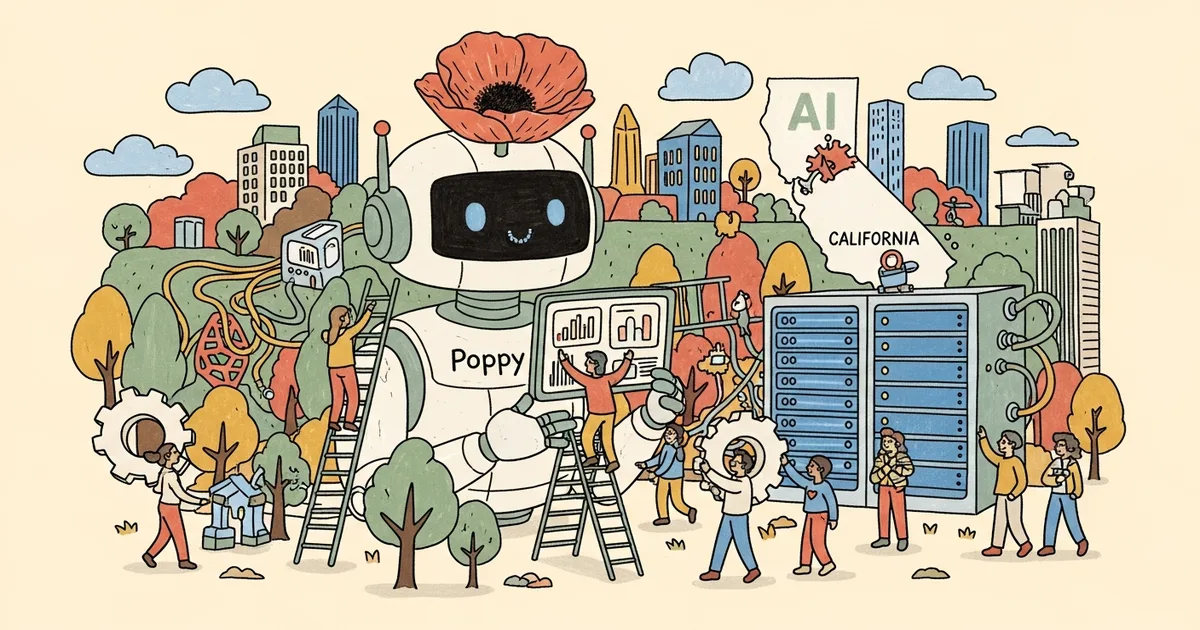
- California Governor Gavin Newsom launched the California Innovation Council, an Emerging Technology Accelerator, and a generative AI assistant called Poppy for state employees on December 16, 2025.
- Poppy operates on 11 AI models within California’s internal infrastructure; all queries, documents, and responses stay inside the state’s secure network.
- The 30-member Innovation Council includes leaders from Stanford, UC Berkeley, the Mozilla Foundation, the Brookings Institute, and former U.S. Senator Laphonza Butler.
- Over 2,600 state employees across 66 departments are using Poppy in a pilot phase that runs through June 2026.
What Happened
Governor Gavin Newsom announced three AI governance initiatives on December 16, 2025: the California Innovation Council, an Emerging Technology Accelerator, and a statewide generative AI digital assistant named Poppy. The initiatives extend a 2023 executive order directing state agencies to adopt generative AI responsibly.
Poppy was developed by the California Department of Technology in collaboration with more than 20 state departments. State Chief Technology Officer Jonathan Porat described it as a tool built “for state workers, by state workers, built by us here at the state.” Since its pilot launch in September 2025, more than 2,600 users across 66 state departments have accessed the assistant, with the pilot capped at 100 users per agency through June 2026.
Why It Matters
California is the first U.S. state to deploy a custom-built AI assistant across its government workforce at this scale. Unlike commercial AI services such as ChatGPT or Gemini, Poppy operates entirely on California’s internal infrastructure. Queries, uploaded documents, and responses never leave the state’s secure network, which addresses data sovereignty concerns that have slowed AI adoption in other government agencies. The system draws information exclusively from official CA.gov websites, preventing the assistant from surfacing unverified external content.
The timing is notable. The White House has issued executive orders aimed at limiting states’ regulatory authority over AI, while California has moved forward with its own legislative framework. Several of California’s new AI laws took effect on January 1, 2026, including provisions carrying civil penalties of $5,000 per violation per day.
Technical Details
Poppy runs on 11 different AI models and draws information exclusively from official CA.gov websites. The system flags personally identifiable information, including Social Security numbers and individual data, and either refuses the task or redacts sensitive content. Deputy Director of Platform Services Shera Mui said Poppy helps “bridge the gap between siloed data and collaborative government work.”
Legal teams use Poppy for policy analysis. HR officials use it for succession planning. General staff use it to complete state forms and navigate internal procedures. The assistant is grounded in public state data, which limits hallucination risk but also restricts its knowledge to government sources. The pilot phase caps access at 100 users per agency, giving the Department of Technology a controlled environment to identify issues before a potential statewide rollout.
Who’s Affected
The 30-member Innovation Council is split into four subgroups covering children’s internet safety, technology fraud, economic development and workforce, and government services modernization. Members include representatives from the Mozilla Foundation, the California Chamber of Commerce, the Brookings Institute, Stanford University, the Atlantic Council, and former U.S. Senator Laphonza Butler.
The Emerging Technology Accelerator creates formal partnerships between the state and academic institutions including the Stanford Institute for Human-Centered AI, UC Berkeley’s School of Information, and Stanford’s McCoy Family Center for Ethics in Society. Additional partners include the Tech Talent Project, US Digital Response, and Nava Labs. These partnerships are intended to provide the state with academic research capacity and technical talent that government agencies typically lack in-house, particularly in areas like AI safety evaluation and workforce training.
What’s Next
Poppy’s pilot ends in June 2026, at which point California will decide on broader deployment. Scaling beyond 2,600 users to the state’s full workforce of approximately 230,000 employees would require significant infrastructure expansion and policy adjustments.
The Innovation Council’s advisory outputs have not yet been published, leaving open the question of whether it produces actionable policy or functions primarily as a signaling mechanism. The state’s Government Operations Agency and Office of Data and Innovation are coordinating implementation across departments. Poppy’s restriction to CA.gov data sources means it cannot assist with tasks requiring external research or cross-referencing non-government databases.
Related Reading
- California Governor Newsom Signs AI Vendor Certification and Procurement Order
- Palantir CEO Alex Karp Says Only Trade Workers and Neurodivergent People Will Thrive in AI Era
- Cloudflare Launches Dynamic Workers for AI Agent Sandboxing at 100x Container Speed
- California sets its own AI rules for state contractors, pushing back against federal policy