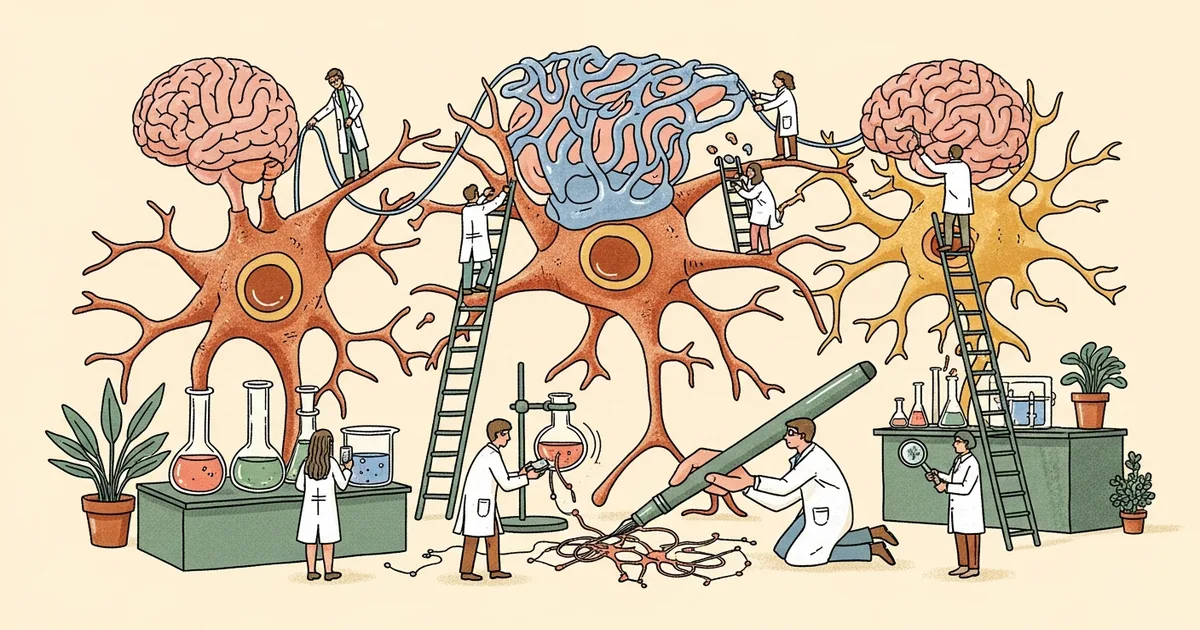
Northwestern University engineers announced on April 18, 2026 that they have 3D-printed artificial neurons on flexible substrates capable of bidirectional communication with living biological neural tissue. The devices generate lifelike electrical spikes using ionic mechanisms — matching biology’s own signaling chemistry — and successfully interface with real neurons under laboratory conditions. The artificial neurons brain interface problem that has stalled neural implant longevity for two decades may have a material science answer.
This is not an incremental refinement of existing brain-computer interface technology. It is a different engineering philosophy — one that meets biology on its own terms rather than forcing tissue to adapt to silicon.
What Northwestern Actually Built
The team engineered organic electrochemical transistors (OECTs) — printable, flexible devices that mimic the ion-channel dynamics of biological neurons. Unlike silicon-based microelectronics that process signals with electrons, OECTs use ions, which is the same carrier mechanism biological neurons rely on. This ionic compatibility enables genuine two-way signal exchange rather than one-directional recording or blunt stimulation.
The devices are printed onto thin polymer substrates — the same material category used in bendable displays — allowing them to conform to the curved, soft geometry of neural tissue. Manufacturing uses adapted inkjet and screen-printing techniques with conductive organic inks, eliminating the cleanroom lithography required for silicon neural probes. Per-unit costs are orders of magnitude lower than conventional BCI hardware, and the organic polymer materials are biocompatible, meaning they do not trigger the acute immune responses that silicon and metal electrodes reliably produce within weeks of implantation.
How the Artificial Neurons Brain Interface Actually Works
Biological neurons communicate through action potentials — precisely timed flows of sodium, potassium, and calcium ions across cell membranes, each spike lasting roughly one millisecond. OECT-based artificial neurons replicate this ion-exchange mechanism, generating voltage spikes that biological neurons interpret as legitimate signals rather than electrical noise from a foreign material. The chemistry matches. That is the breakthrough.
In laboratory testing, Northwestern’s printed devices placed in direct contact with living neural tissue triggered measurable responses in real neurons. The artificial neurons effectively spoke the brain’s electrochemical language. Critically, the communication was bidirectional — the artificial neurons could both stimulate and record from biological cells — which is the defining capability distinguishing useful BCIs from passive recording arrays.
The flexible substrate matters as much as the ionic signaling. The brain experiences micromotion — tiny displacement relative to any implanted hardware — that causes rigid electrodes to cut into tissue and lose signal quality within months. A polymer substrate moves with the brain, preserving both tissue integrity and signal fidelity over longer implant lifetimes.
Neuralink’s Rigid Electrode Problem, Quantified
Neuralink’s N1 chip implant uses 1,024 electrodes mounted on rigid silicon threads. The company’s first human patient, Noland Arbaugh, experienced electrode retraction — the brain’s immune response physically pushing foreign material away — within weeks of his May 2024 implantation. Neuralink acknowledged in regulatory disclosures that a significant portion of functional electrode threads had retracted, reducing effective recording coverage. The company’s second trial patient required a surgical revision to address related complications.
These are not manufacturing defects. They are the predictable consequence of implanting silicon into tissue that is orders of magnitude softer. The brain’s Young’s modulus is approximately 0.5 to 1 kilopascal. Silicon measures around 130 gigapascals. Every micromotion creates a stress concentration at the electrode-tissue boundary, progressively damaging neurons and triggering glial scarring. Independent research on chronic neural implant failure consistently identifies mechanical mismatch — not chemistry, not electrical interference — as the primary driver of signal degradation over time.
Northwestern’s organic polymer approach addresses this at the physics level. The flexible substrate distributes mechanical stress across a larger surface area, reduces the shear forces that cause electrode retraction, and allows the device to deform with brain tissue rather than against it. This is not a marginal improvement to the rigid electrode paradigm. It replaces the paradigm.
Prosthetics: The First Commercial Application
Current neural-controlled prosthetic limbs — including DARPA-funded modular prosthetic limbs used in advanced rehabilitation trials — rely on surface EMG sensors or implanted recording electrodes for motor command decoding. Neither achieves bidirectional communication. Users can send motor commands to a prosthetic limb but cannot receive tactile feedback through the neural pathway a biological hand uses. The result is functional but cognitively expensive prosthetics that require sustained visual attention to operate safely.
Printed artificial neurons that both stimulate and record from peripheral nerve fibers would close this sensorimotor loop. A prosthetic hand could report grip pressure and surface texture back to the brain via peripheral nerve stimulation — not visual or audio substitutes. University of Pittsburgh researchers demonstrated rudimentary tactile feedback in prosthetics as early as 2016 using traditional metal electrodes, but chronic interface degradation prevented clinical translation. The Northwestern flexible printed neuron directly addresses the failure mode that stopped Pittsburgh’s work from scaling.
The global prosthetics market reached $2.1 billion in 2025, according to Grand View Research, with neural-controlled devices representing the fastest-growing segment. Interface longevity — currently the primary technical barrier — is the single largest constraint on that growth curve.
Neuroprosthetics Beyond Limb Replacement
The same flexible interface technology applies directly to conditions involving interrupted neural signal transmission: spinal cord injuries, ALS-related motor neuron degeneration, and peripheral neuropathy, which affects an estimated 20 million Americans according to the National Institute of Neurological Disorders and Stroke. Each condition shares the same underlying problem — severed or degraded signal pathways — and each maps to the same engineering solution Northwestern just demonstrated.
Cochlear implants, the most commercially successful neuroprosthetic to date with over 1 million devices implanted worldwide, work by electrically stimulating the auditory nerve. The Northwestern approach could enable far more spatially precise stimulation of individual nerve fibers, potentially restoring more granular hearing, tactile, or proprioceptive function than current devices achieve. The Synchron Stentrode — deployable endovascularly through the jugular vein without craniotomy — has demonstrated that neural interfaces don’t require open brain surgery to function. Flexible printed neurons are mechanically compatible with the same minimally invasive delivery paradigm, suggesting clinical pathways that avoid the surgical risk profile of Neuralink-class procedures entirely.
The AI Integration Layer Is the Logical Next Step
A printed artificial neuron that communicates bidirectionally with real neural tissue is, functionally, a programmable node in a biological network. The next engineering step — already appearing in peer-reviewed literature — is making that node AI-addressable: capable of receiving decoded intent from a machine learning model and translating it into biologically compatible ionic stimulation patterns in real time.
Neural interface companies including Synchron, BrainGate, and Paradromics are developing AI decoding layers that translate neural activity into digital commands. What has been consistently missing is interface hardware that maintains signal fidelity over clinically meaningful timescales. A flexible printed neuron that doesn’t degrade changes the cost-benefit calculus for every AI-neural integration project currently in development.
The broader AI infrastructure buildout — including the $10 billion data center investments reshaping compute geography — has focused entirely on silicon and custom ASICs. Bio-digital hybrid computing, where printed artificial neurons serve as a stable interface layer between biological and digital processing, represents a third path that no major AI lab has formally committed to. MegaOne AI tracks 139+ AI tools across 17 categories, and neural interface hardware is one of the fastest-moving domains in the portfolio — the Northwestern research is the most significant materials development this category has seen.
Biological neurons consume approximately 20 femtojoules per spike — orders of magnitude below even the most efficient silicon implementations. If hybrid systems combining biological neural efficiency with programmable digital precision become engineerable at scale, the entire economics of AI compute shifts. The Humans First movement, which has organized significant opposition to invasive AI integration, will find flexible neural interfaces structurally harder to oppose than rigid electrode implants. A device that conforms to the body’s mechanics rather than damaging tissue changes the informed consent calculus for patients and regulators alike — the objection to Neuralink is partly about physical risk, and that risk profile does not transfer to a soft, printable polymer device.
Northwestern’s printed neurons remove the primary physical barrier to practical brain-computer interfaces. Every application in the stack — prosthetics that restore tactile feedback, neuroprosthetics that bypass spinal injury, AI-neural hybrids that leverage biological compute efficiency — shared one dependency: an interface that doesn’t fail within months. That dependency now has a credible materials science answer.