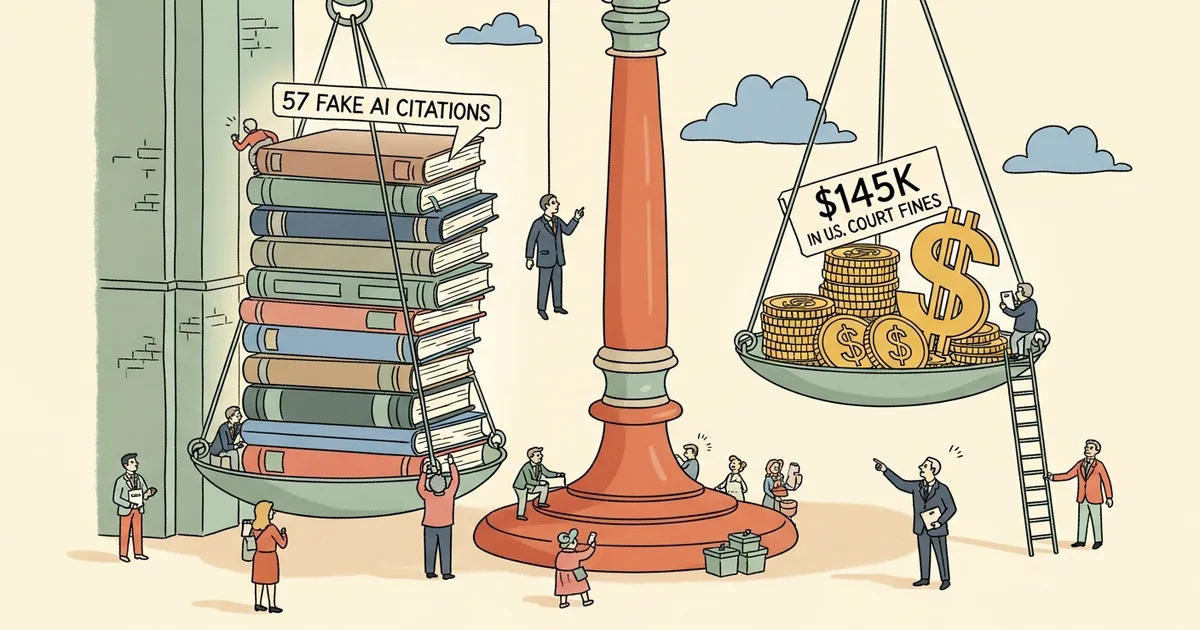
Nebraska attorney Greg Lake (Omaha) was suspended from the practice of law by the Nebraska Supreme Court in April 2026 after 57 of 63 citations in an appellate divorce brief proved defective — 20 of them classified as AI hallucinations: fictitious case names, fabricated judicial quotations, and statutory references pointing to provisions that do not exist in any jurisdiction. US courts have imposed at least $145,000 in documented sanctions against attorneys for AI citation errors in Q1 2026 alone. The legal profession’s reckoning with unverified AI output is now measured in bar suspensions, not just sternly worded judicial orders.
Lake’s case, arising from a contested property division appeal, represents the most severe documented penalty for AI-generated legal errors in US bar history. The Nebraska Supreme Court found that his explanation for the defective citations “lacks credibility” — a phrase with specific weight in disciplinary proceedings — after Lake repeatedly denied using AI tools to draft the brief.
57 of 63 Citations Failed — 20 Were Pure Fabrications
The failure rate in Lake’s appellate brief was not marginal. Of 63 total citations submitted to the Nebraska Court of Appeals, 57 were defective in some form — a 90.5% defect rate that made the brief worse than no brief at all. The most serious category, 20 AI hallucinations, included case names that sound authentic but appear in no legal database, holdings attributed to real courts that those courts never issued, and statutory citations pointing to provisions that do not exist in Nebraska or federal law.
The remaining 37 defective citations included real cases cited for propositions they do not support, misquoted holdings, and incorrect reporter attributions. In appellate practice, where the court and opposing counsel rely on cited authority to evaluate every legal argument, a brief with a 90.5% citation defect rate does not just fail — it actively misleads.
The Nebraska Supreme Court’s order noted that Lake had multiple opportunities to correct the record: during the briefing period, after opposing counsel identified discrepancies, and during the disciplinary proceeding itself. At each stage, he declined to acknowledge AI involvement.
The Denial Pattern Courts Now Recognize
Lake’s repeated denial that he used AI follows a pattern that federal and state courts have now documented across multiple jurisdictions. In the 2023 Mata v. Avianca case in the Southern District of New York — the first AI citation scandal to reach national attention — attorneys Steven Schwartz and Peter LoDuca initially minimized AI involvement before acknowledging that ChatGPT had generated fictitious citations. The SDNY sanctioned both attorneys a combined $5,000 and ordered corrective filings.
What has changed since 2023 is judicial familiarity. The hallucination signatures of large language model output — plausible-sounding but nonexistent case names, citations accurate to volume but wrong on page, attributions to real judges for opinions they never wrote — are now recognizable to experienced federal and state court judges. The Nebraska court’s “lacks credibility” finding reflects that recognition: when the signature of AI-generated content is visible in a brief, denial of AI use functions as an aggravating factor, not a defense. Judges in jurisdictions that require AI disclosure certifications have access to those records, making post-hoc denial more legally consequential than it was three years ago.
5,000 in Q1 2026 — The Sanctions Curve Is Steepening
US courts imposed at least $145,000 in documented monetary sanctions for AI citation errors between January 1 and March 31, 2026. That figure excludes the Nebraska suspension — which carries no set monetary value but is categorically more severe — and does not capture cases resolved informally, state bar disciplinary actions without published orders, or sanctions stayed pending appeal.
The acceleration from earlier years is substantial. All documented monetary sanctions for AI citation errors in US courts in 2023 totaled under $20,000, with Mata v. Avianca accounting for $5,000. The Q1 2026 figure of $145,000 — in three months — suggests a sanction rate that is compounding rather than growing linearly, tracking the broader acceleration in attorney AI tool adoption without corresponding verification infrastructure.
The distribution is not uniform. Solo practitioners and small-firm attorneys working in routine civil and family litigation represent the overwhelming majority of the sanctions record. Enterprise law firms with formal AI governance protocols have not appeared in published sanction orders — a gap that reflects access to purpose-built legal AI platforms rather than superior discipline alone. MegaOne AI tracks 139+ AI tools across 17 categories; the legal vertical shows the sharpest divergence between adoption speed and verification infrastructure of any professional sector we cover.
Harvey Launches Autonomous Legal Agents the Same Week
Harvey, the legal AI company valued at $11 billion, announced end-to-end autonomous legal agents in April 2026 — the same week the Nebraska suspension order became public. Harvey’s agents are designed to conduct legal research, draft briefs, manage discovery correspondence, and produce verified citations, with the company claiming hallucination controls integrated into the output architecture rather than applied as a post-submission check.
The simultaneous timing illuminates the bifurcation in the legal AI market. Enterprise platforms — Harvey, Casetext (now Thomson Reuters), Lexis+ AI — route every citation through live legal databases before delivering output and include accuracy service-level agreements in enterprise contracts. Consumer LLMs implicated in documented sanctions cases generate text that resembles legal citation without any database verification. The distinction is architectural: verification-integrated systems versus generation-only tools deployed without verification workflow.
This is not a model quality problem. The LLMs that produce hallucinated citations are the same models powering enterprise legal platforms — the difference is that Harvey and its competitors built a verification layer on top of generation. The sanctioned attorneys skipped that layer entirely, using consumer subscriptions in the $20-per-month range against cases where a single Westlaw query would have caught every fabricated citation.
Every Documented Case Was Preventable With One Database Query
Every AI citation sanction in the documented record — from Mata v. Avianca in 2023 through the Nebraska suspension in April 2026 — was detectable with a standard legal citation database check. For attorneys with existing Westlaw or LexisNexis subscriptions, the marginal cost of that verification is zero beyond the time required to run each cite. As legal-specific AI platforms have developed with integrated verification pipelines, the gap between what verification infrastructure exists and what sanctioned attorneys used has grown wider, not narrower.
Three steps eliminate the documented risk category entirely:
- Citation existence check — every case citation verified in Westlaw or LexisNexis to confirm the case exists at the exact reporter and page cited.
- Holding verification — the cited passage read directly to confirm the AI’s characterization of the holding or quotation is accurate.
- Statute verification — every statutory citation cross-referenced against the official annotated code for the relevant jurisdiction.
These are not new requirements introduced by AI regulation. They are the standard of care that bar exams test and that legal education has taught since before digital research existed. AI has created a new pathway to violate that standard at scale and speed. The standard itself has not changed.
Suspension vs. Sanction — The Penalty Structure Is Escalating
The Nebraska Supreme Court’s decision to suspend Lake rather than impose a monetary sanction marks an escalation in the documented penalty trajectory for AI citation failures. Cases in 2023 and early 2024 generally produced reprimands, corrective filing requirements, mandatory AI-focused continuing legal education credits, and monetary sanctions in the $500–$20,000 range. Suspension removes an attorney from practice entirely and carries no upper bound on duration.
Courts are developing a working liability framework that distinguishes two categories of attorneys: those who disclose AI use, verify output independently, and certify compliance — and those who do not disclose, do not verify, and deny AI involvement when challenged. The American Bar Association’s Formal Opinion 512 (2023) established that competent AI use requires attorneys to understand tool limitations and independently verify outputs before filing. Courts are now enforcing that opinion through bar discipline rather than treating it as aspirational guidance. The institutional pressure on AI accountability has found its most direct enforcement mechanism in bar discipline systems — because unlike most professional sectors, law already has the investigation, adjudication, and sanction infrastructure to act on individual practitioner misconduct.
What the Sanctions Record Means for Practicing Attorneys
The $145,000 in Q1 2026 sanctions and the Nebraska suspension are the public-record portion of a larger compliance failure. For every case that produces a published sanctions order, there are briefs caught during proofreading, errors noticed by opposing counsel who did not escalate, and judges who flagged issues informally. The documented cases are the ones where the failure was too significant and the judge too committed to accountability to handle quietly.
For any attorney currently using AI tools in practice, the Nebraska case reduces to three concrete requirements that courts are now actively enforcing:
- Disclose — know whether your court has an AI use certification requirement and comply with it. More than two dozen federal districts and multiple state court systems have adopted explicit disclosure rules as of Q1 2026.
- Verify — every citation requires independent database verification before filing. AI output is a research draft, not a verified product.
- Accept accountability — “my AI tool generated it” has been rejected as a defense in every documented sanctions case. The attorney of record is responsible for every citation in every filing.
Harvey’s $11 billion valuation and its autonomous legal agent launch are evidence that the legal AI market understands what verification-integrated architecture looks like. The sanctions record is evidence that most attorneys generating bar discipline incidents are not using that architecture. Until purpose-built verification tools reach the price point and workflow integration of consumer LLMs, courts will continue building the liability framework one suspension order at a time — and the $145,000 Q1 figure will not be the high-water mark.
Related Reading
- Courts Keep Punishing Lawyers for Fake AI Briefs — But Lawyers Won’t Stop
- Schematik Raises $4.6M to Bring AI-Guided Hardware Design to Non-Engineers as Anthropic Launches Bluetooth API
- DeepSeek vs ChatGPT 2026: The Open-Source AI That Matches OpenAI for $0
- Midjourney vs DALL-E vs Imagen 2026: Which AI Image Generator Actually Wins