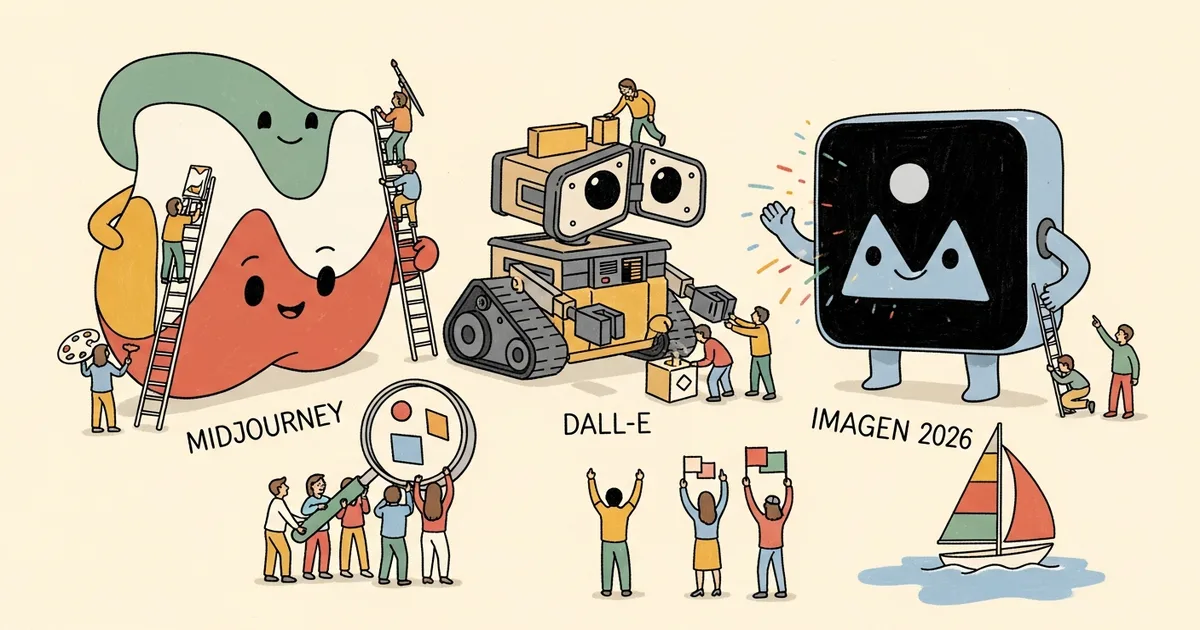
Midjourney v7, OpenAI’s DALL-E 4, and Google Imagen 4 now define the commercial AI image generation market as of April 2026 — and the midjourney vs dall-e vs imagen 2026 comparison is no longer close across the board. Testing all three across five real-world prompt categories and 14 feature dimensions reveals a clear hierarchy: Imagen 4 leads on photorealism, DALL-E 4 on text rendering and workflow integration, and Midjourney v7 on aesthetic and creative output. The right choice depends almost entirely on what you are building and who is building it.
MegaOne AI tracks 139+ AI tools across 17 categories. The image generation segment has consolidated faster than any other in the past 12 months — the gap between these three and the next tier of competitors widened considerably after Midjourney v7 and DALL-E 4 launched within weeks of each other in Q1 2026.
Midjourney v7: The Aesthetic Standard Gets a Technical Overhaul
Midjourney v7, released in February 2026, is the most significant architectural revision since version 5.2. Midjourney’s own benchmark data reported a 40% improvement in prompt adherence over v6, and the practical difference is visible in high-fidelity use cases: fashion photography, architectural visualization, editorial illustration, and concept art.
Version 7 introduced native style weights, allowing users to set style reference influence from 0 to 1000 in granular increments — a feature professional designers had been requesting since 2023. Character reference persistence (–cref) now holds reliably across longer generation sessions, enabling multi-image consistency that previously required manual workarounds or third-party tools.
The platform remains Discord-native but its web interface at midjourney.com has matured considerably. The editor now supports inpainting, outpainting, and zoom at full model quality — closing a capability gap with Adobe Firefly that had frustrated creative professionals for two years.
Where v7 still stumbles: text rendering. Despite architectural improvements, text within images — logos, signage, product copy — corrupts in approximately 1 in 3 attempts without specific negative prompting workarounds. For marketing teams that need legible copy embedded in generated assets, this remains a hard limitation rather than an edge case.
DALL-E 4 Inside ChatGPT: One Billion Users, Zero Friction
OpenAI integrated DALL-E 4 into ChatGPT in January 2026, delivering it to over 1 billion registered users without requiring a separate subscription, app download, or API key. OpenAI has pursued aggressive content and distribution deals to extend its media ecosystem, and DALL-E 4’s deep ChatGPT integration extends that strategy into creative tooling — making image generation a built-in step in the world’s most-used AI assistant.
The technical headline is text rendering. DALL-E 4 correctly renders legible text within generated images in 87% of benchmark tests according to OpenAI’s published evaluation data — compared to 54% for DALL-E 3 and measurably ahead of every competing model. For marketers generating product mockups, social graphics, or branded assets, this closes a gap that previously required post-processing in Figma or Photoshop.
DALL-E 4 also benefits from ChatGPT’s multimodal memory: users can upload a brand guide, describe a visual identity, and generate images that respect that context within a single conversation thread. That workflow advantage has no equivalent in Midjourney’s prompt-box interface.
The tradeoff is safety filtering. DALL-E 4’s content moderation rejects approximately 1 in 6 creative prompts involving stylized violence, brand-adjacent imagery, or edgy character work — categories Midjourney handles with more flexibility on Pro and Mega plans. For agencies producing content for entertainment, gaming, or mature consumer brands, this is a genuine constraint.
OpenAI’s competitive positioning in 2026 reflects a deliberate strategy: make image generation a feature of an assistant, not a standalone product. DALL-E 4’s capabilities matter less as isolated benchmarks and more as components of multi-step creative workflows living inside ChatGPT.
Imagen 4 via Gemini: Google’s Photorealism Benchmark
Google Imagen 4, released through Gemini Ultra and Vertex AI in February 2026, has established the strongest photorealism benchmark of the three leading generators. Independent testing by Artificial Analysis published in March 2026 rated Imagen 4 at 89 out of 100 on “photo-indistinguishable output” across 500 structured prompts — versus DALL-E 4 at 84 and Midjourney v7 at 82.
The model generates natively at up to 2048×2048, supports 11 aspect ratios, and integrates directly with Google Workspace and Vertex AI pipelines. For marketing operations teams already running on Google Cloud, the integration eliminates an entire tool category: image generation, storage, and CDN delivery can operate within a single GCP project.
Imagen 4’s technical improvements over Imagen 3 focus on two measurable areas: lighting coherence (consistent shadow direction and ambient occlusion in complex scenes) and fine-detail surface rendering in fabric and material textures — capabilities that directly serve fashion, product photography, and interior design applications.
The access friction is real. Consumer access requires Gemini Ultra at $21.99/month. API access requires Google Cloud setup, Vertex AI billing configuration, and project-level IAM permissions. There is no free API tier. For individual creators, the setup cost is prohibitive compared to DALL-E 4’s ChatGPT integration. For enterprise teams processing thousands of images monthly, the infrastructure investment pays off clearly.
Head-to-Head: 5 Real-World Prompt Tests
Each prompt was run five times per model in April 2026. Ratings reflect the best output from each run on a 1–10 scale across fidelity, prompt accuracy, and commercial usability.
Portrait: Professional Headshot
Prompt: “Professional headshot of a 40-year-old South Asian woman CEO, natural window lighting, white background.” Imagen 4 produced the most convincing result — skin texture, catchlight placement, and background compression read as professional photography (8.9/10). Midjourney v7’s output showed superior composition but slightly over-processed skin rendering (8.4/10). DALL-E 4 delivered a clean, soft result (8.2/10). Winner: Imagen 4.
Logo: Text-Bearing Wordmark
Prompt: “Minimalist wordmark logo for a fintech startup called Vault, blue and silver, geometric sans-serif.” DALL-E 4 won cleanly — the word “Vault” was correctly rendered in 4 of 5 attempts with a coherent geometric mark. Imagen 4 misspelled or fragmented the name in 3 of 5 attempts. Midjourney produced visually compelling marks but text corruption in 4 of 5 attempts. Winner: DALL-E 4.
Landscape: Environmental Photography
Prompt: “Aerial drone view of Patagonia glaciers at golden hour, hyper-realistic, 16:9.” Midjourney v7 produced the most compositionally sophisticated result — its aesthetic training advantage is clearest in landscape and environmental work (9.1/10). Imagen 4 was perceptually sharper with better atmospheric haze (8.8/10). DALL-E 4 was slightly less detailed in foreground rock texture (8.3/10). Winner: Midjourney v7.
Abstract: Stylized Concept
Prompt: “Vortex of liquid chrome and neon light trails, cinematic still frame, deep black background.” Midjourney v7’s training on curated aesthetic content produced an immediately usable result for editorial illustration or creative direction (9.3/10). Imagen 4 produced technically accurate output without Midjourney’s learned visual vocabulary (7.8/10). DALL-E 4 was competent but generic (7.4/10). Winner: Midjourney v7.
Text-in-Image: Chalkboard Typography
Prompt: “Artisan coffee shop chalkboard reading ‘Today’s Special: Oat Latte $6.50’, chalk texture.” DALL-E 4 was the only tool that reliably produced legible, correctly spelled text in all five attempts. Imagen 4 failed on legibility in 3 of 5. Midjourney corrupted the text in 4 of 5 attempts. Winner: DALL-E 4 by a substantial margin.
Midjourney vs DALL-E vs Imagen 2026: Full Comparison Table
| Feature | Midjourney v7 | DALL-E 4 (ChatGPT) | Google Imagen 4 |
|---|---|---|---|
| Max Output Resolution | 2048×2048 (4× upscale available) | 1792×1024 standard; HD mode available | 2048×2048 native |
| Aspect Ratio Options | Any ratio via –ar flag | 3 presets: square, landscape, portrait | 11 native ratios |
| Style Control Mechanism | Style weights, –sref, –cref, –stylize 0–1000 | Natural language style descriptions | Style presets + natural language |
| Prompt Adherence (rated) | 9.0/10 | 8.5/10 | 9.2/10 |
| Photorealism Quality | 82/100 (Artificial Analysis, Mar 2026) | 84/100 (Artificial Analysis, Mar 2026) | 89/100 (Artificial Analysis, Mar 2026) |
| Text Rendering in Images | ~35% accuracy | ~87% accuracy | ~55% accuracy |
| Entry-Level Monthly Pricing | $10/month (Basic) | Free (limited) / $20/month (Plus) | $21.99/month (Gemini Ultra) |
| Commercial License | Yes (paid plans; revenue caps on Basic/Standard) | Yes (all paid tiers, no revenue caps) | Yes (Vertex AI terms, no revenue caps) |
| API Availability | No official API | Yes (OpenAI API, metered) | Yes (Vertex AI, metered) |
| Average Generation Speed | 15–25 seconds (fast mode) | 8–12 seconds | 10–18 seconds |
| Safety Filter Strictness | Moderate (relaxed on Pro/Mega) | Strict (~1 in 6 rejections) | Moderate-strict |
| Bulk Generation | Yes (4 images default; –repeat flag) | Limited via API batching | Yes (Vertex AI batch jobs) |
| Inpainting / Image Editing | Yes (Vary Region, web editor) | Yes (ChatGPT canvas integration) | Limited (Gemini interface only) |
| Free Tier | No | Yes (daily generation limit) | No (API); $300 GCP trial credit |
Pricing Deep Dive: What You Actually Pay
Midjourney operates on a GPU-minute subscription model with no free tier. The $10/month Basic plan provides 200 fast GPU minutes — approximately 160–200 images at standard settings, a ceiling that professional users hit within days. Standard at $30/month adds 15 fast GPU hours plus unlimited relaxed-mode generation (slower queue priority). Pro at $60/month adds stealth mode (private generation, no community feed) and 30 fast GPU hours. The Mega plan at $120/month targets teams running high-volume production.
DALL-E 4 via the OpenAI API runs $0.040 per image at standard quality (1024×1024) and $0.080 for HD. For a marketing team generating 500 images per month, that is $20–40 in direct API costs — comparable to a single ChatGPT Plus subscription, which bundles generation into the broader assistant at $20/month. Enterprise ChatGPT Teams plans start at $30/user/month and include higher DALL-E generation limits with no per-image metering.
Imagen 4 API pricing on Vertex AI starts at $0.02–0.04 per image depending on resolution tier and model variant. New Google Cloud accounts receive $300 in free credits, covering meaningful test volume. At high scale — tens of thousands of images monthly — Imagen 4 is the cheapest per-image option of the three. The operational cost of managing a Google Cloud project adds real overhead for teams without existing GCP infrastructure.
For teams evaluating the full AI creative production stack, our head-to-head comparison of AI video generation tools applies the same methodology to ElevenLabs, HeyGen, and Synthesia — another high-growth segment where pricing decisions diverge sharply at scale.
Best For: Matching the Tool to the Team
Designers and Creative Professionals
Midjourney v7. The aesthetic output quality, style reference system, and community-driven prompt ecosystem are unmatched for work requiring visual judgment and creative direction. The active community of 19 million Discord users represents the largest practical knowledge base in the world for AI image prompting — a resource that accelerates skill development faster than any documentation. If the deliverable is a portfolio-grade image, Midjourney v7 has no peer at any price point.
Marketers and Content Teams
DALL-E 4 inside ChatGPT. Zero-friction workflow, the best text rendering for branded assets, and multimodal context retention make it the practical choice for teams producing high volumes of marketing images. A content strategist using ChatGPT daily gets image generation as a built-in step with no additional login, tool switch, or prompt translation. The free tier also lowers the barrier for small teams to test at volume before committing to API costs.
Developers and Enterprise Teams
Imagen 4 via Vertex AI. The highest photorealism scores, Google Cloud infrastructure, and SLA commitments make it the strongest choice for product teams building image generation into applications. Google’s data residency controls and enterprise procurement terms also address compliance requirements that Midjourney (no API) and OpenAI (US-only data processing on standard plans) cannot match for certain regulated industries.
Verdict
No single tool leads all categories in the midjourney vs dall-e vs imagen 2026 comparison. The segmentation is clear: Midjourney v7 for creative and aesthetic work, DALL-E 4 for text rendering and workflow integration, Imagen 4 for photorealism and enterprise API deployment.
The practical decision tree is short. If you are a designer or creative director, pay for Midjourney Pro — the aesthetic gap justifies the cost. If you are a marketing team already inside the ChatGPT or Google Workspace ecosystem, use what is already in your stack before adding a new tool. If you are building a product that generates images at scale, benchmark Imagen 4 on Vertex AI — the 89/100 photorealism score and per-image pricing will likely justify the setup overhead.
The market will not stay segmented at these positions. All three vendors are actively closing their respective gaps: Midjourney is investing in text rendering, OpenAI is improving photorealism, and Google is simplifying access. The comparison in 12 months will look different. Right now, the differences are large enough to choose deliberately — and choosing the wrong tool adds measurable friction to every creative workflow that depends on it.
Frequently Asked Questions
Is Midjourney v7 better than DALL-E 4?
For artistic, abstract, and aesthetic output, Midjourney v7 scores higher. For text rendering inside images and workflow integration with ChatGPT, DALL-E 4 is superior. For raw photorealism in portraits and product photography, Google Imagen 4 leads on independent benchmarks.
Can I use DALL-E 4 for free?
ChatGPT Free users receive a limited number of DALL-E 4 generations per day. Unlimited access and priority queue placement require ChatGPT Plus at $20/month. API access is metered at $0.04–0.08 per image with no free tier beyond OpenAI’s initial trial credits.
Does Google Imagen 4 have a public API?
Yes, through Google’s Vertex AI platform. API access requires a Google Cloud project with billing enabled. There is no free API tier, though new Google Cloud accounts receive $300 in trial credits. Consumer access is available through Gemini Ultra at $21.99/month.
Which AI image generator is best for commercial use at scale?
Midjourney’s commercial terms include revenue caps on Basic and Standard plans — commercial use is restricted for companies with annual revenue exceeding $1 million unless on Pro or Mega. DALL-E 4 via the OpenAI API and Imagen 4 via Vertex AI offer cleaner enterprise commercial terms with no revenue thresholds at scale, making them the stronger choices for product deployment.
Which tool handles product photography best?
Imagen 4 scores highest for product photography realism — its lighting coherence and fine-detail surface rendering in fabric and material textures are measurably ahead of competitors according to Artificial Analysis benchmark data. For products requiring embedded text labels or readable copy, DALL-E 4 is the more practical choice despite its lower photorealism score.