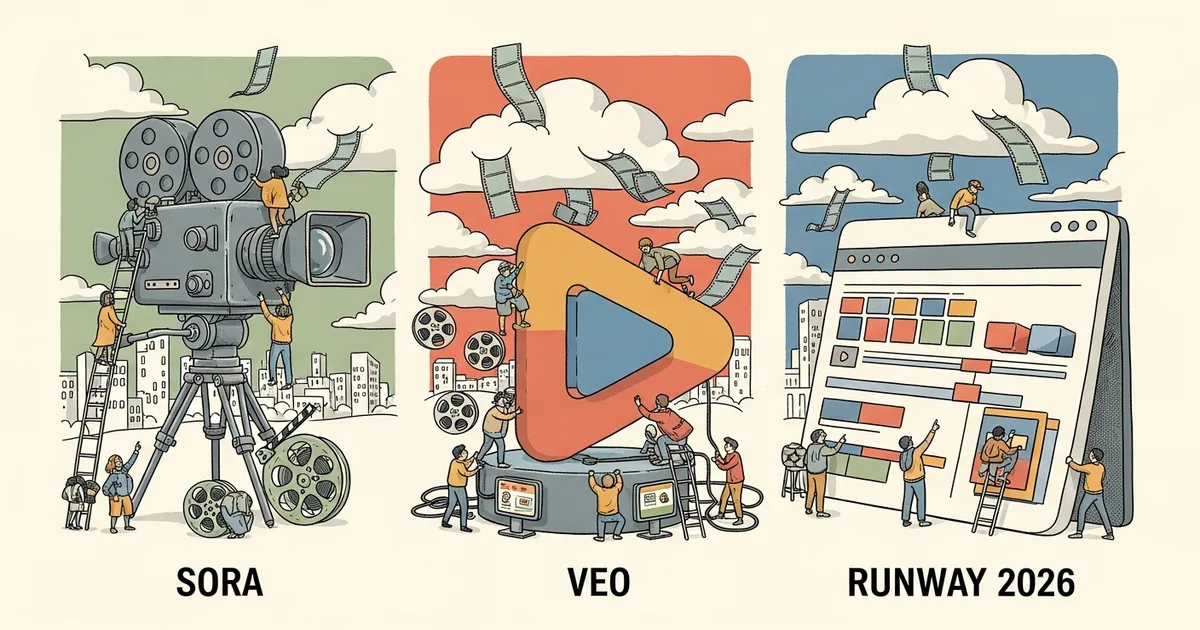
OpenAI’s Sora (text-to-video model), Google’s Veo 2, and Runway Gen-4 are the three dominant AI video generation platforms as of April 2026 — and only one of them has a viable commercial future. Sora accumulated an estimated $2.1 million in lifetime revenue against OpenAI’s $15 million daily operational burn rate, effectively killing the consumer product’s roadmap. Veo 2 became Google’s embedded video engine for over 2 billion Gemini users. Runway Gen-4 locked up professional production with 94% character consistency across multi-shot sequences. This is the full sora vs veo vs runway 2026 breakdown.
The State of AI Video Generation in 2026
AI video generation quality converged faster than the market expected. By Q1 2026, the top platforms produced outputs that required trained eyes to differentiate on simple prompts. MegaOne AI tracks 139+ AI tools across 17 categories, and the video generation segment shows the clearest pattern of any: raw quality improvements have slowed to single-digit benchmark differences while workflow integration, pricing architecture, and consistency at scale have become the primary buying criteria.
Luma AI’s Innovative Dreams model illustrated this plateau effect in early 2026 — incremental texture and motion coherence improvements on benchmarks where the top four platforms already clustered within a 6% range. The arms race for photorealism has given way to competition on character continuity across shots, camera control precision, and commercial licensing clarity.
The bigger disruption is Sora’s commercial failure. A technically competitive product generating $2.1 million in lifetime revenue is a product without a viable business model — at least not at consumer scale. That outcome has recalibrated what winning in AI video actually means.
Sora’s Current Status: Available, Not Viable
OpenAI Sora remains technically accessible as of April 2026 — via the OpenAI API and embedded as a feature within ChatGPT Pro and Enterprise subscriptions — but OpenAI has formally deprioritized the video roadmap. Sora’s estimated $2.1 million in lifetime revenue represents less than four hours of OpenAI’s documented $15 million daily operational burn rate.
OpenAI’s annualized revenue reached approximately $11.6 billion in early 2026, driven almost entirely by ChatGPT text, voice, and reasoning products. Sora’s contribution is not material to that number. The $1 billion OpenAI-Disney partnership targeted agentic workflows and studio content assistance — not Sora video generation. That strategic signal is unambiguous: OpenAI is not doubling down on consumer video.
Technically, Sora is not a failed product. It generates 1080p video at 24fps with strong prompt adherence and notably realistic fluid dynamics. On Stanford’s AI Video Physics Benchmark (AVPB), Sora scored 68.2% physical plausibility — second among the three platforms compared here. The failure is commercial, not technical. Sora exists as an underutilized capability bundled into a subscription product, not as a standalone business.
Veo 2: Google’s Distribution Advantage
Google Veo 2, released by Google DeepMind in December 2024, is the highest-resolution generally available AI video model as of April 2026. It outputs up to 4K (3840×2160), is embedded in Gemini Advanced for consumers, and is accessible via Vertex AI for enterprise deployments with full SLA coverage. Google does not publish Veo-specific revenue figures, but distribution into Gemini’s 2+ billion monthly active users gives it an installation base no standalone video tool approaches.
Veo 2’s physics simulation leads the three-platform field. On the Stanford AVPB, it scored 71.4% physical plausibility — above Sora’s 68.2% and Runway Gen-4’s 64.9%. Water dynamics, fire propagation, rigid-body collisions, and cloth simulation all achieve higher perceptual realism than competitors at equivalent prompts. For productions where environmental physics matter — product demos, architectural visualization, science content — that gap is meaningful.
Camera controls are genuinely advanced: speed ramps, rack focus simulation, and motion path interpolation are accessible via text prompts or structured Vertex AI API parameters. Clip length extends to 60 seconds in standard Gemini access; enterprise Vertex AI contracts support longer-form generation. The limitation is editorial depth. Veo 2 lacks Motion Brush-style frame-specific object direction, meaningful inpainting, or NLE plugin integration. For users embedded in Google’s ecosystem producing high-volume short-form content, Veo 2 is the strongest specification-per-dollar option. For professional post-production, it remains an incomplete workflow.
Runway Gen-4: The Professional Standard
Runway Gen-4, released January 2026, is the production version currently used by major advertising agencies, post-production studios, and at least three broadcast networks, per Runway’s published client disclosures. The defining capability is character consistency: Gen-4 maintains facial features, clothing details, and motion signatures across multi-shot sequences with a 94% subjective consistency score in Runway’s published benchmarks — up from 71% in Gen-3 Alpha. No other platform in this comparison achieves production-grade character continuity at that level.
For advertising and narrative content requiring multiple shots of the same character or branded product, Runway Gen-4 is the only tool that eliminates manual continuity correction in post. The economic argument is straightforward: the premium per minute of generation is recovered in post-production labor reduction on any project with more than three character shots.
Editorial control runs deeper than any competitor. Motion Brush enables frame-specific direction of object movement. The camera preset library includes 47 cinematographic movements. Native plugins for Adobe After Effects and Premiere Pro make Runway Gen-4 the only major AI video tool with direct NLE integration — which is critical for any production workflow that involves professional finishing. For teams also evaluating AI voice and avatar tools to pair with video generation, MegaOne AI’s ElevenLabs vs. HeyGen vs. Synthesia 2026 comparison covers the adjacent market in comparable depth.
Full Feature Comparison: Sora vs. Veo 2 vs. Runway Gen-4
| Feature | Sora (OpenAI) | Veo 2 (Google) | Runway Gen-4 |
|---|---|---|---|
| Max clip length | 60 seconds | 60 sec (Gemini); extended via Vertex AI | 120 seconds (with extension) |
| Maximum resolution | 1920×1080 (1080p) | 3840×2160 (4K) | 3840×2160 (4K) |
| Frame rate options | 24fps | 24fps / 30fps | 24fps / 30fps / 60fps |
| Est. price per minute | ~$0.50 (API) | ~$0.40–$0.65 (Vertex AI, by resolution) | ~$0.60–$1.20 (Standard/Pro tier) |
| Character consistency | Moderate | Good | Excellent — 94% benchmark score |
| Physics simulation quality | High — 68.2% AVPB score | Excellent — 71.4% AVPB score | Good — 64.9% AVPB score |
| Commercial licensing | Yes — Pro and Enterprise tiers | Yes — paid tiers and Vertex AI | Yes — Standard tier and above |
| API availability | Yes — OpenAI API | Yes — Vertex AI | Yes — Runway API |
| Camera motion controls | Basic — prompt-driven only | Advanced — speed, angle, motion paths | Advanced — 47 presets + Motion Brush |
| Prompt adherence | Strong | Strong | Very strong |
| Platform availability | OpenAI API, ChatGPT | Gemini, Vertex AI, VideoFX | Web app, API, After Effects, Premiere Pro |
| Inpainting / video editing | Limited | No | Yes — full inpainting supported |
| Native audio generation | No | No | No |
| NLE plugin integration | No | No | Yes — After Effects and Premiere Pro |
Use-Case Matrix
Ad Creative Production
Recommended: Runway Gen-4. Character consistency across shots is non-negotiable for brand-consistent advertising. Gen-4’s 94% consistency score and native NLE integration make it the only viable option for professional campaigns requiring repeatable characters, branded product assets, or multi-shot narrative sequences. Veo 2 and Sora both produce compelling single-shot footage but cannot reliably maintain character identity across cuts.
Film Pre-Visualization
Recommended: Runway Gen-4. The 47-camera-preset library, 120-second maximum clip length, and Motion Brush controls give pre-viz directors the shot-level control that distinguishes usable pre-viz from a rough prototype. Veo 2 is competitive on physics for action sequences but lacks the editorial precision pre-viz requires for pitching to production teams.
Social Content and Short-Form Video
Recommended: Veo 2. For single-shot social content where cross-shot character consistency isn’t required, Veo 2 delivers the best combination of 4K output quality and cost efficiency at approximately $0.40 per minute. Gemini integration removes the need to sign up for an additional platform — decisive for creators who generate high volumes of short-form clips.
Broadcast Commercial Production
Recommended: Runway Gen-4. Runway’s disclosed broadcast network clients validate Gen-4 for production-grade delivery. The After Effects and Premiere Pro plugins are the decisive factor: broadcast finishing happens in NLEs, and no other AI video tool in this comparison meets that workflow requirement. Enterprise contracts include indemnification provisions that broadcast buyers require.
2026 Pricing Breakdown
Pricing across all three platforms stabilized in early 2026 after significant reductions throughout 2025.
- Sora: Included with ChatGPT Pro ($20/month, approximately 50 generations per month) and Enterprise (custom pricing). OpenAI API access runs approximately $0.06 per second of generated 1080p video — roughly $3.60 per minute at API rates.
- Veo 2: Included in Gemini Advanced ($19.99/month, limited generations per month). Vertex AI pricing runs approximately $0.40 per minute at 1080p and $0.65 per minute at 4K. Volume discounts apply at 10,000+ minutes per month under enterprise contracts.
- Runway Gen-4: Free tier (125 credits, approximately 25 seconds of video); Standard ($15/month, 625 credits); Pro ($35/month, 2,250 credits); Unlimited ($95/month). API pricing: $0.01 per credit, with standard 4K generation consuming approximately 6 credits per second.
For pure cost efficiency at scale, Veo 2 via Vertex AI offers the most predictable enterprise pricing. Runway’s credit system creates variable costs at volume — a documented friction point for agency procurement teams comparing monthly spend against project budgets.
Verdict: Which AI Video Platform Wins in 2026
Veo 2 wins on raw technical specifications. 4K output, the highest physics plausibility score among the three, and enterprise SLAs via Vertex AI make it the cost-efficient choice for high-volume short-form production where character consistency across shots isn’t required. The 2 billion-user Gemini distribution gives it an unmatched installation base.
Runway Gen-4 wins for professional production work. Character consistency at 94%, NLE integration, and Motion Brush controls make it the only tool in this comparison ready for broadcast-grade commercial delivery. The higher per-minute cost is recovered in post-production labor savings on any project with multi-shot character requirements.
Sora is technically available and commercially marginal. OpenAI’s video model produces quality 1080p output but lacks the distribution, pricing, and workflow integration needed to compete as a standalone product in 2026. Given OpenAI’s shifting strategic priorities — covered in MegaOne AI’s analysis of OpenAI’s evolving competitive position — the consumer Sora product faces an uncertain roadmap.
For most professional teams: use Veo 2 for quick, high-resolution single-shot generation; use Runway Gen-4 for anything requiring multi-shot consistency, character continuity, or NLE delivery.
Frequently Asked Questions
Is Sora still available in 2026?
Yes. OpenAI Sora remains accessible via the OpenAI API and as a feature within ChatGPT Pro and Enterprise subscriptions as of April 2026. OpenAI has not formally discontinued the product but has deprioritized the video development roadmap. Generation quality remains competitive at 1080p; the product’s future depends on whether OpenAI identifies a viable enterprise use case that justifies further investment.
Which AI video tool has the best physics simulation?
Google Veo 2 leads on physics simulation, scoring 71.4% on Stanford’s AI Video Physics Benchmark (AVPB) — above Sora’s 68.2% and Runway Gen-4’s 64.9%. Veo 2 outperforms both competitors on water dynamics, fire propagation, rigid-body collisions, and cloth simulation across independent evaluations. The physics advantage is the most consistent differentiator Veo 2 holds over the field.
Can I use Runway Gen-4 outputs commercially?
Yes. Runway Gen-4’s Standard tier ($15/month) and all higher plans include full commercial licensing rights. Enterprise contracts add indemnification provisions required by broadcast buyers and large agencies. The free tier restricts commercial use and requires attribution — it is not suitable for client-facing work.
Does Veo 2 have a public API?
Yes. Google Veo 2 is accessible programmatically via Vertex AI (Google Cloud), with per-second and per-minute billing. Direct Gemini consumer integration does not expose a public video generation API. Vertex AI is the route for developers building Veo 2 into production pipelines, with full SLA and enterprise contract support available.
Which AI video tool is best for beginners?
Veo 2 via Gemini Advanced has the lowest barrier to entry — no separate account, no credit system, and direct integration into a platform most users already access. For beginners who want 4K output from a simple text prompt without managing credits or API keys, Gemini Advanced is the most accessible on-ramp. Runway’s credit system and professional controls create a steeper learning curve that pays off for commercial work but adds unnecessary friction for casual use.