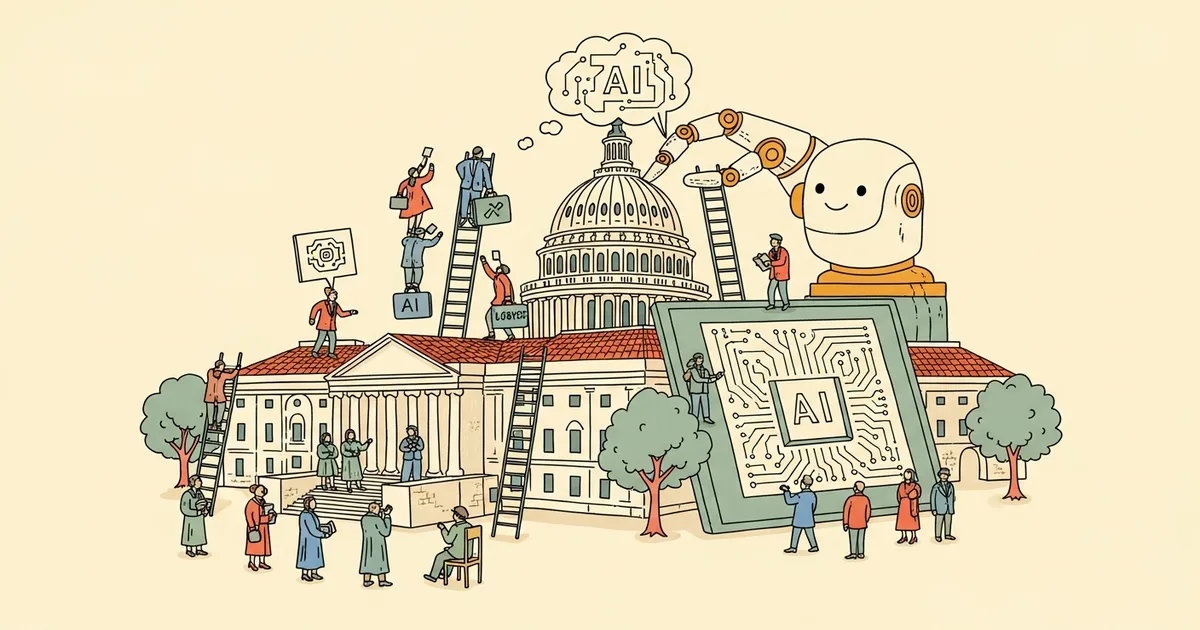
The Stanford University Human-Centered Artificial Intelligence (HAI) AI Index 2025, published in April 2025, documented a measurable shift in how AI lobbying shapes Congress: industry representatives in U.S. congressional hearings have tripled since 2017, while independent academic witnesses have been steadily displaced. The result is a regulatory environment increasingly drafted by the same companies Congress is supposed to be overseeing.
This is not lobbying in the abstract. It is Sam Altman flying to Washington, Dario Amodei sitting beside senators, and Sundar Pichai offering reassurances to committees — while researchers who study long-term AI harms struggle to secure an invitation.
What the Stanford AI Index Actually Found
The Stanford HAI AI Index tracks participation in AI-related congressional hearings as part of its annual measurement of AI’s societal footprint. The 2025 edition found that between 2017 and 2024, industry witnesses went from representing roughly one-third of AI hearing participants to the dominant category — more than tripling in absolute numbers as congressional AI hearings themselves multiplied.
Academic witnesses, who once made up 40–50% of AI hearing participants, have seen their share fall sharply over the same period. Civil society organizations — nonprofits, advocacy groups, and independent think tanks without commercial AI interests — have experienced a similar contraction.
The timing is not coincidental. ChatGPT‘s November 2022 launch triggered a wave of congressional attention, and the companies that built these systems responded with political infrastructure that universities structurally cannot replicate.
The Testimony Circuit: Altman, Amodei, and Pichai
Sam Altman’s May 2023 appearance before the Senate Judiciary Subcommittee on Privacy, Technology, and the Law became something of a template. Altman called for AI regulation — specifically, a new federal agency to license AI companies. The proposal sounded responsible. It also happened to favor well-capitalized incumbents who could absorb compliance costs while blocking smaller competitors.
Dario Amodei, CEO of Anthropic, has testified before multiple Senate committees, consistently framing the company’s safety-focused approach as the industry model. Sundar Pichai, CEO of Alphabet, testified in 2023 calling for “responsible AI development” — while Google simultaneously accelerated deployment to match OpenAI’s commercial momentum.
The pattern across all three executives is consistent: advocate for regulatory frameworks that validate existing practices and raise barriers to entry for potential rivals. Academics who study bias propagation, labor displacement, or AI-driven concentration of power are rarely present in real time to challenge these framings. The hearing format itself — prepared testimony, five-minute questioning rounds — favors executives with polished communications teams over researchers accustomed to academic rigor.
AI Lobbying in Congress: Who Spends What
Congressional testimony is visible. The durable influence comes from permanent lobbying infrastructure. Public disclosure filings under the Lobbying Disclosure Act show the scale of investment from the industry’s largest players in 2023 alone:
- Meta: approximately $19.2 million in total lobbying expenditures, consistently among the top five corporate spenders in Washington
- Alphabet/Google: approximately $11.5 million, with AI policy representing a growing share of its Washington portfolio
- Microsoft: approximately $10.5 million, significantly expanding AI-focused engagements following its $13 billion investment in OpenAI
- Amazon: exceeded $20 million, covering AWS and its expanding AI infrastructure and services business
- OpenAI: registered as a lobbying organization in mid-2023, hiring former congressional staffers and veterans of the White House Office of Science and Technology Policy
Combined, those five organizations spent over $60 million influencing the U.S. legislative process in a single year. According to OpenSecrets, the broader technology sector has consolidated its position as one of Washington’s top-three lobbying sectors — precisely as AI moved from research curiosity to geopolitical priority. The academic institutions that study AI lack anything resembling equivalent political infrastructure.
How Academic Witnesses Are Being Squeezed Out
The structural disadvantages facing academic witnesses in Washington are worth naming directly. Universities run on grant cycles and publication timelines, not news cycles. A congressional hearing called on three weeks’ notice is accessible to a company with a permanent DC office and a dedicated policy team; it is nearly impossible for a researcher juggling courses, grant applications, and institutional clearances.
Funding creates a second pressure. AI labs are now among the largest sources of research grants at major universities. MIT, Stanford, Carnegie Mellon, and Berkeley have all accepted substantial funding from Google, Microsoft, Meta, and OpenAI. Researchers who study the harms of specific AI systems do so knowing the company they’re examining may also be their institution’s major donor. That relationship does not produce open defiance.
The growing public backlash against unchecked AI deployment reflects real concern, but public concern without lobbying infrastructure does not move regulatory text. Civil society efforts are operationally outmatched in Washington by companies with policy teams, former officials on retainer, and direct access to the committees that draft legislation.
What Actually Gets Written Into Law
The EU AI Act, which entered into force in August 2024, provides a documented data point on how sustained industry lobbying reshapes final legislation. The Act’s initial draft was measurably stronger: transparency requirements for foundation models were weakened, the definition of “high-risk” AI systems was narrowed, and enforcement timelines were extended. Stanford HAI researchers and AI safety advocates tracked these changes in real time as industry lobbied against provisions they found commercially inconvenient.
In the United States, the frameworks gaining legislative traction — voluntary commitments, safe harbor provisions, federal pre-emption of state-level AI laws — are architecturally favorable to large incumbents. California’s SB 1047, which would have imposed safety requirements on large AI models, was vetoed by Governor Gavin Newsom in September 2024 after sustained industry opposition. The pattern holds across jurisdictions.
OpenAI’s corporate evolution — from nonprofit to capped-profit to full commercial enterprise — is proceeding in a regulatory environment where OpenAI itself is helping draft the oversight rules governing that transition. That institutional conflict of interest would not pass academic peer review. In Washington, it is standard operating procedure.
The Information Asymmetry Lawmakers Cannot Easily Fix
There is a genuine information problem Congress faces. AI systems are technically complex, and congressional staffers — often young, overworked, and generalist — depend on outside experts to understand what they are regulating. Industry fills that vacuum efficiently. A Google policy director can walk a staffer through how large language models work in an afternoon. A university AI ethics center can submit written testimony that may go unread.
MegaOne AI tracks 139+ AI tools across 17 categories and consistently observes the gap between how AI capabilities are framed for policymakers and what independent analysis finds. The discrepancy is not always deliberate deception — sometimes it is simply the difference between a company’s best-case framing and a researcher’s honest uncertainty about long-term systemic effects. In regulatory contexts, that gap produces lasting consequences.
The political alignments consolidating between AI’s largest players and Washington insiders reflect this dynamic at scale. When the same executives testifying before Congress are also funding campaigns, hosting AI summits for legislators, and offering agency secondments to congressional staff, the information environment shapes itself in predictable ways.
The Structural Fix Is Obvious. The Political Will Is Not.
Restoring independent expertise in AI regulatory hearings does not require complex legislation. Congress could mandate balanced witness panels — something the Senate Commerce Committee has occasionally attempted but never consistently enforced. The National Science Foundation already funds independent AI research; a dedicated appropriation for policy-facing AI safety work would cost tens of millions annually, a fraction of what a single AI company spends on lobbying in a given year.
What it requires is political will from legislators who currently depend on the same companies for campaign contributions. Meta, Alphabet, Microsoft, and Amazon collectively channeled hundreds of millions of dollars into political action committees and candidate campaigns across the 2022 and 2024 election cycles, per OpenSecrets data.
The Stanford HAI AI Index 2025 is publicly available and represents the most comprehensive annual accounting of AI’s societal footprint. The finding on congressional testimony is not a procedural footnote — it is a description of the mechanism by which legal frameworks get written. That mechanism is running heavily in one direction. The researchers who track where it leads are watching from outside the room, which is precisely how the companies in the room prefer it.