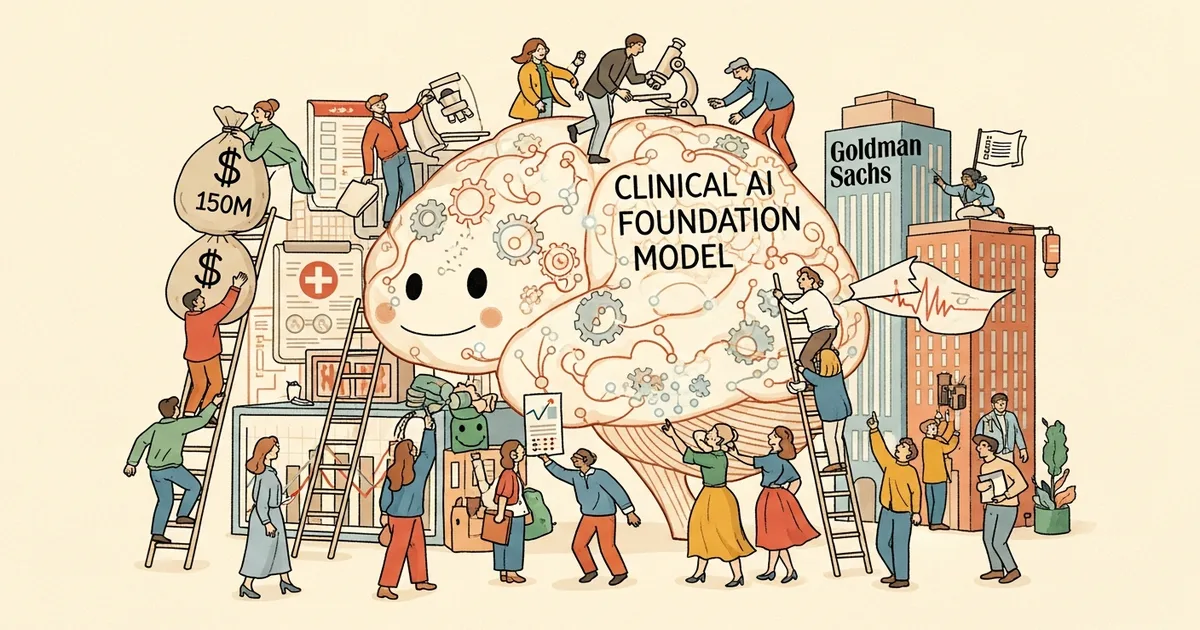
- Fierce Healthcare reported on May 3, 2026 that Aidoc raised $150 million in new funding, backed by Goldman Sachs, to scale its clinical AI foundation model.
- Aidoc has been one of the longest-running clinical-AI deployment vendors, with FDA-cleared imaging triage tools deployed in U.S. hospitals since 2018.
- The round adds to a 2026 wave of large clinical-AI funding events including separate raises by competitors in the radiology-AI and clinical-decision-support categories.
- The Google News redirect to Fierce Healthcare’s article was paywalled during research; specific deal terms, valuation, and additional investors should be confirmed against the original report.
What Happened
Clinical AI company Aidoc raised $150 million in new funding backed by Goldman Sachs to scale its clinical AI foundation model, Fierce Healthcare reported on May 3, 2026. The Google News redirect to the Fierce Healthcare article was paywalled during research, so deal-specific details — valuation, total raise structure, additional investor names beyond Goldman Sachs — should be confirmed against the original Fierce Healthcare report.
Why It Matters
Aidoc has been one of the longest-running and most-deployed clinical-AI companies in U.S. hospitals, with FDA-cleared imaging triage tools live in production since 2018. The “foundation model” framing in the funding announcement is a notable shift: most clinical-AI deployments to date have been narrow task-specific models (intracranial hemorrhage detection, pulmonary embolism flagging, fracture identification). A clinical-AI foundation model points toward generalist clinical AI capable of multiple downstream tasks from a single underlying model — the same architectural shift that transformed natural-language and computer-vision applications in the past three years. Goldman Sachs’s involvement signals continued institutional capital flowing into clinical AI despite the broader market’s caution on healthcare-AI exits.
Technical Details
Detailed technical disclosure was not retrievable from the source URL during research due to the paywall on Fierce Healthcare’s article. Public-facing details from Aidoc’s prior product roadmap suggest the foundation model effort builds on the company’s existing imaging-triage corpus across more than 1,000 deployed hospitals — a substantial training-data footprint by clinical-AI standards. The foundation-model architecture would replace stack-of-narrow-models with a general clinical encoder fine-tuned for multiple downstream triage and decision-support tasks.
Open questions include: which modalities the foundation model covers (CT, MRI, X-ray, multi-modal text-and-image); whether Aidoc plans to make the model accessible to other developers via API; FDA clearance pathway implications, since foundation models typically require a different regulatory review than narrow task-specific tools; and how Aidoc differentiates against competitors including Rad AI, Annalise.ai, and the radiology-AI capabilities being built into Microsoft Nuance and Epic.
Who’s Affected
Aidoc’s existing 1,000+ hospital deployments are the primary deployment surface for the foundation model and the most direct beneficiaries. Competitors in the clinical-AI category — Rad AI ($150M Series F in mid-2025), Annalise.ai, Cleerly, Viz.ai — face renewed competition from a better-capitalized incumbent moving toward a generalist architecture. Goldman Sachs’s healthcare-AI thesis gets a high-profile new entry. Hospital procurement teams gain a clearer picture of where clinical-AI vendor consolidation may be heading: foundation-model architectures favor scale, which favors well-funded incumbents.
What’s Next
Aidoc has not publicly disclosed the foundation model’s launch timeline or specific clinical applications targeted for FDA clearance under the new funding. Expect roadmap details in subsequent product announcements. The clinical-AI category will likely see additional large rounds through 2026 as foundation-model architectures spread, and Aidoc’s deployment scale gives it advantages in negotiating data-partnership agreements with hospital systems. We will update with deeper coverage once specific technical and clinical details are public.