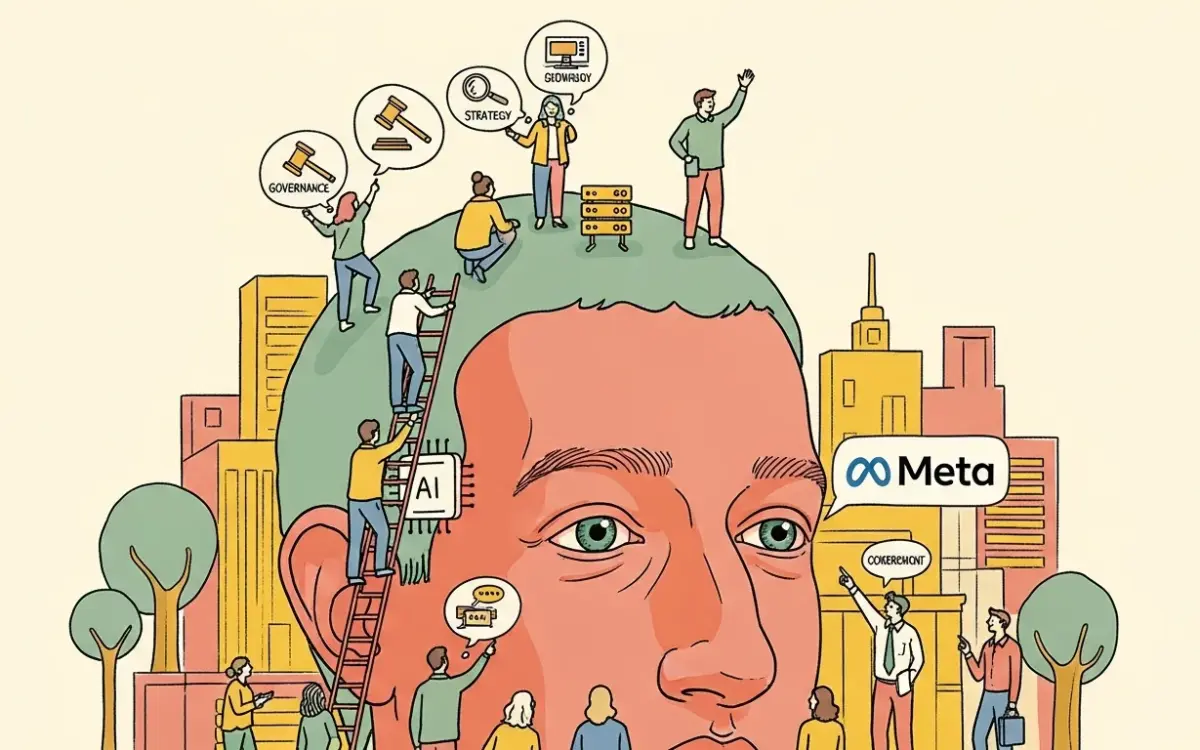
- Mark Zuckerberg is building a personal AI agent to help him perform CEO duties at Meta, acting as an automated chief of staff that retrieves information and surfaces decisions across the company.
- The Wall Street Journal first reported the project in March 2026; Meta plans to eventually give every employee their own AI agent.
- Meta’s AI-related capital expenditures for 2026 are projected at $115 billion to $135 billion, nearly double the $72 billion spent in 2025.
- Employee performance reviews at Meta now factor in AI usage, and staff attend AI tutorial meetings several times per week.
What Happened
Mark Zuckerberg is developing a personal AI agent designed to handle executive duties at Meta, according to a report first published by The Wall Street Journal and covered by Euronews on March 24, 2026. The tool is still in early development and operates as an automated chief of staff, pulling information that would normally require consulting multiple layers of employees.
The agent retrieves answers, surfaces decisions made by different teams, flags relevant signals from across Meta’s product portfolio, and compresses information that would otherwise pass through a chain of human intermediaries. Meta did not respond to requests for comment on the project.
Why It Matters
The project signals how large technology companies are beginning to apply AI agents internally, not just as products for external customers. Zuckerberg is using himself as the test case for a tool he eventually wants to deploy across the entire organization, a strategy that puts the CEO at the front of adoption rather than mandating it from above.
During a January 2026 earnings call, Zuckerberg described the broader strategy: “We’re elevating individual contributors and flattening teams. If we do this, then I think that we’re going to get a lot more done and I think it’ll be a lot more fun.” The implication is a management structure where AI agents replace middle-management information routing, reducing the number of human intermediaries between a decision and the data that informs it.
This approach is distinct from how most companies deploy AI. Rather than starting with customer-facing chatbots or automating support tickets, Meta is targeting the executive layer first, the most expensive and time-sensitive part of the information chain.
Technical Details
Meta has not disclosed the specific architecture or model powering the CEO agent. The company builds its own Llama family of open-weight language models, making it likely the agent runs on internal Meta infrastructure rather than third-party APIs. What is known is that the tool functions as an autonomous planner: it can retrieve intelligence across business units, identify decisions that require Zuckerberg’s attention, and complete tasks with minimal human intervention.
The company is investing heavily in AI-native tooling across the organization. Meta’s fourth-quarter earnings report revealed AI-related capital expenditures for 2026 will be between $115 billion and $135 billion, nearly twice the $72 billion spent in 2025. Employees attend AI tutorial meetings several times per week, participate in AI hackathons, and are encouraged to build their own AI tools for internal use.
Who’s Affected
Inside Meta, employee performance reviews now partly factor in AI usage, suggesting that adopting these tools is no longer optional. The CEO agent is the starting point for a broader rollout in which every person inside and outside the company would eventually have their own personal AI agent, according to Zuckerberg.
For the broader tech industry, Zuckerberg’s project sets a precedent. If a CEO of a $1.5 trillion company uses an AI agent to replace parts of the management information chain, other executives will face pressure to follow.
What’s Next
Zuckerberg has framed this as the beginning, not the end product. The next step is expanding the AI agent from a personal tool to a company-wide system where every Meta employee has access to their own agent. Beyond Meta’s walls, Zuckerberg has said he envisions a future where every person outside the company also has a personal AI agent, though no details on that consumer product have been shared.
No timeline has been disclosed for the broader internal rollout. A key limitation is that the agent currently handles information retrieval and decision surfacing, not autonomous decision-making itself. Zuckerberg still makes the final calls on every decision the agent surfaces, and Meta has not indicated when or whether that will change.