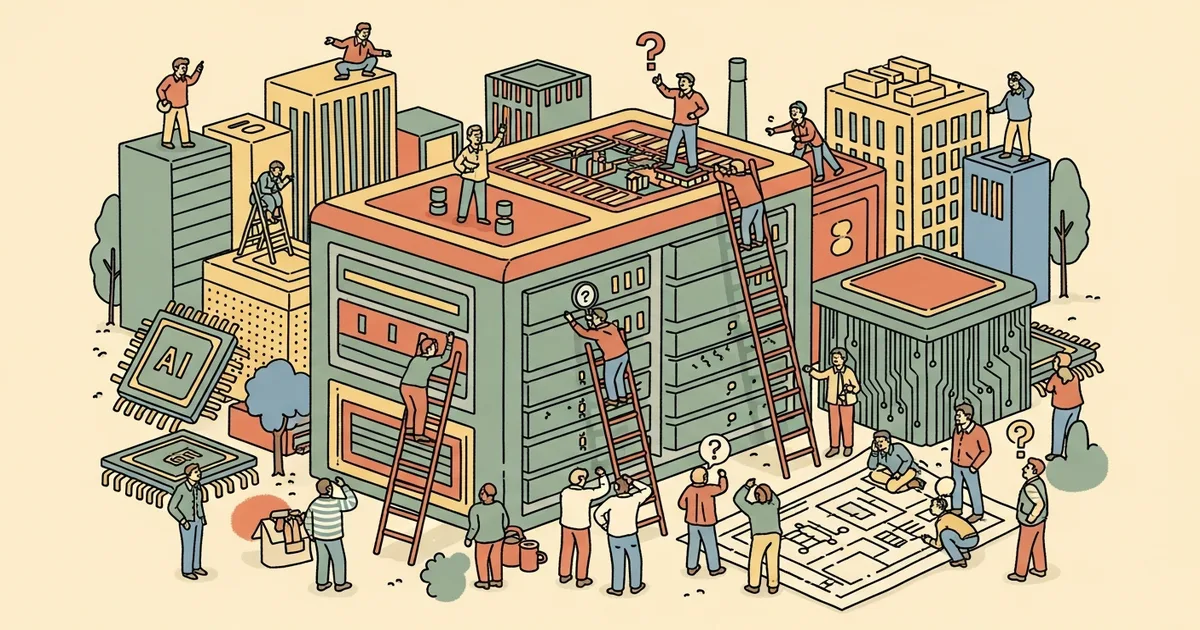
- Bloomberg’s May 20, 2026 segment frames the bear case for the current AI capex cycle.
- The argument: hyperscaler AI infrastructure spend may be running ahead of monetisable enterprise demand.
- 2026 hyperscaler capex guidance — including Microsoft above $80B — has been a primary driver of bond-market saturation and grid-constraint pressure.
- The Bloomberg segment lands hours before Nvidia‘s Q1 fiscal 2027 earnings, the most direct empirical test of the bear thesis.
What Happened
Bloomberg published a video segment on Tuesday under the title “What if Big Tech’s Massive Bet on AI Is a False Start?”, framing the bear case for the broader AI capex cycle. The segment ran the same morning Nvidia was scheduled to report Q1 fiscal 2027 earnings after the bell, with revenue expectations at a record $79 billion.
Why It Matters
The bear thesis has been building through Q1 and Q2 2026 commentary from a small but increasingly visible set of analysts and investors. The case rests on three observations. First, hyperscaler AI infrastructure spend has scaled faster than enterprise AI revenue: Microsoft’s 2026 capex guidance above $80 billion sits against Microsoft Copilot revenue measured in single-digit billions. Second, model-maker concentration: The Information’s recent analysis showed Anthropic and OpenAI capture 89% of AI startup revenue but burn $30+ billion combined annually on training. Third, infrastructure constraints — grid capacity, transmission interconnection queues exceeding 5-7 years, U.S. bond-market saturation pushing Alphabet to look overseas — suggest the supply chain cannot absorb the capex pace anyway.
The counter-narrative, articulated by Nvidia’s leadership and most hyperscalers, is that AI capex represents fixed cost build-out that will yield decade-scale returns once enterprise adoption matures. The Nvidia Q1 print this evening is the most direct empirical test.
Technical Details
Bloomberg’s segment is presented as video; specific guests, named comparison data points, and detailed financial models are paywalled behind subscription. The bear-thesis arguments typically reference three categories of evidence. Productivity gains lag headlines: McKinsey, Gartner, and academic studies through 2025-2026 consistently find AI productivity improvements between 5-30%, well below the framing implied by capex levels. Margin pressure on application-layer AI companies: Anthropic’s pricing changes on Opus 4.7 (image-processing cost tripling, programmatic-use billing changes from June 15) reflect cost pressure even at the model-maker tier. Talent costs: Andrej Karpathy joining Anthropic’s pretraining team, multiple seven-figure individual compensation packages disclosed in OpenAI documents, and continued aggressive hiring at all frontier labs all imply persistent OpEx scaling.
Who’s Affected
Public-market AI equity holders — particularly Nvidia, Microsoft, Alphabet, Meta, Amazon, Oracle, and CoreWeave — face the question directly. Hyperscaler customers who have built business cases around continued AI capex pace face revisitation if guidance moderates. Bond-market participants holding AI-infrastructure paper face credit-quality questions if revenue ramps lag. AI startups dependent on hyperscaler capacity face the inverse risk — too much capacity, falling rental rates, margin compression at platform layer.
What’s Next
Nvidia’s Q1 fiscal 2027 earnings call later Tuesday is the most direct near-term test. Subsequent quarterly prints from Microsoft, Alphabet, Meta, and Amazon will further refine the picture. Industry analysts at Morgan Stanley, Goldman Sachs, and Bernstein are expected to publish refreshed AI-infrastructure demand models through the next two earnings cycles. The Bloomberg segment is one of several similarly-framed pieces likely to appear through mid-2026 as the AI-capex thesis is tested in real revenue ramps.