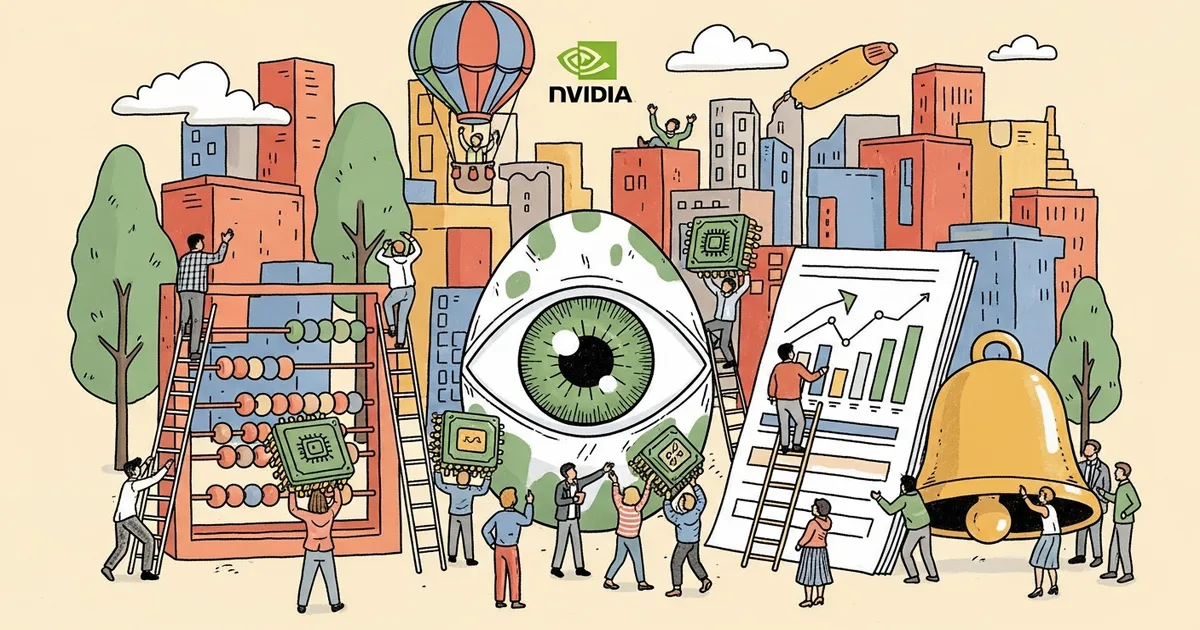
- Nvidia reports Q1 fiscal 2027 earnings after the closing bell on May 20, with revenue expected to reach a record $79 billion.
- Bloomberg’s preview flags Blackwell ramp pacing, China revenue under export controls, and hyperscaler in-house-silicon impact as the key variables.
- Each Nvidia quarterly print has become an effective macro indicator for AI-infrastructure demand.
- The expected print would put Nvidia at an annualised run-rate above $300 billion.
What Happened
Nvidia is set to report Q1 fiscal 2027 earnings after the closing bell on Tuesday, with revenue expected to reach a record $79 billion, Bloomberg’s preview segment noted on the morning of the report. The $79 billion figure was previously reported by Bloomberg on May 18 as the analyst consensus expectation.
Why It Matters
Each Nvidia quarterly print is now functioning as a macro indicator for AI-infrastructure demand. A $79 billion quarter — if achieved — would put Nvidia at an annualised run-rate above $300 billion, a scale historically reserved for the largest oil, retail, and consumer-products incumbents. The print also tests whether AI capex continues at 2025-2026 pace or shows signs of moderation.
Bloomberg also published a parallel segment on Tuesday titled “What if Big Tech’s Massive Bet on AI Is a False Start?” — framing the bear case for the broader AI capex cycle. Nvidia’s print is the most direct empirical test of which framing the market should weight.
Technical Details
Three variables are most likely to drive the post-earnings move per Bloomberg’s preview. First, Blackwell (B200) ramp pacing — Blackwell is in commercial volume shipments through 2026 but supply-chain capacity, yield rates, and customer deployment timing remain operationally relevant. Second, China revenue under the latest export controls — Nvidia’s H20 and H200 China-specific variants generate material but politically constrained revenue. Third, hyperscaler in-house silicon impact — Google TPU, AWS Trainium/Inferentia, Microsoft Maia/Cobalt, and Meta MTIA all compete for specific workloads, though Nvidia’s CUDA software moat remains the durable advantage analysed in last week’s Wired essay.
Margin sustainability is the secondary question. Nvidia’s gross margin has been above 70% for multiple quarters. Competing merchant-silicon suppliers (AMD’s MI300, Intel Gaudi, Cerebras wafer-scale) compete on specific workload price-performance. Forward guidance — Q2 fiscal 2027 revenue outlook and full-year shape — typically moves the post-earnings price more than the trailing quarter.
Who’s Affected
Nvidia equity holders face one of the year’s most-watched single-stock events. Hyperscaler customers — Microsoft Azure, Meta, Alphabet, Amazon AWS, Oracle — face capex-allocation decisions across Nvidia versus in-house silicon. AI labs — OpenAI, Anthropic, Google DeepMind, xAI, Mistral — depend on hyperscaler capacity allocations driven by Nvidia supply. Bond markets reading the print will adjust pricing on AI-infrastructure debt issuance; the saturation of U.S. corporate bond markets with AI-capex paper (Alphabet was reported on May 13 to be turning overseas) is the related constraint.
What’s Next
The earnings call typically extends 60-90 minutes after the print release. Analyst guidance for Q2 fiscal 2027 and the full-year shape will be the most-watched parts of the call. Specific topics to track: Blackwell ramp pacing, hyperscaler in-house silicon impact on Nvidia share, China revenue under export controls, and the rate at which AI-data-centre power constraints translate into customer purchase deferrals.