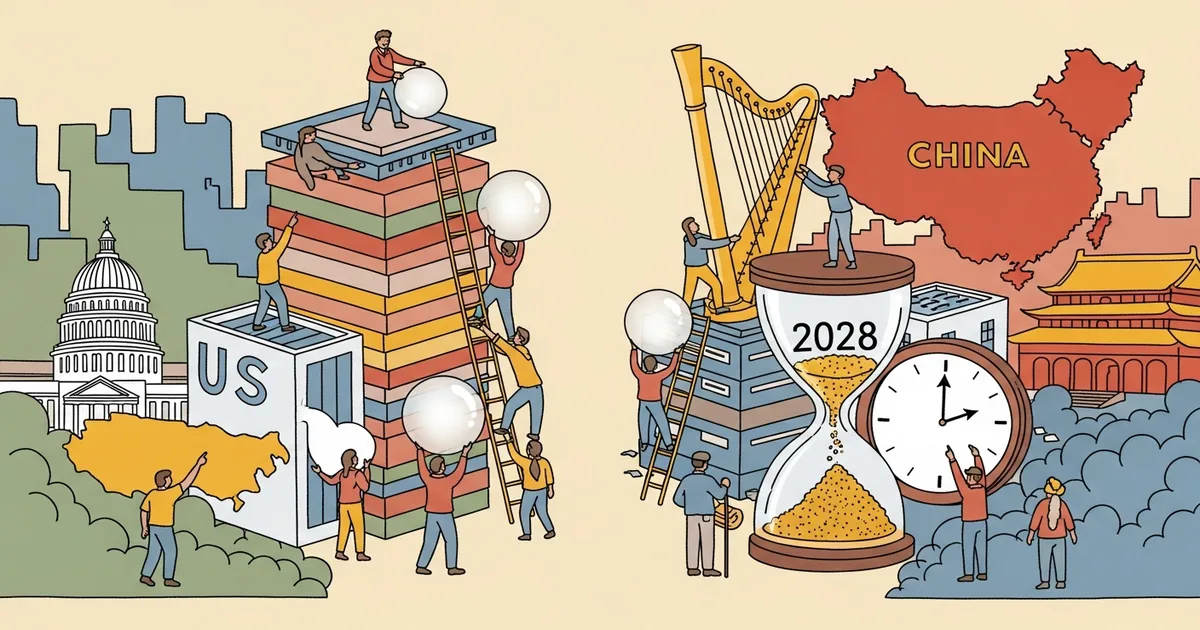
- Anthropic published a policy paper on May 14, 2026 arguing the US has until 2028 to consolidate its compute advantage over China or cede AI norm-setting to authoritarian regimes.
- The paper cites an analysis projecting Huawei will reach only 4 percent of NVIDIA’s aggregate compute capacity by 2026, dropping to 2 percent by 2027 if export controls hold.
- Anthropic accuses DeepSeek, Moonshot, and Minimax of using roughly 24,000 fraudulent accounts to generate over 16 million Claude interactions for capability distillation.
- The paper was reported by Maximilian Schreiner at The Decoder on May 15, 2026, the same week as President Trump’s two-day Beijing summit with Xi Jinping.
What Happened
Anthropic released an extensive policy paper on May 14, 2026 framing the AI competition between the US and China as a binary 2028 question, according to a report by Maximilian Schreiner at The Decoder. The paper outlines two scenarios for the end of the current US administration’s term: either Washington closes the loopholes that let Chinese labs close the gap, or Beijing reaches near-parity and exports authoritarian AI standards globally. The timing was deliberate — the paper landed during Trump’s two-day visit to Beijing and while Congress is actively debating AI export controls, chip licenses, and cloud access.
Why It Matters
The paper formalizes a position Anthropic has argued in fragments through prior congressional testimony, putting numbers and a timeline on what frontier labs have previously framed as abstract concern. The week itself was dense with US-China AI signaling: Trump’s Beijing summit included direct conversation with Xi over NVIDIA H200 export rules, the Department of Defense announced cooperation with ten AI companies for classified networks while excluding Anthropic, and Reuters reported that Washington had cleared H200 sales to several major Chinese tech firms. Anthropic positioned the paper as a policy intervention into all three threads at once, planting its flag firmly on the restrictive, security-focused side of the export-control debate.
Technical Details
Anthropic’s central technical claim is that compute, not data or talent, is the bottleneck of frontier AI competition. The paper credits the combined US-allied stack — NVIDIA’s chip designs, TSMC’s fabrication, and ASML’s lithography — with creating a hardware advantage that export controls have widened. Anthropic cites an analysis projecting Huawei will reach only 4 percent of NVIDIA’s aggregate compute capacity by 2026, falling to 2 percent by 2027 if export controls hold.
The paper documents two specific evasion patterns. First, physical chip smuggling and access to US compute through foreign data centers. Second, systematic distillation attacks: Chinese labs use thousands of fake accounts to scrape outputs from American frontier models and replicate their capabilities. Anthropic accuses DeepSeek, Moonshot, and Minimax of generating over 16 million Claude interactions through roughly 24,000 fraudulent accounts in February 2026 — a practice OpenAI, Google, and the Frontier Model Forum have separately condemned. The paper also flags that only 3 of 13 top Chinese labs have published safety evaluations to date, and cites the Center for AI Standards and Innovation finding that DeepSeek’s R1-0528 fulfilled 94 percent of malicious requests under common jailbreaking techniques.
Who’s Affected
NVIDIA, TSMC, ASML, and the Bureau of Industry and Security at the Department of Commerce are the named beneficiaries of the proposed policy direction. Chinese labs including DeepSeek, Moonshot AI, Minimax, Zhipu, and Alibaba’s Qwen team are the targets of the tighter enforcement Anthropic recommends. US allied governments — particularly in Southeast Asia and the Gulf, where transshipment has been documented in prior Bureau of Industry and Security enforcement actions — are positioned as essential to closing third-country reshipping routes. OpenAI, Google, and the Frontier Model Forum have already publicly condemned the distillation-via-fake-accounts pattern, putting them implicitly on the same side as Anthropic on this specific enforcement question.
What’s Next
Anthropic indicated the paper will be circulated to congressional offices working on the next round of export-control legislation, expected to advance through committee this summer. In the paper’s preferred scenario — closed loopholes, distillation cracked down on through legislation, US AI infrastructure exported globally — Anthropic projects a 12- to 24-month lead in model intelligence. In the alternative scenario, Chinese labs reach near-parity, Beijing scales AI-powered surveillance, and Huawei data centers gain global market share. Anthropic’s exclusion from the Pentagon’s recent ten-company AI cooperation deal remains unresolved; the company is challenging its supply-chain-risk designation in court.