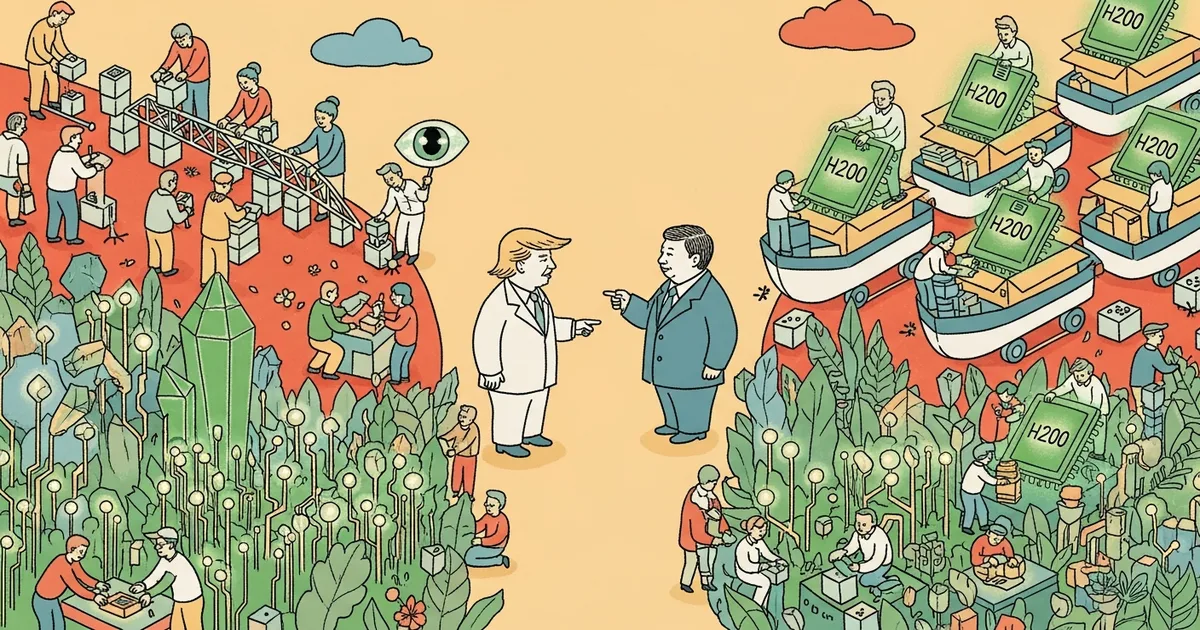
- President Donald Trump told reporters he discussed AI guardrails with Chinese leader Xi Jinping during their two-day summit in Beijing.
- The conversation included NVIDIA Corporation’s H200 chips, Trump told Bloomberg in remarks reported May 15, 2026.
- The disclosure follows a separate Reuters report this week that Washington cleared H200 sales to several major Chinese tech firms, reversing prior export restrictions.
- NVIDIA CEO Jensen Huang traveled to Beijing on Air Force One as a last-minute addition to the US delegation that also included Tim Cook and Elon Musk.
What Happened
President Donald Trump confirmed on May 15, 2026 that artificial-intelligence guardrails were a topic of his direct conversation with Chinese leader Xi Jinping during their two-day summit in Beijing this week, according to Bloomberg’s reporting. Trump added that NVIDIA‘s H200 data-center accelerators came up in the same conversation, marking an unusual moment of head-of-state-level discussion of a single product line. The disclosure landed alongside news that Treasury Secretary Bessent told CNBC during the trip that the United States expects a “step-function jump” in upcoming Gemini and OpenAI model releases, framing US compute leadership as the underlying policy stake of the summit.
Why It Matters
The H200 specifically — NVIDIA’s Hopper-architecture data-center accelerator — has been a focal point of US export controls since the prior administration tightened restrictions on Hopper-class shipments to China in 2024. Reuters separately reported earlier this week that Washington had cleared H200 sales to several Chinese tech firms, reversing the restriction. Trump’s confirmation that the chip class came up at head-of-state level adds context to that policy reversal and to NVIDIA CEO Jensen Huang’s last-minute inclusion on Air Force One for the trip. The full CEO delegation also included Apple’s Tim Cook, Elon Musk, and executives from Cisco, Qualcomm, and Micron — a roster that reads as a who’s-who of US technology export interests rather than a typical bilateral trade delegation.
The summit also coincided with Anthropic’s release of a policy paper arguing the US has until 2028 to lock in its AI compute lead over China — a framing directly at odds with the H200 sales clearance. China analyst Rui Ma told Bloomberg in earlier coverage that “Jensen’s absence reflected a disconnect between Washington’s confidence in Nvidia as leverage and China’s willingness to endure pain for semiconductor self-reliance.”
Technical Details
The H200 is NVIDIA’s Hopper-generation data-center accelerator with 141 GB of HBM3e memory and 4.8 TB/s of memory bandwidth, positioning it between the H100 and the newer Blackwell B200 in the NVIDIA roadmap. The Bureau of Industry and Security at the US Department of Commerce had previously classified Hopper-class chips above specific compute thresholds for restricted export. The “guardrails” framing Trump used was not defined further in the cited remarks; prior US-China track-two dialogues have used the term to refer to incident-prevention hotlines, model-deployment red lines for autonomous-weapons applications, and military-AI confidence-building measures comparable to nuclear-era hotlines.
Who’s Affected
NVIDIA shareholders, who watched Huang’s Air Force One inclusion as an implicit policy signal, are the most directly exposed equity holders. Chinese hyperscalers including ByteDance, Alibaba, Tencent, and Baidu were the named beneficiaries of the reported H200 sales clearance. AMD and Intel, which compete with NVIDIA in data-center accelerators, face revised market-access asymmetries that may favor competitors who can sell more freely into China. The Bureau of Industry and Security and the Defense Innovation Unit are positioned to translate the head-of-state conversation into regulatory specifics through the next licensing cycle.
What’s Next
The full text of any agreed-upon AI guardrails has not been published, and neither government released a joint statement detailing the scope of discussions. NVIDIA has not commented publicly on the specific H200 clearance volumes or pricing. Xi reportedly warned Trump that Taiwan could push both nations into “conflict” — a reminder that the chip-export discussion is overlaid on a more fundamental geopolitical question that the summit did not resolve. Subsequent Bureau of Industry and Security licensing actions over the next 60 days will be the practical test of whether the head-of-state conversation translates into a durable policy shift.