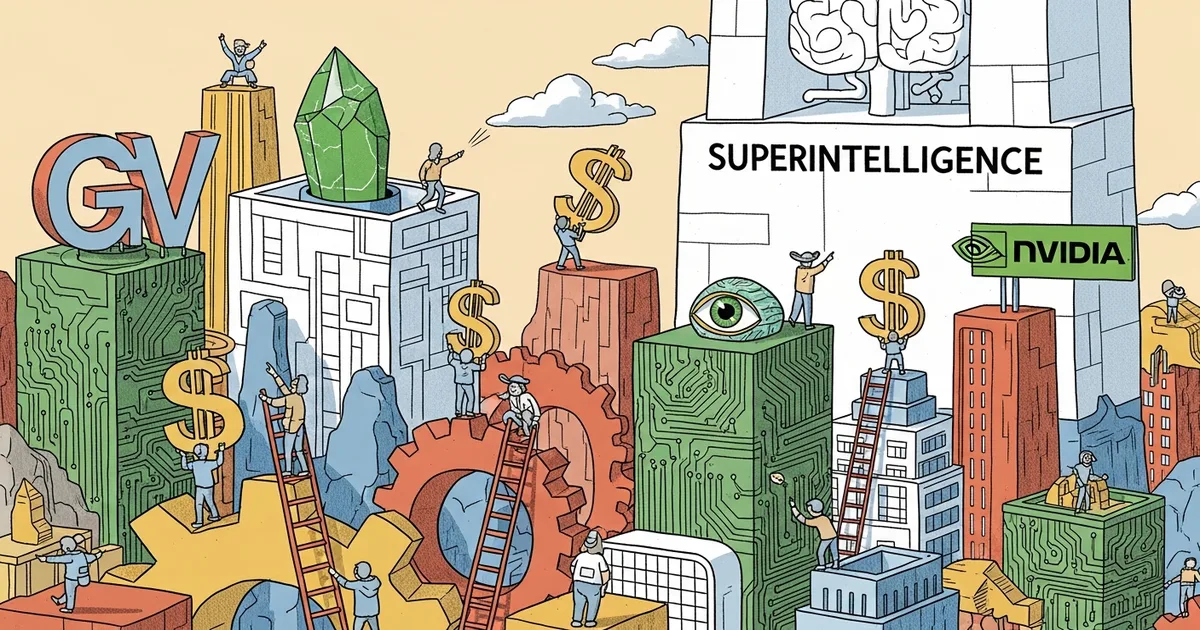
- Recursive Superintelligence raised at least $500 million at a $4 billion pre-money valuation in a round led by GV (formerly Google Ventures), with Nvidia also participating.
- The round was oversubscribed and could ultimately reach $1 billion in total capital raised, according to the Financial Times.
- Co-founders include Richard Socher, former chief scientist at Salesforce, and Tim Rocktäschel, an AI professor at University College London and former principal scientist at Google DeepMind.
- The company’s core self-improvement technology remains in a research phase and has not been tested over extended time periods, per the Financial Times.
What Happened
Recursive Superintelligence, a startup founded roughly four months ago, has raised at least $500 million at a $4 billion pre-money valuation, according to a report by The Decoder citing the Financial Times. GV (formerly Google Ventures) led the round, with Nvidia participating as an investor. The round was oversubscribed, meaning total capital raised could reach as much as $1 billion. The company has not officially launched a product.
Why It Matters
The raise follows a pattern established by other pre-product AI research labs. Safe Superintelligence (SSI), co-founded by former OpenAI chief scientist Ilya Sutskever, raised $1 billion at a $5 billion valuation in September 2024, within months of its founding and before publishing any research or shipping a product. Like SSI, Recursive Superintelligence is attracting large sums based primarily on founding team credentials rather than demonstrated technology. The round reflects continued institutional and corporate venture appetite for early-stage bets on research targeting the theoretical upper bounds of machine intelligence.
Technical Details
Recursive Superintelligence’s stated research objective is to build an AI system capable of improving its own capabilities without human involvement — a concept the research community refers to as recursive self-improvement. The roughly 20-person team includes alumni from OpenAI, Google, and Meta, alongside co-founders Richard Socher, former chief scientist at Salesforce, and Tim Rocktäschel, an AI professor at University College London who previously served as principal scientist at Google DeepMind. The Financial Times reported that the self-improvement concept remains in a research phase as of April 2026 and has not been validated over extended time periods. No benchmark results, model architecture specifications, or evaluation frameworks were publicly disclosed alongside the funding announcement.
Who’s Affected
The funding creates immediate competition for research talent across other frontier AI labs, particularly for researchers with backgrounds in reinforcement learning, self-supervised learning, and autonomous systems. Nvidia’s role as an investor — rather than purely a hardware supplier — continues a pattern the company has established across multiple AI startup rounds, extending its strategic influence beyond chip sales. Academic institutions may also face compounding recruiting pressure: co-founder Tim Rocktäschel holds a faculty position at University College London, and startup compensation structures typically exceed what universities can offer.
What’s Next
Recursive Superintelligence has not disclosed a product launch timeline, research publication schedule, or specific milestones for moving out of the research phase. Given the oversubscribed status of the current round, the company may close additional capital before announcing a final figure. The Financial Times report did not indicate when the company expects to produce a testable or publicly demonstrable system.