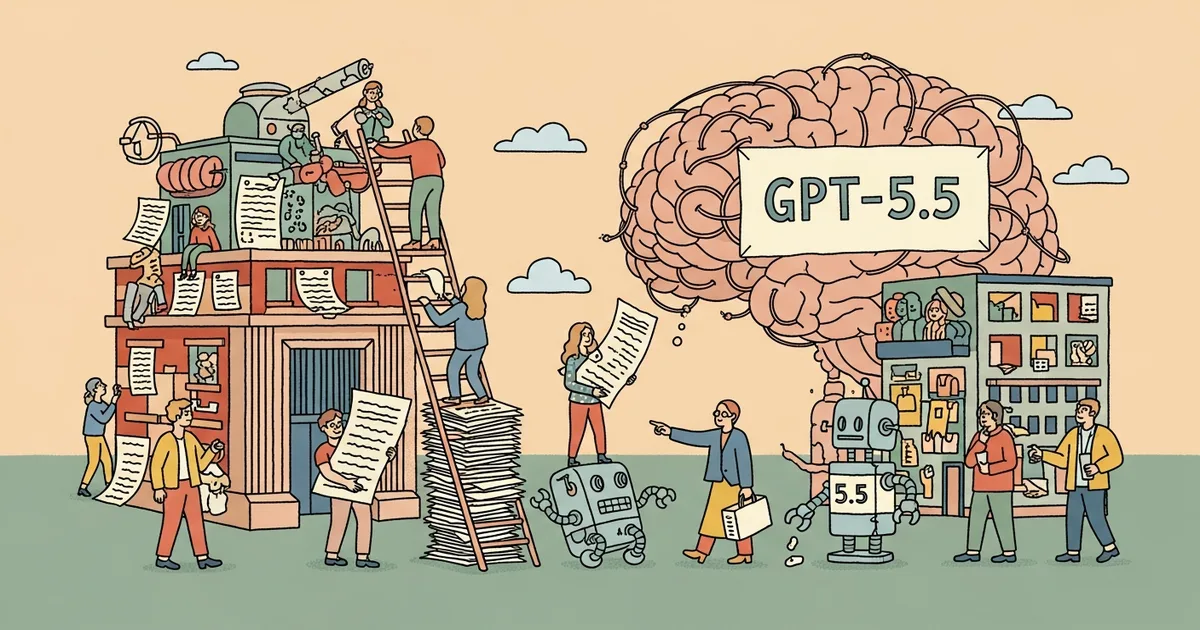
- OpenAI’s new GPT-5.5 prompting guide instructs developers to start from scratch rather than migrate existing prompt stacks from earlier models.
- The guide warns that legacy prompts overspecify process steps, which narrows the model’s search space and produces mechanical-sounding outputs.
- Role definitions — including a seven-part schema of Role, Personality, Goal, Success criteria, Constraints, Output, and Stop rules — are now formally recommended at the top of every prompt.
- For streaming applications, OpenAI recommends a visible preamble to acknowledge the request while the model reasons or calls tools before returning output.
What Happened
OpenAI published a structured prompting guide for GPT-5.5, advising developers against treating the model as a drop-in replacement for predecessors such as GPT-5.2 or GPT-5.4. According to The Decoder, the organization recommends beginning migration with the smallest prompt that still achieves the desired result, then layering in reasoning effort levels, tool descriptions, and output format only as needed. The guide marks a notable shift in how OpenAI officially frames prompt engineering for its most capable models.
Why It Matters
A large share of production applications built on OpenAI’s API rely on prompt templates written for earlier model generations. If those prompts actively degrade GPT-5.5‘s output quality — as the guide claims — developers face a non-trivial migration burden even when upgrading within the same model family. The guidance also signals that OpenAI views over-specified prompts as a systemic pattern rather than an edge case.
Technical Details
OpenAI states that GPT-5.5 reasons more efficiently than its predecessors, recommending developers test “low” and “medium” reasoning effort settings before reaching for higher levels. The guide contrasts two customer service prompt approaches: a recommended version that states only “Resolve the customer’s issue end to end” alongside clear success criteria, versus a rejected version that micromanages each step — “First inspect A, then inspect B, then compare every field, then think through all possible exceptions.” OpenAI says the latter creates noise and constrains the model unnecessarily.
On citation behavior, the guide specifies that retrieval budgets and evidence standards should be written directly into the prompt — including how the model should respond when evidence is absent. The organization also notes that absolute directives using words like “ALWAYS” or “NEVER” should be reserved for genuine invariants such as security rules or required output fields, with decision rules used for judgment calls instead.
Who’s Affected
The guidance is directed at developers and organizations running production workloads on OpenAI’s API, particularly those with established prompt libraries built for earlier GPT models. Teams building customer-facing assistants, support automation, and coaching tools are specifically addressed, as the guide’s seven-part schema and personality-split recommendations are tailored to those use cases. Streaming application developers are also called out, given GPT-5.5’s tendency to spend noticeable time on reasoning or tool calls before returning any visible output.
What’s Next
Developers adopting GPT-5.5 are advised to audit existing prompts against the new schema before assuming parity with prior deployments. OpenAI’s recommended path is iterative: establish a minimal baseline first, validate with representative examples, then adjust reasoning effort and tool scope. No timeline for further model-specific prompting documentation was announced.