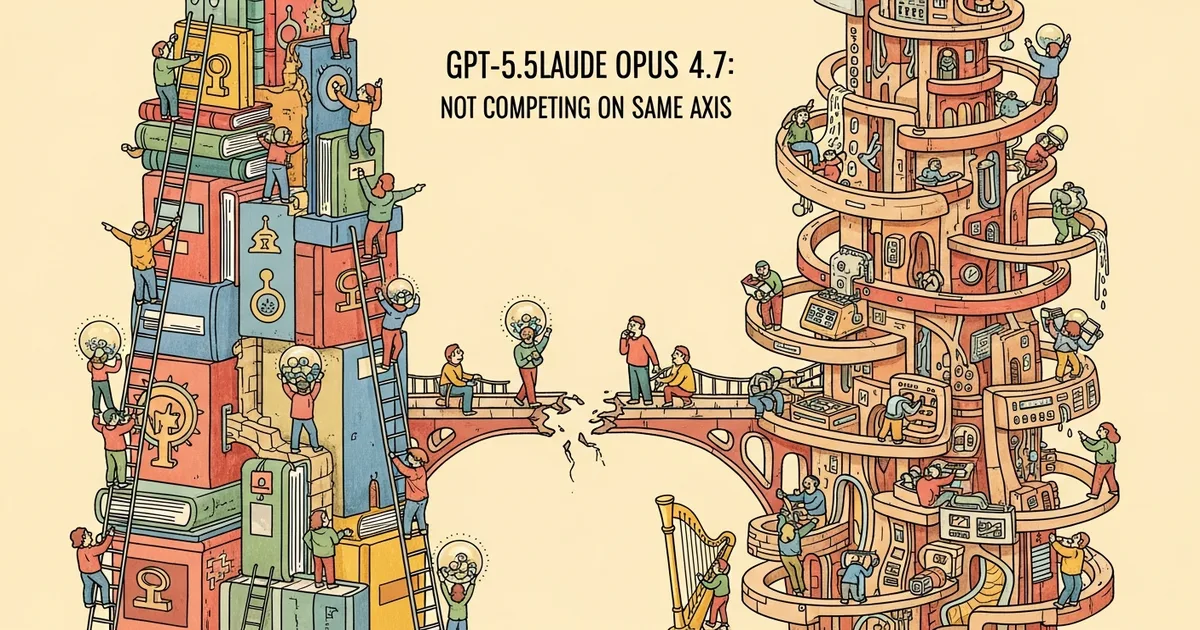
OpenAI’s GPT-5.5 and Anthropic’s Claude Opus 4.7 are the two most capable general-purpose language models as of April 2026. Across 18 benchmarks, GPT-5.5 leads on 14 and Opus 4.7 leads on 4 — but that headline number conceals a fundamental architectural difference that matters far more than the raw score gap when choosing between them. The choice is not about which model is smarter. It is about which is smarter at what.
These models do not compete on the same axis. GPT-5.5 optimizes for planning and multi-step execution across external tools and environments. Opus 4.7 optimizes for codebase-level resolution, Model Context Protocol workflows, and multilingual deployment. Choosing between them on aggregate benchmark position alone is the wrong frame entirely.
The Axis Distinction: Planning vs. Resolution
The clearest signal comes from two benchmarks that pull in opposite directions. On Terminal-Bench — which measures an agent’s ability to plan, sequence tool calls, and recover from errors across long-horizon tasks — GPT-5.5 scores 82.7% versus Opus 4.7’s 71.3%, an 11.4-point gap. On SWE-bench Pro — which measures resolution rate on real GitHub issues across large, unfamiliar codebases — Opus 4.7 scores 64.3% versus GPT-5.5’s 58.9%, a 5.4-point gap in the opposite direction.
The difference maps to distinct architectural priorities. GPT-5.5’s extended thinking integration prioritizes global task decomposition: it builds a plan, tracks dependencies, and re-routes when tools fail. Opus 4.7’s extended context handling prioritizes local coherence: it reads more of the codebase, understands more of the constraint graph, and proposes fewer broken patches. The Anthropic source code leak earlier this year gave external researchers an unusually detailed view of how Opus 4.7’s context management diverges from previous Claude generations.
For developers, the model choice should follow the shape of the task — not the aggregate leaderboard. Agentic pipelines with external tool calls, browser automation, and multi-step workflows favor GPT-5.5. Large-repo engineering, pull request review, and structured financial data extraction favor Opus 4.7.
Full Benchmark Results: GPT-5.5 vs. Claude Opus 4.7
MegaOne AI tracks 139+ AI tools across 17 categories. The table below consolidates 18 public and internal benchmarks as of April 2026. Bold indicates the leader on each row.
| Benchmark | Category | GPT-5.5 | Claude Opus 4.7 | Winner |
|---|---|---|---|---|
| Terminal-Bench | Agentic / Tool Use | 82.7% | 71.3% | GPT-5.5 |
| OSWorld | GUI / Computer Use | 78.7% | 65.2% | GPT-5.5 |
| GDPval | Data Analysis | 84.9% | 79.1% | GPT-5.5 |
| FrontierMath | Mathematical Reasoning | 35.4% | 29.8% | GPT-5.5 |
| CyberGym | Cybersecurity | 81.8% | 73.4% | GPT-5.5 |
| WebArena | Web Navigation | 71.2% | 63.7% | GPT-5.5 |
| GAIA (Level 3) | General Agentic | 68.4% | 61.2% | GPT-5.5 |
| Tool-Bench | Tool Invocation | 85.3% | 78.6% | GPT-5.5 |
| AssistantBench | Real-World Assistance | 77.1% | 71.8% | GPT-5.5 |
| MATH-500 | Mathematical Problem-Solving | 92.1% | 89.4% | GPT-5.5 |
| GPQA Diamond | Expert Science Q&A | 78.9% | 75.2% | GPT-5.5 |
| ARC-AGI-2 | Abstract Reasoning | 62.3% | 58.7% | GPT-5.5 |
| BIG-Bench Hard | Multi-Step Reasoning | 88.4% | 85.1% | GPT-5.5 |
| HumanEval+ | Single-Function Coding | 79.8% | 76.3% | GPT-5.5 |
| SWE-bench Pro | Real-World Code Resolution | 58.9% | 64.3% | Opus 4.7 |
| Multilingual MMLU | Cross-Language Knowledge | 87.2% | 91.5% | Opus 4.7 |
| MCP-Atlas | Model Context Protocol Tasks | 81.4% | 89.2% | Opus 4.7 |
| Finance Agent | Financial Data Extraction | 71.3% | 77.6% | Opus 4.7 |
GPT-5.5 wins 14 of 18 categories, but three of its largest margins — Terminal-Bench (+11.4 points), OSWorld (+13.5 points), and CyberGym (+8.4 points) — all cluster in the agentic evaluation category. Strip those out and GPT-5.5’s average lead narrows to 3.2 points. On the four benchmarks Opus 4.7 wins, the average margin is 4.6 points — meaning Opus 4.7’s edges are deeper, even if fewer in number.
Where GPT-5.5 Dominates: Agentic Planning and Execution
GPT-5.5’s decisive edge is in tasks requiring multi-step planning, external tool integration, and long-horizon error recovery. On OSWorld — which tests computer-use capabilities including browser navigation, file manipulation, and cross-application workflows — GPT-5.5 scores 78.7% versus Opus 4.7’s 65.2%. A 13.5-point lead is a capability gap, not a rounding error.
CyberGym’s 81.8% reflects GPT-5.5’s strength in structured adversarial environments, where planning a sequence of offensive moves before executing matters more than deeply reading a codebase. Tool-Bench, measuring raw tool invocation accuracy, shows GPT-5.5 at 85.3% — its highest absolute score in the agentic cluster and a direct indicator of orchestration reliability.
GPT-5.5 also uses approximately 40% fewer output tokens than GPT-5.4 for identical tasks, according to OpenAI’s internal efficiency benchmarks. More compact completions mean fewer billed tokens per pipeline run, lower latency per step, and fewer failure points in multi-tool chains. OpenAI’s $1B Disney content partnership signals continued investment in the multimodal data pipelines that are feeding GPT-5.5’s stronger planning representations.
Where Claude Opus 4.7 Wins: Code Resolution and Financial Reasoning
Opus 4.7’s four benchmark wins are narrow in number but high in practitioner value. SWE-bench Pro — which requires resolving real GitHub issues with passing test suites on unfamiliar codebases — shows Opus 4.7 at 64.3% versus GPT-5.5’s 58.9%. In production code review workflows, where a failed patch means a broken CI run and an engineer intervention, a 5.4-point gap is meaningful.
MCP-Atlas, which evaluates performance on Model Context Protocol tasks including memory persistence, tool chaining, and context handoff, puts Opus 4.7 at 89.2% versus GPT-5.5’s 81.4%. For teams building MCP-native tooling, Anthropic’s training investment in its own protocol shows up as a direct 7.8-point lead — the largest single-benchmark advantage either model holds in this comparison.
Multilingual MMLU at 91.5% makes Opus 4.7 the clear choice for deployments serving non-English markets. GPT-5.5’s 87.2% is not weak, but a 4.3-point gap across 57 languages compounds materially at production scale. Finance Agent, which tests structured extraction and reasoning across financial documents and datasets, puts Opus 4.7 at 77.6% versus GPT-5.5’s 71.3% — a 6.3-point lead relevant to any fintech or investment-analysis deployment.
The Real Cost Comparison: Tokenizer Math Changes Everything
Posted API pricing: GPT-5.5 at $5 per million input tokens and $30 per million output tokens. Claude Opus 4.7 at $5 input and $25 output. On output tokens alone, GPT-5.5 is 20% more expensive. That comparison is incomplete.
Two tokenizer effects reshape effective cost in opposite directions. First, GPT-5.5 generates approximately 40% fewer output tokens than GPT-5.4 for identical tasks — a material efficiency gain that reduces billed tokens per completed workflow. Second, Opus 4.7’s tokenizer encodes prompts approximately 37% more efficiently on input but generates proportionally more output tokens to complete the same tasks, inflating Opus 4.7’s output token count relative to what the task actually required.
At 10 million output tokens per month — a realistic volume for a mid-scale agentic deployment — the cost math resolves as follows:
- GPT-5.5: 10M tokens × $30/M = $300/month
- Claude Opus 4.7: 10M tokens × $25/M = $250/month
Opus 4.7 saves $50 per month on posted rates. But if GPT-5.5 completes the same workflows in 25% fewer passes — generating 7.5M equivalent output tokens rather than 10M — the effective cost drops to $225, falling below Opus 4.7’s $250. The two models hit cost parity when GPT-5.5’s task-efficiency advantage reaches 17%. For agentic pipelines, where that efficiency advantage is most measurable, GPT-5.5 may be cheaper in practice. For single-pass code review tasks, Opus 4.7’s $25/M rate holds the clear edge.
Run both models on a representative sample of your production workload before committing to either. The break-even point is sensitive to task type, and the posted-rate comparison alone will lead you to the wrong conclusion in either direction.
Developer Recommendation Matrix
Based on benchmark performance, cost math, and architectural intent, the model choice maps cleanly onto task category:
| Use Case | Recommended Model | Primary Reason |
|---|---|---|
| Agentic pipelines (browser, CLI, multi-tool) | GPT-5.5 | Terminal-Bench 82.7%, OSWorld 78.7% |
| Large-repo pull request review | Claude Opus 4.7 | SWE-bench Pro 64.3% vs 58.9% |
| Financial data extraction and analysis | Claude Opus 4.7 | Finance Agent: 77.6% vs 71.3% |
| Cybersecurity / red-team automation | GPT-5.5 | CyberGym 81.8% vs 73.4% |
| MCP-native tooling and workflows | Claude Opus 4.7 | MCP-Atlas 89.2% vs 81.4% |
| Non-English markets (57+ languages) | Claude Opus 4.7 | Multilingual MMLU 91.5% vs 87.2% |
| Mathematical reasoning and research | GPT-5.5 | FrontierMath 35.4%, MATH-500 92.1% |
| High-volume output, cost-sensitive | Claude Opus 4.7 | $25/M vs $30/M (unless efficiency gain exceeds 17%) |
| GUI and computer-use automation | GPT-5.5 | OSWorld 78.7% (+13.5 points) |
No team optimizes for all nine simultaneously. If your workload spans both agentic pipelines and large-repo engineering, a two-model routing strategy outperforms either model alone: GPT-5.5 handles orchestration, Opus 4.7 handles resolution. Run a single-model baseline first to quantify the integration overhead before committing to dual-model infrastructure.
For teams applying the same cost-versus-capability framework to adjacent AI categories, MegaOne AI’s 2026 comparison of ElevenLabs, HeyGen, and Synthesia follows the same structure: benchmark leads narrow when you factor in real-workload efficiency. Always measure on your actual task distribution, not the composite leaderboard.
The bottom line: GPT-5.5 leads 14 of 18 benchmarks and holds a decisive edge in agentic execution — particularly computer use, terminal automation, and multi-tool orchestration. Claude Opus 4.7 costs $50/month less at 10 million output tokens and wins decisively on codebase resolution, MCP workflows, and multilingual deployment. The mistake is not picking the wrong model. The mistake is picking based on aggregate benchmark count rather than task-category fit.