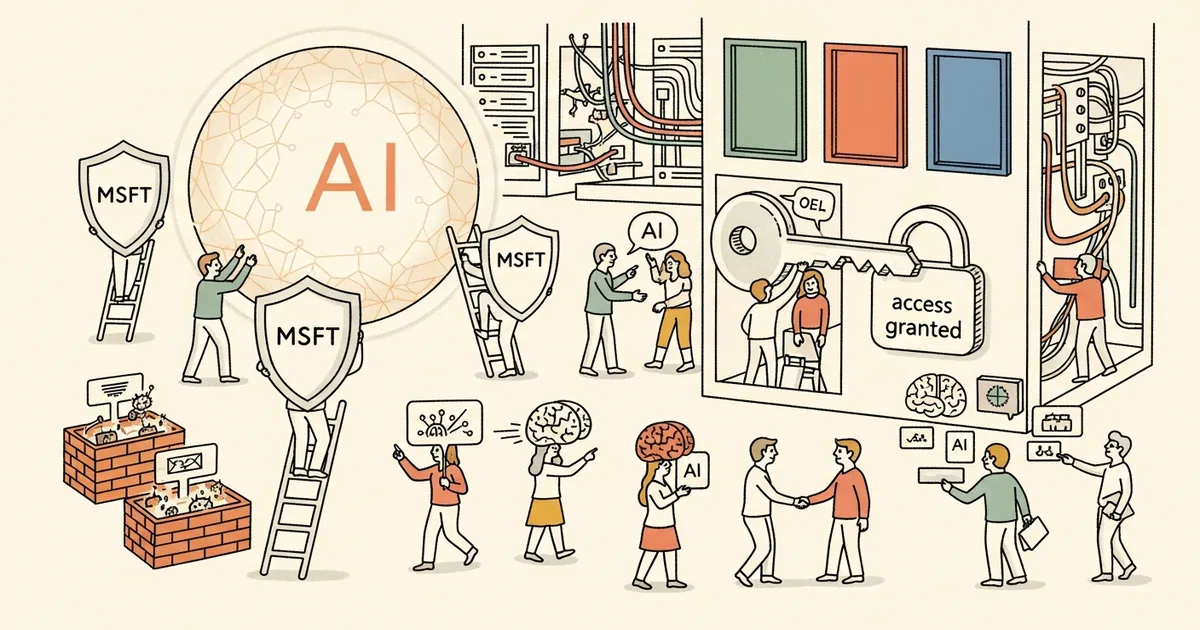
- OpenAI launched “Trusted Access for Cyber,” giving Microsoft preferential access to its most capable AI models for use in security operations.
- Microsoft will commit its full cybersecurity division to defending OpenAI’s models, infrastructure, and shared enterprise customers in exchange.
- The program is framed under Microsoft’s Secure Future Initiative, with explicit scope extending to open-source software hardening.
- The announcement arrives as Anthropic’s Mythos model — which claims autonomous vulnerability discovery — faces partial validation and industry skepticism.
What Happened
OpenAI and Microsoft announced a deepened cybersecurity partnership on April 24, 2026, built around a new initiative called “Trusted Access for Cyber.” Under the program, OpenAI will give Microsoft preferential access to its most capable AI models specifically for security work, according to reporting by The Decoder. In exchange, Microsoft is committing its full cybersecurity division to actively protect OpenAI’s models, underlying infrastructure, and enterprise customers shared between the two companies.
OpenAI stated in the announcement: “AI models are becoming much more capable in cybersecurity, and that progress raises the bar for everyone.”
Why It Matters
The deal formalizes cybersecurity as a bilateral defense obligation between a frontier AI lab and its largest infrastructure partner, rather than a standard vendor relationship. Microsoft’s Secure Future Initiative (SFI) — established in 2023 under Microsoft Vice Chair and President Brad Smith following congressional scrutiny over a series of significant breaches, including a Chinese state-sponsored intrusion into Microsoft Exchange Online — provides the institutional and operational framework for the new program.
The announcement arrives amid a contested industry debate over what large language models can actually do in offensive security contexts. Anthropic recently attracted attention with Mythos, a model the company claims can autonomously identify and exploit security vulnerabilities. An early study supported that claim only in part, and critics argued existing open-source models had demonstrated broadly similar capabilities, characterizing Anthropic’s framing as partly marketing.
Technical Details
“Trusted Access for Cyber” is structured as a mutual capability exchange rather than a standard licensing arrangement. Microsoft gains access to OpenAI’s frontier model tier — described as the company’s “most capable” — for security-specific applications. In return, Microsoft’s cybersecurity team assumes active defensive responsibilities over OpenAI’s model stack, inference infrastructure, and shared enterprise deployments. The announcement explicitly extended the program’s scope to open-source software hardening as a component of the broader SFI mission.
Neither company disclosed specific model names, version numbers, capability benchmarks, or how frontier model access will be technically delivered into Microsoft’s security tooling stack. No quantitative claims about threat detection improvement rates or incident response reductions were included in the announcement, making independent evaluation of the program’s expected security outcomes currently not possible.
Who’s Affected
Enterprise customers deployed across both Microsoft Azure and OpenAI’s API are most directly positioned to benefit, as the program is framed around delivering a unified security posture across both platforms. Security operations teams currently using Microsoft Defender, Sentinel, or Copilot for Security may eventually see OpenAI’s frontier models integrated into detection and response workflows, though neither company specified product-level integrations or deployment timelines. Cybersecurity vendors building AI-native tools on OpenAI’s API will now compete against a partnership that vertically combines frontier model access with Microsoft’s enterprise security infrastructure and SFI funding commitments.
What’s Next
Neither OpenAI nor Microsoft provided a public roadmap specifying how the Trusted Access for Cyber program will be structured, measured, or expanded. The absence of technical specifics leaves open whether “most capable models” refers to current production releases, preview systems, or capabilities not yet publicly available. As the broader industry debate over autonomous AI security capabilities continues — with Anthropic’s Mythos claims still being assessed by independent researchers — both companies are expected to provide additional detail as the program moves into active deployment.