- OpenAI has discontinued its standalone Codex coding model for the second time, integrating its capabilities into GPT-5.5.
- Romain Huet, OpenAI’s Head of Developer Experience, confirmed that GPT-5.3—released in early February 2026—was the final standalone Codex release.
- GPT-5.5 uses fewer tokens than GPT-5.4 on equivalent Codex tasks, though API pricing still rises approximately 20 percent.
- The Codex AI agent software, launched alongside Codex-1 in May 2025, remains under active development and is not being discontinued.
What Happened
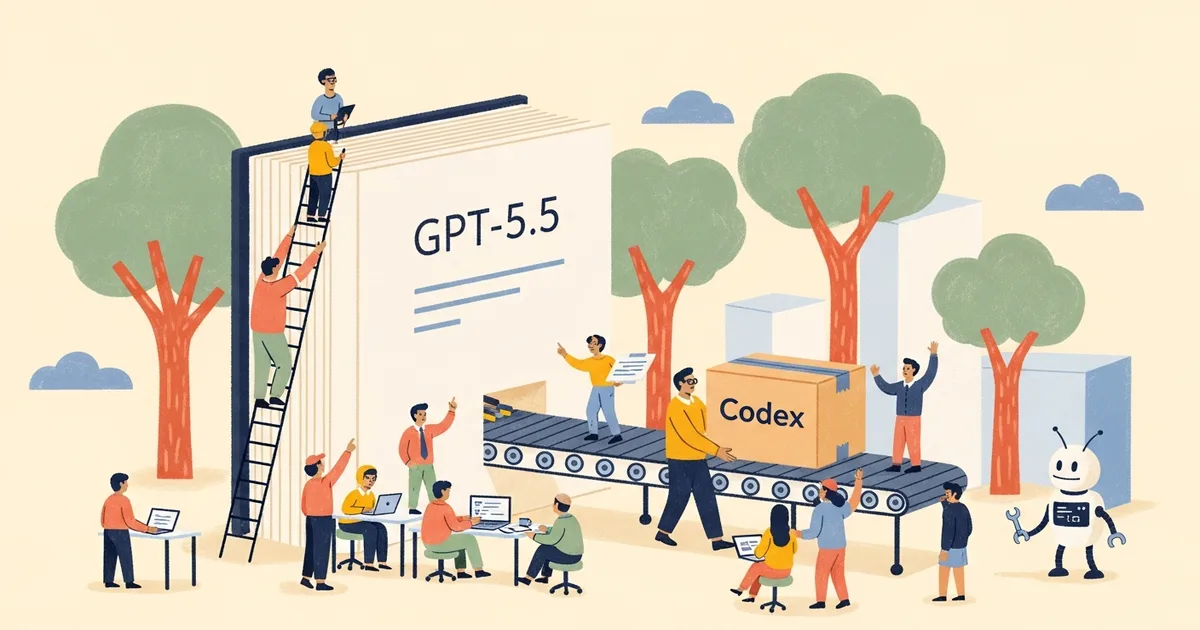
OpenAI has retired its dedicated Codex coding model line, folding its programming capabilities into GPT-5.5, according to reporting by The Decoder. Romain Huet, OpenAI’s Head of Developer Experience, confirmed the change: GPT-5.4 was the version where Codex was absorbed into the main model family, meaning GPT-5.3—which shipped in early February 2026—stands as the final standalone Codex release. There is no longer a dedicated coding model line separate from OpenAI’s primary GPT series.
Why It Matters
This is the second time OpenAI has discontinued a dedicated Codex model. The company originally shut down its first Codex model in 2023, citing a preference for consolidating coding capabilities into general-purpose language models. OpenAI reversed that position in May 2025, relaunching the brand as Codex-1—built on the o3 architecture—paired with a dedicated Codex AI agent software platform designed for autonomous, multi-step programming tasks.
The repeated cycle of specialization and consolidation reflects a broader unresolved question in the industry: whether vertical models tuned specifically for code offer durable advantages over general-purpose models as those models continue to scale. OpenAI’s decision to fold Codex back into the main family suggests the company believes, for now, that GPT-series scaling has closed the gap.
Technical Details
Huet stated that GPT-5.5 delivers “big gains in agentic coding—where AI handles programming tasks on its own—plus better computer use and stronger performance on general tasks.” These are OpenAI’s stated claims; no independently benchmarked results from a peer-reviewed venue have been published to corroborate them.
On resource efficiency, OpenAI says GPT-5.5 consumes fewer tokens than GPT-5.4 on equivalent Codex tasks, meaning the same coding outputs require less context processing. Despite that efficiency improvement, API pricing for GPT-5.5 is approximately 20 percent higher than GPT-5.4 when measured on comparable workloads—so the efficiency gains do not offset the price increase for most users. The Codex AI agent software—the separate agentic coding platform launched in May 2025—is not part of this consolidation and continues development as a distinct product.
Who’s Affected
Developers and enterprises using the dedicated Codex API endpoint for high-volume automated coding tasks face a mandatory migration to GPT-5.5, along with the associated cost increase. The roughly 20 percent price rise will have the most impact on teams running large-scale code generation, automated review pipelines, or continuous integration workflows that make frequent API calls. Organizations already using the Codex AI agent software as a separate agentic layer are not directly affected by the model consolidation.
What’s Next
Huet described the Codex AI agent software as a continued key development priority for OpenAI alongside ChatGPT, signaling the company intends to maintain a separate agentic coding product even without a distinct underlying Codex model. OpenAI has not publicly specified a deprecation timeline for existing Codex API endpoints, nor whether GPT-5.5 will be accessible through legacy Codex endpoints. Developers should track OpenAI’s official API changelog and deprecation notices for migration deadlines and endpoint continuity details.