Key Takeaways
- Netflix released its first public AI model, VOID (Video Object and Interaction Deletion), on Hugging Face in early April 2026.
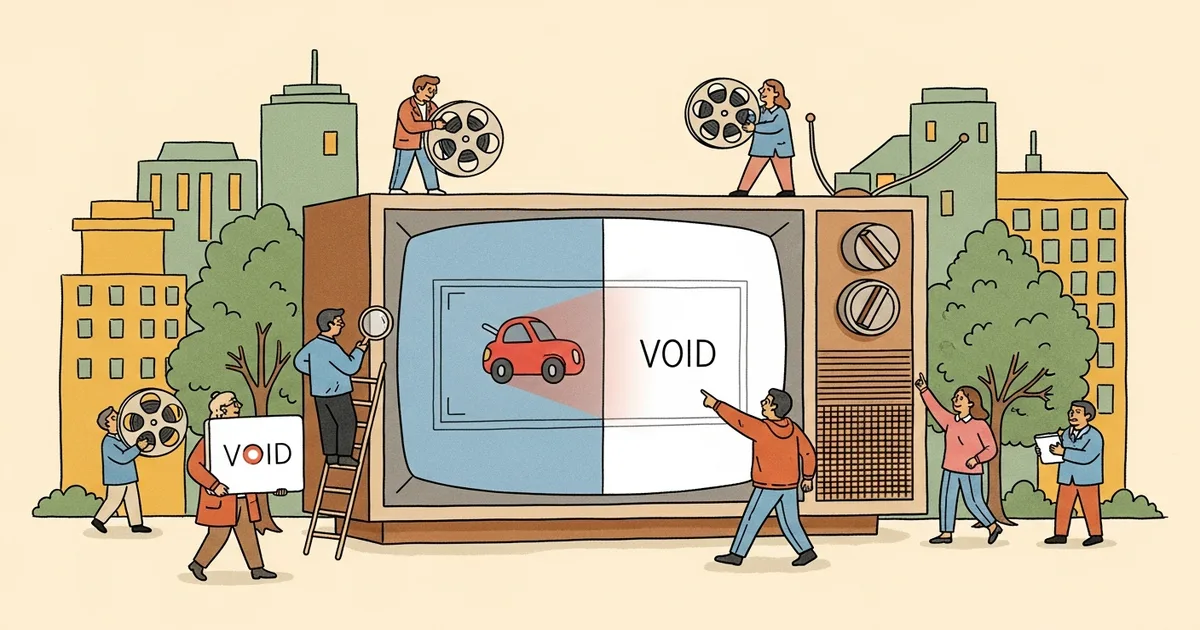
- VOID removes objects from video footage along with their associated interactions, going beyond simple inpainting by handling shadows, reflections, and physical effects.
- The model is available on Hugging Face with source code on GitHub and a live demo hosted on Hugging Face Spaces.
- The release reached 1,364 upvotes on the r/LocalLLaMA subreddit, reflecting strong community interest in Netflix’s entry into open-source AI.
What Happened
Netflix, the global streaming platform with over 300 million subscribers, published its first public AI model to Hugging Face in early April 2026. The model, called VOID (Video Object and Interaction Deletion), is designed to remove objects from video footage while also erasing their associated interactions — including shadows, reflections, and physical disturbances caused by the removed object.
The release marks a notable shift for Netflix, which has historically kept its AI and machine learning research internal. The model’s source code is available on GitHub, and a live demo is hosted on Hugging Face Spaces under the account of Sam Motamed, who appears to be one of the project’s developers.
Why It Matters
Netflix entering the open-source AI model space is significant for two reasons. First, it signals that even companies with massive proprietary content libraries see strategic value in public model releases for research credibility, talent recruitment, and community goodwill. Second, VOID addresses a genuine pain point in video production: removing unwanted objects from footage is one of the most labor-intensive tasks in post-production, often requiring frame-by-frame manual work by VFX artists.
The “interaction deletion” component is what distinguishes VOID from existing video inpainting tools. Standard inpainting fills in the area where an object was removed, but does not account for the object’s effect on its surrounding environment. VOID handles the full cascade — if you remove a ball rolling across sand, VOID also removes the trail it left behind. If you remove a person walking through a puddle, the splashes disappear too.
Technical Details
VOID operates as a video-to-video model that takes input footage and a mask identifying the object to remove. The model then generates output video with the object and its interactions erased, filling the affected areas with contextually appropriate content that maintains temporal consistency across frames.
The model weights are hosted on Hugging Face under the netflix/void-model repository, and the inference code is available on GitHub at Netflix/void-model. The Hugging Face Spaces demo allows users to test the model on their own video clips without local installation, lowering the barrier to evaluation.
The interaction deletion capability requires the model to understand not just what an object looks like, but how it affects its environment physically. This involves reasoning about lighting (shadows cast by the object), surface interactions (footprints, tire tracks, water displacement), and reflections in nearby surfaces. Handling these secondary effects across multiple video frames adds complexity well beyond single-frame inpainting.
Specific architectural details, training data composition, and formal benchmark comparisons were not included in the initial release materials as of April 4, 2026. Netflix has not published a formal research paper alongside the model, though the GitHub repository may contain additional technical documentation.
Who’s Affected
Video editors, VFX artists, and post-production studios stand to benefit most directly. Removing objects from video — whether stray equipment visible in a shot, logos requiring legal clearance, or unwanted background elements — is a routine but time-consuming task in professional video production. An AI model that handles both the object and its environmental interactions could reduce hours of manual rotoscoping, compositing, and touch-up work per project.
The open-source AI community, particularly users active on r/LocalLLaMA where the announcement received 1,364 upvotes, is interested in running the model locally for personal and commercial video editing projects. Independent filmmakers and content creators working without VFX budgets could benefit disproportionately from free access to this capability.
What’s Next
Netflix’s decision to release VOID publicly may indicate future open-source model releases from the company’s research divisions, potentially covering other video processing tasks like scene classification, content-aware editing, or automated color grading. For the video AI space, VOID sets a higher standard for what object removal tools should include — not just erasure of the target, but comprehensive cleanup of all secondary effects. Competing tools from Adobe, Runway, and other video AI companies will likely need to match this interaction-aware capability to remain competitive.