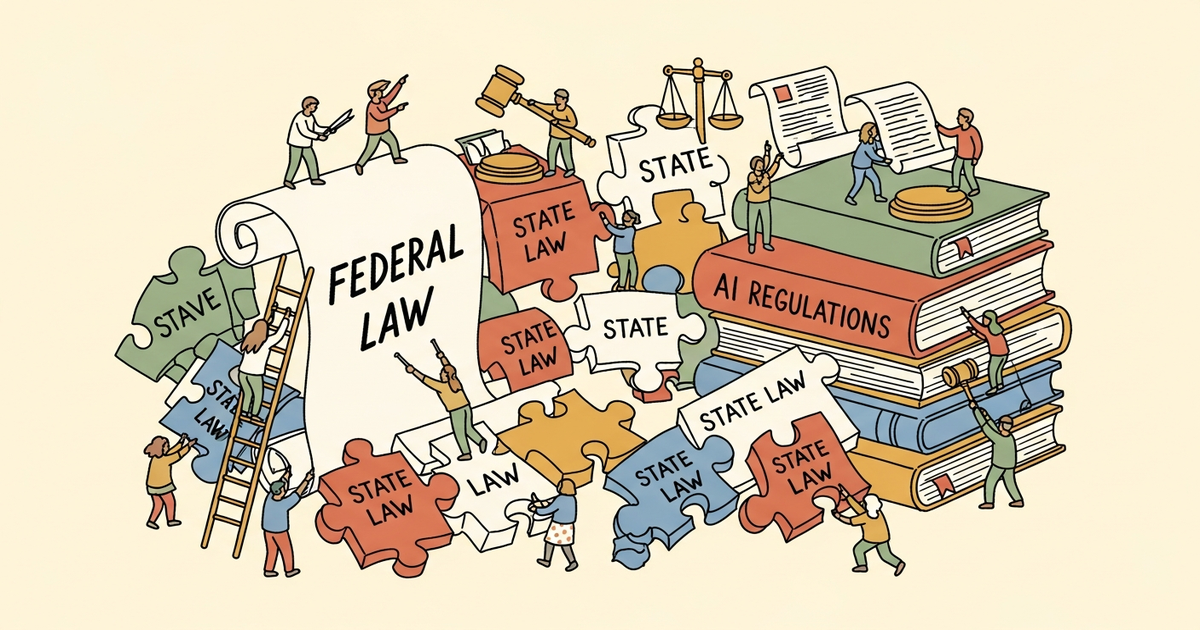
- The White House released a National Policy Framework for AI on March 20, 2026, calling on Congress to preempt state AI laws with a unified federal regulatory approach.
- A December 2025 executive order created a DOJ task force to challenge state AI regulations deemed inconsistent with federal policy, though legal scholars note executive orders alone cannot preempt state law.
- The framework proposes regulatory sandboxes with 10-year exemptions, opposes open-ended liability for AI companies, and carves out exceptions for child safety and data center infrastructure.
- Congressional leadership from both chambers expressed support, while critics warned the approach prioritizes industry interests over public accountability.
What Happened
On March 20, 2026, the White House released a four-page National Policy Framework for Artificial Intelligence, outlining legislative recommendations for Congress to establish federal control over AI regulation. White House science and technology adviser Michael Kratsios and Special Adviser for AI and Crypto David Sacks jointly presented the framework, which calls for broad federal preemption of existing state AI laws.
The framework builds on President Trump’s December 11, 2025 executive order that directed the Attorney General to establish an AI litigation task force. That task force is charged with challenging state AI laws deemed inconsistent with federal policy, including on grounds of unconstitutional regulation of interstate commerce.
Why It Matters
At least a dozen states have enacted or proposed AI-specific legislation covering areas from algorithmic discrimination to deepfake disclosure. The patchwork of state rules creates compliance challenges for AI companies operating nationally, but also reflects legitimate local concerns about AI risks that differ across jurisdictions.
The federal framework takes what it describes as a “light-touch” regulatory approach, relying on existing agencies rather than creating a new AI regulatory body. Brad Carson, president of Americans for Responsible Innovation, warned the approach would give “tech companies another chance for harmful products with no accountability.”
The tension between innovation-friendly federal policy and protective state regulation mirrors historical battles over financial regulation, environmental rules, and data privacy. In those precedents, federal preemption sometimes weakened consumer protections that states had implemented in response to local harms.
Technical Details
The framework addresses seven policy areas: children’s safety through parental controls and age assurance, community effects from AI deployment, copyright protections via a collective licensing system for negotiations between rights holders and AI providers, prevention of indirect government censorship, federal regulatory sandboxes, workforce training, and state law preemption.
Regulatory sandboxes would allow companies to operate under 10-year exemptions from certain federal rules while developing AI products. The framework explicitly opposes “open-ended liability” for AI companies, a position that would limit legal exposure for model developers and deployers.
Certain areas are excluded from preemption: child safety regulations, AI compute and data center infrastructure rules (except for streamlined permitting), and state government procurement and use of AI systems. The framework also proposes deepfake protections with carve-outs for satire and news content, and calls for streamlined data center permitting while protecting residential ratepayers from increased energy costs.
Who’s Affected
AI companies operating across multiple states would benefit from a single federal standard replacing fragmented state requirements. State attorneys general and legislators who have crafted AI-specific protections face potential rollback of their regulatory authority. Consumers in states with strong AI protections, such as those requiring algorithmic impact assessments or bias audits, could see those safeguards preempted.
House Speaker Mike Johnson, Majority Leader Steve Scalise, and committee chairs Brett Guthrie, Jim Jordan, and Brian Babin offered immediate support. Senator Marsha Blackburn said she would seek “bipartisan support” while developing complementary legislation.
What’s Next
Legal scholars have noted that executive orders cannot unilaterally preempt state laws under the Supremacy Clause, meaning Congress must pass legislation for the framework to have binding force. Congress has already declined to include comprehensive AI preemption provisions in both the One Big Beautiful Bill Act and the National Defense Authorization Act, suggesting the path to federal legislation remains uncertain.
The December 2025 executive order directed the Secretary of Commerce to publish an evaluation by March 11, 2026 identifying burdensome state AI laws that merit referral to the DOJ task force. Whether any actual legal challenges materialize against specific state laws will determine how much practical pressure the executive branch can exert without congressional action.
Related Reading
- White House Releases AI Legislative Framework Calling for Federal Preemption of State Laws
- California sets its own AI rules for state contractors, pushing back against federal policy
- White House Releases Federal AI Framework, Urges Congress Against Heavy Regulation
- Japan AI Promotion Act: Innovation-First Regulation Without Penalties
- Decoding the 2026 White House AI Blueprint: Federal AI Policy Takes Shape