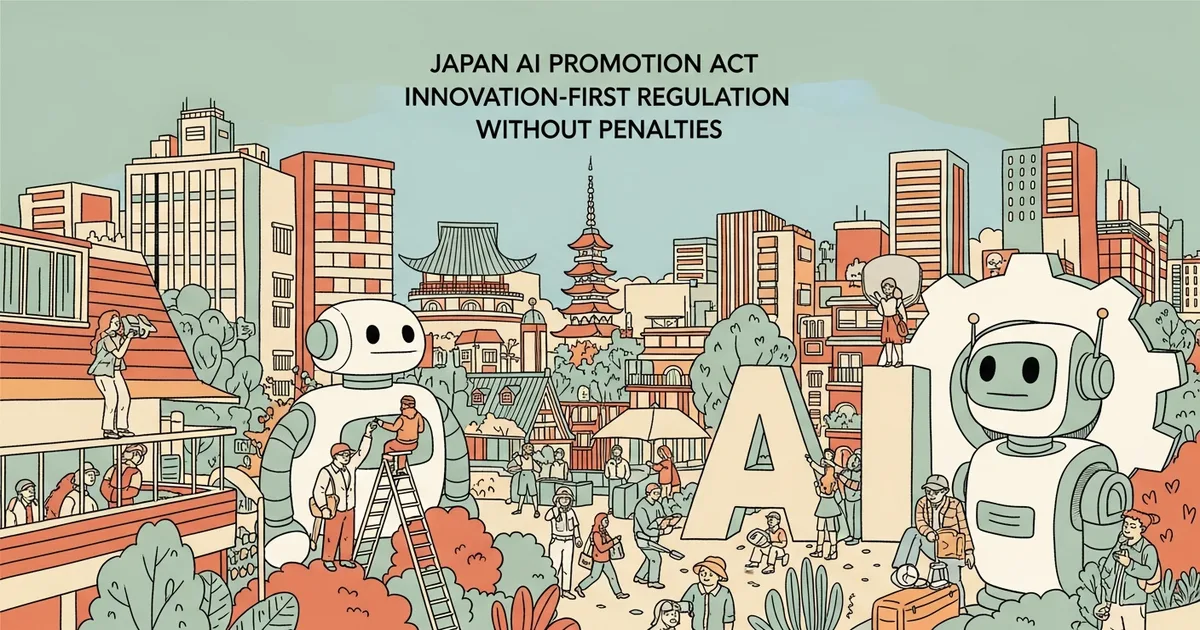
- Japan’s Diet passed the AI Promotion Act on May 28, 2025, making it the country’s first dedicated AI legislation.
- The law contains no financial penalties, no prohibited AI use cases, and no conformity assessments — enforcement relies on public disclosure of non-compliance.
- An AI Strategy Headquarters under the Prime Minister’s Office now coordinates national AI policy and drafts the AI Basic Plan.
- Japan is positioning itself as the “world’s most AI-friendly country” amid concerns about lagging private AI investment, where it currently ranks 12th globally.
What Happened
On May 28, 2025, Japan’s National Diet approved the Act on the Promotion of Research and Development and Utilization of Artificial Intelligence-Related Technology, commonly known as the AI Promotion Act. The legislation passed with broad bipartisan support. Most provisions took effect on June 4, 2025, with chapters establishing the AI Strategy Headquarters and the AI Basic Plan entering into force on September 1, 2025.
The legislation makes Japan one of the first major economies in the Asia-Pacific region to enact a dedicated AI law. However, unlike the European Union’s AI Act, Japan’s approach deliberately avoids prescriptive rules, product classifications, or punitive measures of any kind.
Why It Matters
Japan ranks 12th globally for private AI investment, a position the government views as a strategic vulnerability in an increasingly AI-driven global economy. The AI Promotion Act is designed to reverse that trend by signaling that Japan will not burden AI developers with heavy compliance costs or regulatory uncertainty.
The law implements Prime Minister Shigeru Ishiba’s stated goal of making Japan the “world’s most AI-friendly country.” According to the Future of Privacy Forum’s analysis, the Act “does not impose direct fines or penalties” and instead relies on authorities issuing advice, requesting information, or publicly disclosing non-compliance.
This represents a deliberate contrast with the EU’s risk-based framework, which includes fines of up to 35 million euros or 7% of global annual turnover for the most serious violations. Japan’s government calculated that a permissive regulatory environment would attract more investment than strict rules would protect against harm.
Technical Details
The Act rests on four core principles: treating AI as a strategic national asset, promoting industrial adoption across the economy, mitigating risks through transparency and information sharing, and actively contributing to international AI governance norms.
Japan’s regulatory framework operates on three distinct layers. The AI Promotion Act sets the strategic direction and institutional architecture. The 2024 AI Business Operator Guidelines provide sector-specific voluntary standards for companies developing or deploying AI systems. Existing statutes — including the Act on the Protection of Personal Information, the Copyright Act, and sector-specific regulations in finance, healthcare, and telecommunications — supply the actual enforcement mechanisms and legal penalties.
Obligations under the Promotion Act are classified as “duties to endeavor,” a well-established category in Japanese law that carries no legal penalties for non-compliance. Authorities can request reports from AI operators, offer administrative guidance, and publicly name organizations that fail to meet established standards, but they cannot impose fines or sanctions under this law alone. Violations of existing laws, however, remain fully enforceable with their own penalty structures.
The AI Strategy Headquarters, placed directly under the Prime Minister’s Office, serves as the central coordinating body for all AI-related policy. It is tasked with drafting and periodically updating the AI Basic Plan, which sets national investment priorities, research targets, and workforce development goals.
Who’s Affected
All AI developers and deployers operating in Japan fall within the Act’s scope, but the practical impact is limited given the absence of binding requirements. Companies already complying with Japan’s privacy, intellectual property, and consumer protection laws face minimal additional obligations under the new legislation.
Foreign AI companies entering the Japanese market will find fewer regulatory barriers compared to the EU or South Korea, where mandatory compliance frameworks impose concrete costs. Domestic startups, universities, and research institutions stand to benefit from increased government funding channeled through the AI Basic Plan’s investment priorities.
What’s Next
The AI Strategy Headquarters is expected to publish the first comprehensive AI Basic Plan in 2026, which will set concrete investment targets, research priorities, and benchmarks for measuring Japan’s progress in AI adoption. Whether Japan’s innovation-first approach attracts the private investment it seeks is unclear — the country’s AI adoption rates have historically lagged behind the United States, China, and the United Kingdom despite strong academic research output in robotics and machine learning.
Related Reading
- US AI Regulation 2026: Federal Preemption Battles and State Law Patchwork
- India AI Governance: Pro-Innovation Guidelines Without Binding Legislation
- China AI Regulation: The World’s Most Layered AI Governance Framework
- NVIDIA Tested Whether GPT-5 Could Control a Robot — It Failed at Every Basic Task Without Human Help
- Intel and SambaNova Just Built an AI Inference Platform Without NVIDIA — The CPU Comeback Is Real