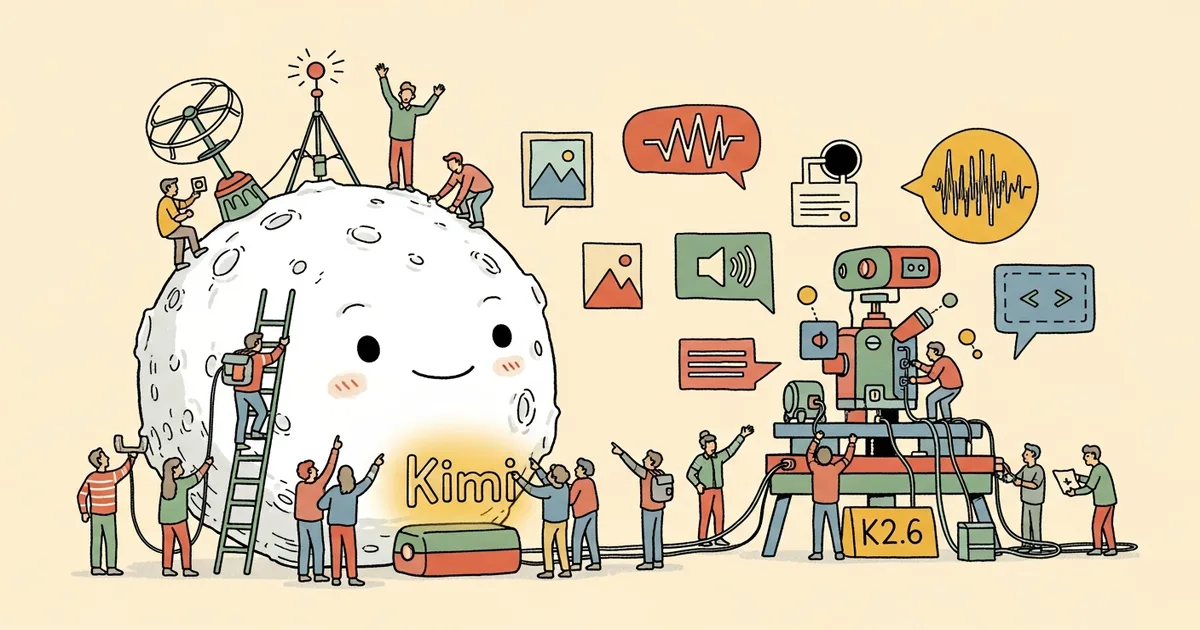
- Moonshot AI open-sourced Kimi K2.6 on April 20, 2026, publishing model weights on Hugging Face under a Modified MIT License.
- The model uses a Mixture-of-Experts architecture with 1 trillion total parameters and 32 billion activated per forward pass, with 384 experts and 8 selected per token.
- K2.6 supports agent swarm configurations scaling to 300 simultaneous sub-agents and up to 4,000 coordinated execution steps.
- A native MoonViT vision encoder with 400 million parameters and a 256K-token context window are included in the base architecture.
What Happened
Moonshot AI, the Beijing-based lab behind the Kimi assistant, open-sourced Kimi K2.6 on April 20, 2026, releasing model weights on Hugging Face under a Modified MIT License. The model is built for autonomous software engineering workloads — specifically long-horizon coding pipelines, front-end generation from natural language prompts, and massively parallel agent swarms. According to Moonshot AI’s release documentation, the architecture enables "a new open ecosystem where humans and agents from any device collaborate on the same task." The model is accessible via Kimi.com, the Kimi mobile app, the company’s API, and the Kimi Code CLI.
Why It Matters
The release adds a significant open-weights option to a market where agentic coding models have largely been available only through proprietary APIs. Competing systems from Anthropic, Google, and OpenAI require API access with per-token billing; K2.6’s Modified MIT License allows direct deployment from downloaded weights. The 300-sub-agent swarm ceiling and 4,000-step execution depth place it above most publicly documented open-weight agent frameworks, which have generally demonstrated coordination in the tens-of-agents range. Moonshot AI’s earlier Kimi K1.5 and K2 releases established the lab’s trajectory in long-context reasoning before this agentic-focused iteration.
Technical Details
Kimi K2.6 is a Mixture-of-Experts model with 1 trillion total parameters, of which 32 billion are active per forward pass. Its expert pool contains 384 specialists, with 8 selected per token at inference time alongside one permanently active shared expert. The model has 61 transformer layers — including one dense layer — an attention hidden dimension of 7,168, a MoE hidden dimension of 2,048 per expert, and 64 attention heads using Multi-head Latent Attention (MLA) with SwiGLU activations.
Vision capability is integrated architecturally via a MoonViT encoder carrying 400 million parameters, supporting image and video input without auxiliary adapter layers. The vocabulary spans 160,000 tokens and the context window reaches 256,000 tokens. Moonshot AI’s documentation specifies vLLM as the recommended inference runtime for production deployments.
Who’s Affected
Software engineering teams running autonomous coding pipelines are the direct audience: K2.6 is optimized for tasks requiring parallel sub-agent decomposition across long execution horizons. Enterprise operators evaluating alternatives to proprietary agentic coding tools — including GitHub Copilot Workspace, Cursor, and Devin — gain an open-weight option they can self-host or fine-tune. Hugging Face platform users and independent researchers can access the weights immediately, though commercial deployers will need to review the specific terms of the Modified MIT License before production use.
What’s Next
Moonshot AI has not announced a roadmap for follow-on releases or supervised fine-tune variants of K2.6. Independent benchmark results on SWE-bench Verified and similar agent-task evaluations are expected to appear shortly following the public weight release. The availability of a Kimi Code CLI suggests the company is pursuing developer tooling as a primary distribution channel alongside the web and API products.