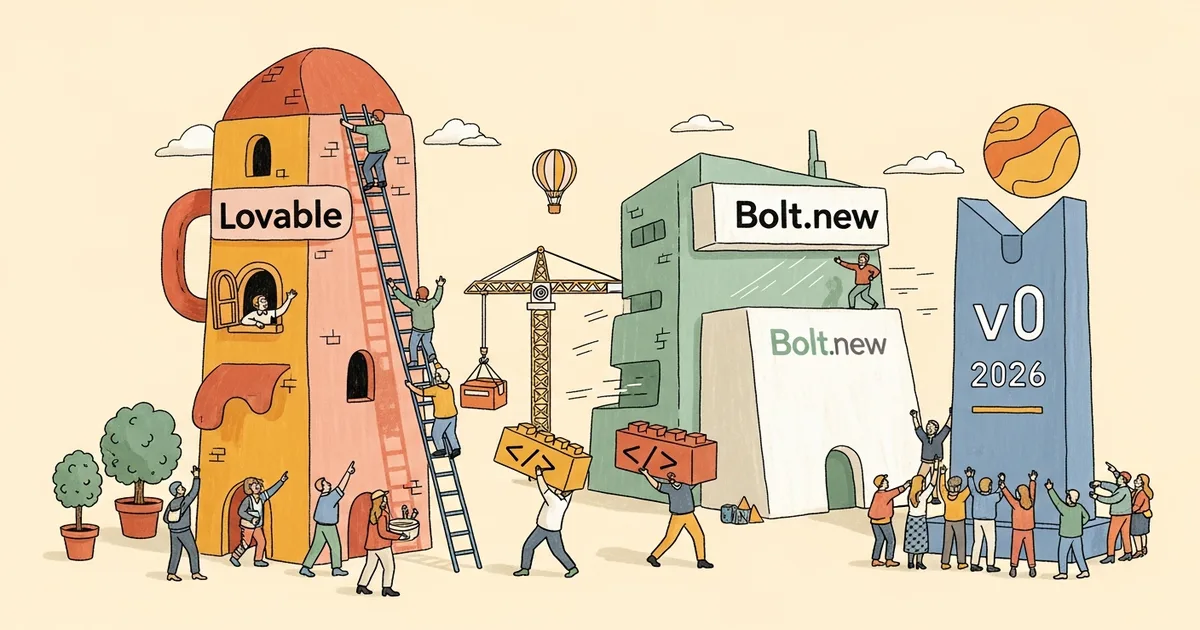
In April 2026, the lovable vs bolt.new vs v0 question has a concrete answer — they solve different problems, and choosing wrong costs days of rework, not hours. After evaluating all three across 12 feature dimensions, MegaOne AI’s finding is direct: Lovable wins on full-stack coherence, Bolt.new on framework flexibility, and v0 by Vercel on enterprise UI quality. None is the only tool you need. All three together cost less per month than a single hour of senior frontend engineering.
MegaOne AI tracks all three platforms across 139+ AI tools in 17 categories. Collectively, they represent the center of gravity in the vibe-coding movement — the term Andrej Karpathy popularized in early 2025 for describing software by intent rather than specification. Tools like Emergent’s Wingman demonstrated early that non-engineers could ship functional apps this way. Lovable, Bolt.new, and v0 have since competed to own that workflow at different ends of the technical spectrum.
What Lovable, Bolt.new, and v0 Each Actually Solve
Lovable (formerly GPT Engineer) is a Swedish AI full-stack builder backed by Creandum, which led the company’s $15 million Series A in late 2024. It reported over 1 million registered users within its first quarter post-relaunch, and secondary market valuations have placed the company well above the unicorn threshold. Its core proposition: describe a full-stack web application in natural language, and Lovable produces a running app — connected to a real Postgres database via Supabase, with authentication configured — in a single session.
Bolt.new is StackBlitz’s AI builder, launched in September 2024. It runs on WebContainers — StackBlitz’s technology that executes Node.js directly in the browser, requiring no server-side environment. Bolt’s differentiator is framework breadth: React, Next.js, Vue, Svelte, Astro, and Remix are all supported. It crossed 1 million users in its first month according to StackBlitz’s published figures, making it one of the fastest developer tool launches on record.
v0 by Vercel launched in October 2023 as a component generator and has since evolved into a full application builder. It defaults to Next.js App Router with shadcn/ui components and Tailwind CSS, deploying natively to Vercel. Its enterprise credentials are the strongest of the three: team dashboards, SSO, and Vercel’s global edge network come with the package.
Frontend Output Quality
v0 produces the most polished frontend output of the three by a consistent margin. Its default component library — shadcn/ui with Radix UI primitives underneath — outputs accessible, composable components that require substantially less post-generation cleanup than Lovable or Bolt equivalents. Vercel’s published comparisons cite approximately 40% fewer manual corrections before production deployment versus baseline AI generation.
Lovable’s output improved meaningfully with its 2.0 release in January 2026, which introduced design system themes. The default aesthetic is still recognizably AI-generated — functional grid layouts, conservative typography — but prompt specificity and theme selection can push quality significantly higher. For founders who care about a working product over pixel-perfect design, Lovable is adequate. For consumer-facing products with brand requirements, expect a design pass.
Bolt.new’s frontend quality is framework-dependent. React + Vite outputs are clean and consistent. Next.js outputs have historically lagged in App Router adoption, a gap that narrowed through 2025 but has not fully closed. Vue and Svelte outputs are solid but represent a smaller share of Bolt’s tested surface area.
Backend and Database Handling
Lovable’s Supabase integration is the most significant technical advantage any of these platforms holds. A single prompt — “build a subscription tracking tool with user accounts, a dashboard showing active subscriptions and renewal dates, and email alerts” — produces a working Postgres schema, row-level security policies, Supabase Auth configuration, and a connected React UI. No environment variable setup. No separate schema migration. No manual configuration step.
Bolt.new supports database connections but does not auto-provision infrastructure. You supply connection strings to an existing Supabase, Turso, or PlanetScale instance; the AI generates queries and ORM setup, but it doesn’t create the database. Developers who want schema control will prefer this. Founders who want a working product will find it a meaningful friction point.
v0 is weakest on backend integration. It generates API routes, server actions, and middleware, but database setup is manual. Vercel Postgres (Neon-powered) integrates most smoothly, but provisioning is not automated. v0 is best understood as a UI-first tool with server-side awareness — not a full-stack generator in the way Lovable is.
Deployment and Hosting
Each platform has a natural deployment partner, and choosing a tool also means choosing a hosting trajectory:
- Lovable — Lovable’s own managed hosting (custom domains on Starter+) or GitHub export to any static or Node.js host
- Bolt.new — Netlify (primary integration), Cloudflare Pages, or ZIP download for self-hosting
- v0 — Vercel (zero-config, native) or GitHub export to any Next.js-compatible host
Vercel’s deployment infrastructure is the most mature. Edge functions, ISR, Vercel Analytics, and Speed Insights are all available inside the same dashboard. For teams already on Vercel Pro or Enterprise, v0 is effectively infrastructure they’ve already paid for — the total cost of a v0-built app in production is lower than it appears on the pricing page.
Lovable removed custom domain support from its free tier in Q3 2025, which generated significant community backlash on X and GitHub Discussions. The free tier now produces preview URLs only. Custom domains require the $20/month Starter plan minimum.
Feature and Pricing Comparison
| Feature | Lovable | Bolt.new | v0 (Vercel) |
|---|---|---|---|
| Primary framework | React + Vite | React, Next.js, Vue, Svelte, Astro, Remix | Next.js (App Router) |
| React Native / mobile | No | Expo (experimental) | No |
| Database integration | Supabase (auto-provisioned) | BYO database, manual config | Vercel Postgres (semi-auto) |
| Authentication | Supabase Auth (automatic) | Manual wiring required | NextAuth / Clerk (manual) |
| Deployment target | Lovable hosting / GitHub export | Netlify / Cloudflare / download | Vercel (native) |
| Team features | Shared projects on Pro+ | Limited, no team dashboard | Full Vercel team management |
| Enterprise SSO | No | No | Yes (Vercel Enterprise) |
| Error recovery | Auto-retry on build fail | Live error overlay in browser | Integrated Vercel build logs |
| One-shot app quality | High (full-stack coherent) | Medium–High (framework-dependent) | High (UI-focused) |
| Iteration speed | 1–3 min per revision | Sub-minute (in-browser) | 1–2 min per revision |
| Export options | GitHub, ZIP | Download, GitHub, Netlify deploy | GitHub, Vercel deploy |
| Custom domain (free tier) | No (Starter+ required) | Yes | With Vercel Hobby plan |
| Free tier | 5 credits/day | 150K tokens/day | 200 credits/month |
| Paid plan (individual) | $20/mo (100 credits) or $50/mo (unlimited) | $20/mo (~10M tokens) | $20/mo (~5,000 credits) |
| Team / enterprise pricing | $50/mo team plan | Custom | $20/member/mo (Vercel Team) |
On pricing mechanics: Bolt.new’s token-based model is the most granular but hardest to predict. Community reports on X suggest complex, multi-file applications with real backend logic exhaust the $20/month allocation within 8–12 projects. Lovable’s credit system is more predictable: one full-stack app generation typically costs 3–8 credits depending on complexity. v0’s credits are least transparent — simple components cost 1 credit, full app generations consume 10–20.
Real-World Projects and Traction
Lovable’s public showcase concentrates in SaaS and internal tooling: subscription management dashboards, admin panels, customer portals, and lightweight CRMs. The platform’s template library exceeded 3,000 published projects in early 2026 — a meaningful signal of what builders are actually shipping, not just prototyping.
Bolt.new established itself as the default tool for competitive hackathons. StackBlitz reported that Bolt-generated projects placed in 14 of the top 25 finalist slots at major 2025 hackathons including ETHGlobal Bangkok. Framework flexibility is the primary driver: judges frequently specify tech stacks, and Bolt’s ability to switch frameworks without starting a new project eliminated a common friction point.
v0’s enterprise traction is the most commercially significant. Vercel’s 2025 annual report cited v0 adoption by major engineering organizations for design system acceleration — component libraries, documentation sites, and UI prototypes that previously required dedicated frontend resourcing. This positions v0 less as a “ship an app today” tool and more as a professional multiplier for engineering teams at scale.
The broader context: this segmentation mirrors patterns across every AI creative vertical. In AI video, ElevenLabs, HeyGen, and Synthesia occupy similarly distinct tiers — one winning on output quality, one on flexibility, one on enterprise credibility. The same winner-take-most pressure is forming here. The infrastructure layer enabling all three continues to scale in parallel: Nebius’s $10 billion AI data center investment in Finland illustrates where compute capacity for these workloads is being concentrated.
The vibe-coding boom that accelerated all three has not been without critics. The Humans First movement has raised pointed questions about software quality when generation speed outpaces understanding of what is generated. It is a legitimate critique — and one that actually favors v0 over Lovable or Bolt, since v0’s output is closest to what a senior engineer would write from scratch.
Verdict: Which to Choose
Choose Lovable if you are a non-technical founder or PM who needs a full-stack web app — database, authentication, and UI — running today, not as a static demo but as a connected product. Its automatic Supabase provisioning is the clearest differentiator in this category.
Choose Bolt.new if you are a developer who wants maximum framework flexibility and in-browser iteration without local environment setup. Best for hackathons, client demos, and situations with specific tech stack constraints.
Choose v0 if you are building on Next.js, you care about UI quality and accessibility at a production level, or you are already inside the Vercel ecosystem. The output quality gap is real, and for consumer-facing applications with brand standards, it matters.
The $60/month combined cost of all three Pro plans is lower than one hour of senior frontend engineering time in most markets. For serious builders, using all three at different stages — Lovable to validate, Bolt.new to iterate on specific interactions, v0 to produce the polished UI layer — is the most pragmatic approach available in April 2026.
FAQ
Can Lovable build mobile apps?
No. Lovable generates web applications using React + Vite. React Native, iOS, and Android targets are not supported as of April 2026.
Is Bolt.new’s free tier sufficient for real projects?
For simple, single-page applications, yes. Multi-page apps with backend logic typically exhaust the 150K token/day free tier within two to three sessions.
Does v0 work without a Vercel account?
Code generation works without Vercel. Deployment requires either a Vercel account or exporting the project to GitHub and deploying elsewhere. GitHub export is available on all paid tiers.
Which tool is best for non-technical users?
Lovable, by a clear margin. Its automatic Supabase provisioning means the generated app connects to a real database — not a static mockup — from the first generation. Bolt.new and v0 require more technical judgment to wire up data sources.
Are there free alternatives worth considering?
Replit’s Agent feature and the open-source bolt.diy project offer overlapping functionality. Neither matches the one-shot full-stack quality of these three platforms on their paid tiers.