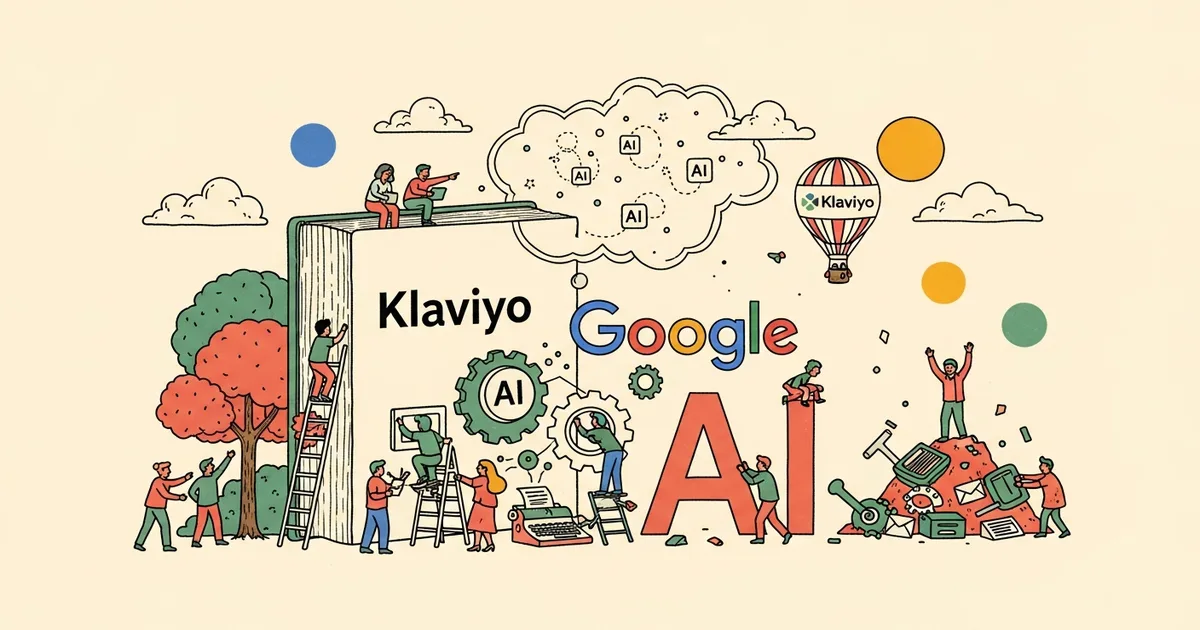
The Klaviyo-Google AI partnership, announced April 15, 2026, integrates Klaviyo’s (NYSE: KVYO) real-time customer data platform with Google’s search, advertising, AI, and messaging infrastructure. The deal spans the full commerce journey — from Google Search discovery through post-purchase loyalty — and makes manually scheduled marketing campaigns structurally obsolete for brands that implement it correctly.
This is not an API integration bolted onto two separate products. It is a co-designed system in which Google’s Gemini AI models consume unified behavioral data from both platforms and make autonomous channel, content, and timing decisions — without a marketer building a campaign brief or scheduling a send.
The Klaviyo-Google AI Partnership: What It Actually Combines
At its core, the integration merges two historically siloed data layers. Google contributes behavioral intent signals: search queries, Shopping interactions, YouTube engagement, and signed-in browsing behavior. Klaviyo contributes owned first-party data: purchase history, email engagement rates, SMS response patterns, and on-site behavioral sequences. The unified dataset feeds Google’s Gemini models, which orchestrate customer touchpoints autonomously across all connected channels.
Klaviyo serves more than 167,000 brands globally and processes over 30 billion data points daily across email and SMS. Google Ads reaches an estimated 4.3 billion users worldwide. The combination gives brands the first live feed of Google intent signals into a CRM system — not a retrospective audience export, but a real-time signal that triggers immediate action.
The practical use case: a customer searches “trail running shoes” Monday morning. By Monday afternoon, they receive a personalized SMS from a Klaviyo-integrated brand — not because a marketer built a flow, but because the AI detected high purchase intent and selected SMS as the highest-conversion channel based on that individual’s historical engagement patterns.
The Mechanics of Autonomous CRM
Traditional CRM is a batch operation: collect data, build a segment, design a flow, schedule sends. That cycle typically takes days. Autonomous CRM replaces the human-in-the-middle with AI agents that monitor signals continuously and act in real time.
Under the Klaviyo-Google framework, the Gemini-powered AI layer makes three categories of decisions for every customer, continuously:
- Channel selection: Email, SMS, Google Display, Google Shopping, or Google Business Message — whichever the model determines has the highest conversion probability for that individual at that moment.
- Content generation: Personalized product recommendations, dynamic pricing signals, and contextual messaging — generated per individual, not per segment.
- Timing optimization: Send time calibrated to each customer’s historical engagement windows, not a brand-wide “best time to send” estimate.
The system recalibrates after every interaction. A customer who abandons a cart at 10 PM, ignores the follow-up email, then searches the same product category the next morning gets a targeted Shopping ad — not a second email. The approach mirrors how autonomous AI exploration systems handle continuous environmental scanning: constant signal intake, real-time decision-making, no human checkpoint required.
Bidirectional Ad Suppression — The Hidden Feature
The most commercially significant technical detail in the partnership is bidirectional ad suppression. Klaviyo can now automatically pause Google ad spend on customers who have already converted — eliminating a persistent budget waste that HubSpot’s own research estimated at 18% of retargeting expenditure across e-commerce brands.
The reverse mechanism is equally valuable: Klaviyo suppresses email and SMS sends to customers currently in an active Google ad funnel, preventing conflicting messages from fragmenting the purchase journey. This cross-channel coordination has been technically achievable for years but required manual audience exports, API polling, and operational investment most brands never made. The native integration makes it automatic and real-time.
For brands spending $50,000 per month on Google retargeting, eliminating 18% waste recaptures $9,000 monthly — before any improvement in owned channel performance. At scale, that efficiency gain alone justifies the integration cost.
Competitive Threat to HubSpot and Salesforce
HubSpot (NYSE: HUBS) and Salesforce (NYSE: CRM) are the primary competitive targets of this announcement. Both have invested heavily in AI — HubSpot through its Breeze AI suite, Salesforce through Agentforce — but neither has a native, real-time integration with Google’s advertising and search ecosystem at this depth.
| Platform | AI Engine | Google Integration | Real-Time Data | Autonomous Agents |
|---|---|---|---|---|
| Klaviyo + Google | Gemini | Native (April 2026) | Yes | Full |
| HubSpot | Breeze AI | Ad sync only | Partial | Limited |
| Salesforce Marketing Cloud | Einstein / Agentforce | API-based | Batch | Partial |
| Braze | Sage AI | None native | Yes | Limited |
Salesforce’s structural advantage has always been enterprise depth: complex B2B workflows, deep ERP integration, multi-cloud orchestration. Autonomous B2C CRM is a mid-market and e-commerce problem — exactly Klaviyo’s territory. Salesforce Marketing Cloud is architecturally built for batch processing, not real-time inference at the speed this partnership requires.
HubSpot is the more immediate competitive casualty. Its customer base overlaps heavily with Klaviyo’s SMB-to-mid-market e-commerce segment. Breeze AI operates within HubSpot’s own data walls and has no Google integration equivalent — building one from scratch would require exactly the kind of partnership Klaviyo just closed. Klaviyo (KVYO) rose 8.4% in pre-market trading on the announcement. HubSpot (HUBS) fell 3.1%.
The Broader AI Platform Consolidation
This deal is one instance of a structural pattern accelerating across the AI industry. Just as OpenAI’s $1 billion deal with Disney marked AI providers pursuing deep vertical integration with content ecosystems, the Klaviyo-Google partnership represents the same logic applied to commerce infrastructure: secure complementary capabilities before a competitor bridges the gap.
The AI integration pattern — platform plus intent data plus autonomous execution — is appearing across every vertical. MegaOne AI has documented this consolidation wave reaching categories as granular as consumer weather apps. The commerce stack version carries uniquely high strategic stakes because every autonomous action maps directly to measurable revenue.
The traditional separation of paid media and owned media is architecturally collapsing. Autonomous AI treats email, SMS, and Google ads as a single coordinated surface. Brands maintaining separate agency relationships for paid and owned — still the majority, per Gartner’s 2025 CMO Survey — are running a fragmented architecture against a unified one.
MegaOne AI tracks 139+ AI tools across 17 categories. The convergence of CRM and advertising platforms is the fastest-moving trend in the B2C AI stack heading into late 2026. Within 18 months, expect Adobe Experience Cloud, Braze, and Attentive to either announce comparable Google integrations or pursue acquisitions to close the gap.
Real Risks in an Autonomous System
The partnership’s autonomy is also its primary liability. AI output quality scales directly with data input quality. A Klaviyo profile built on incomplete purchase history, mismatched email-to-device identifiers, or stale consent records generates poor recommendations — and in an autonomous system, those errors propagate at scale before any human notices.
Privacy is the second constraint. Google’s Privacy Sandbox transition shifted the ecosystem toward logged-in, first-party signals. Users who browse without a Google account remain effectively invisible to this system. The integration is powerful for the 63% of Google users who remain signed in across sessions (per Google’s Q4 2025 data) but creates systematic blind spots for the remainder.
Regulatory exposure expands alongside capability. A system that simultaneously targets a customer via email, SMS, and paid ads raises substantive questions under GDPR Article 22 (automated decision-making), CCPA, and the EU AI Act’s commercial automation provisions — none of which have final interpretive guidance for autonomous CRM at this scale. The Humans First movement’s ongoing scrutiny of automated commercial systems has found new grounds for challenge in architectures with no mandatory human review checkpoint.
What Brands Should Do Now
The partnership enters general availability in Q3 2026 for Klaviyo’s enterprise tier, with early access open now for qualifying U.S. and UK brands. Brands that activate without data preparation will produce worse outcomes than their current manual campaigns. Four prerequisites matter:
- Unify customer identifiers: Match Klaviyo profiles to Google Ads customer match lists. Identifier mismatches break the real-time signal loop and produce misdirected autonomous decisions.
- Implement enhanced conversions: Pass first-party purchase data upstream to Google via the Enhanced Conversions API — this is the technical foundation for bidirectional suppression.
- Audit consent records: Autonomous AI increases send velocity. Every compliance gap in email or SMS consent is amplified proportionally at scale.
- Define outcome metrics before activation: Set specific revenue, LTV, or reactivation targets. Without explicit goals, the AI defaults to optimizing engagement proxies — clicks and opens — rather than business outcomes.
The Klaviyo-Google partnership is the first credible autonomous CRM architecture available to mid-market brands without an enterprise services contract. Brands that integrate cleanly in 2026 build a compounding data flywheel — more interactions, better AI calibration, stronger personalization — that will be structurally difficult for manual-campaign competitors to overcome in 2027.
Related Reading
- Trustpilot’s ChatGPT Citations Surge 246%: Answer Engine Optimization Is Now Essential
- Cisco Is About to Spend $350 Million to Watch Your AI Agents
- ChatGPT Gains Apple CarPlay Integration in iOS 26.4 for Hands-Free Voice Conversations
- Point Your Phone at Any Outfit and Google Will Find Every Piece — Circle to Search’s Fashion Upgrade [2026]
- Google’s AI Health Coach Now Lives on Your Wrist — And It Knows More About Your Body Than You Do