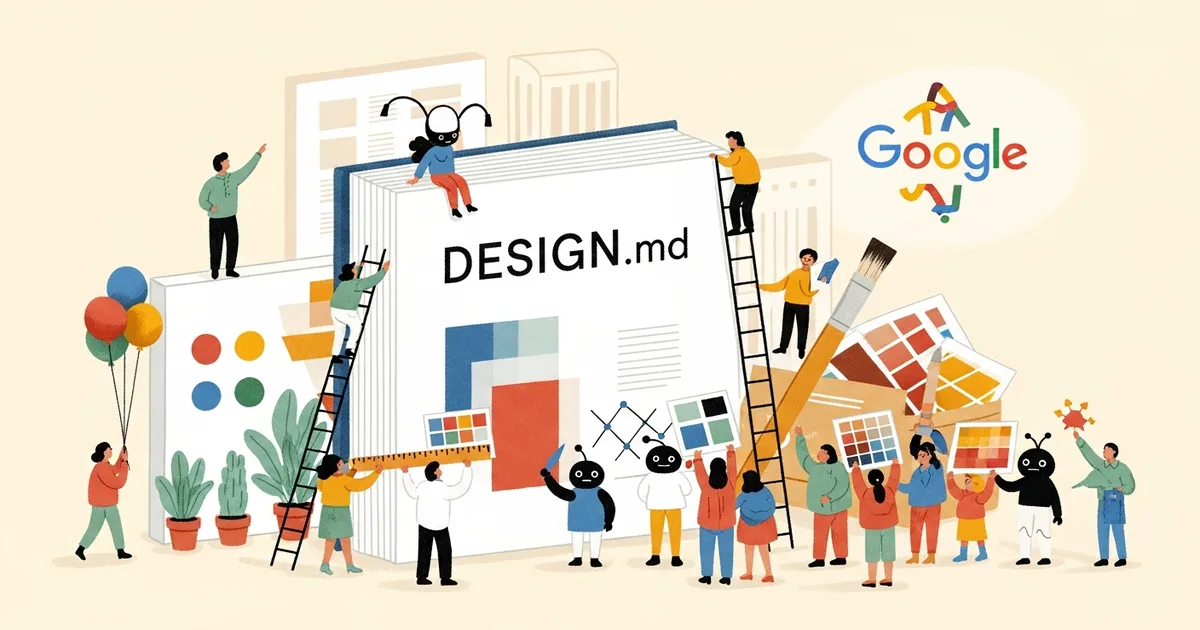
- Google released DESIGN.md, a machine-readable file format for encoding brand design rules, as open source under an Apache 2.0 license in April 2026.
- Each file pairs YAML-encoded design tokens—exact hex colors, font sizes, spacing values—with plain-text rationale notes that AI agents can interpret contextually.
- A companion CLI tool validates, compares, and exports DESIGN.md files to Tailwind CSS and W3C DTCG formats.
- The project remains in alpha; Anthropic launched Claude Design, a competing AI front-end design agent, around the same period.
What Happened
Google open-sourced DESIGN.md, a structured file format built to give AI agents a machine-readable encoding of brand design rules that persists across projects and platforms. The release, reported by The Decoder in April 2026, emerged from Stitch, Google’s AI-powered interface design tool that launched in mid-March 2026. The project is hosted on GitHub under an Apache 2.0 license and is described by Google as currently in alpha.
Why It Matters
AI design agents have lacked a portable, standardized method for ingesting and enforcing brand constraints, which has produced inconsistent outputs as context shifts between sessions or tools. Anthropic recently entered the same space with Claude Design, an AI agent targeting front-end design, slide creation, and related tasks. The DESIGN.md release represents an attempt to establish an interoperable specification before the market consolidates around proprietary prompt schemas embedded in individual tools.
Technical Details
Each DESIGN.md file combines two layers of information: design tokens encoding exact values—hex color codes, pixel-level font sizes, spacing increments—stored in YAML, alongside plain-text notes that explain the design rationale behind each value. According to the project specification documented on the Stitch site, this dual structure is intended to allow AI agents to match brand values precisely and apply them correctly in novel interface scenarios. The accompanying CLI tool supports three operations: validating a DESIGN.md file for internal consistency, comparing two files to surface divergences, and exporting token data to Tailwind CSS configuration files or the W3C Design Token Community Group (DTCG) format. The spec also enables agents to cross-check generated designs against WCAG accessibility guidelines by using the token definitions as a reference baseline.
Who’s Affected
Frontend developers and design system teams using AI agents to generate or audit interface code are the most direct beneficiaries, as DESIGN.md offers a structured alternative to manually re-specifying brand rules in every prompt session. Platform builders integrating AI design capabilities—including those building on top of Stitch, third-party design agent frameworks, or code generation pipelines—would need to adopt the schema to interoperate with projects that use it. Enterprises with formal brand governance or accessibility compliance requirements may find the WCAG integration and CLI validation workflow relevant to their review processes.
What’s Next
Google has made DESIGN.md file generation available for free through Stitch, which may accelerate adoption among teams already using the tool. The alpha designation means the specification and CLI interface remain subject to breaking changes before a stable release. Whether the format achieves broader adoption as a cross-platform standard or stays tightly coupled to Google’s own toolchain will depend on uptake from design tool vendors and AI framework developers outside the Google ecosystem.