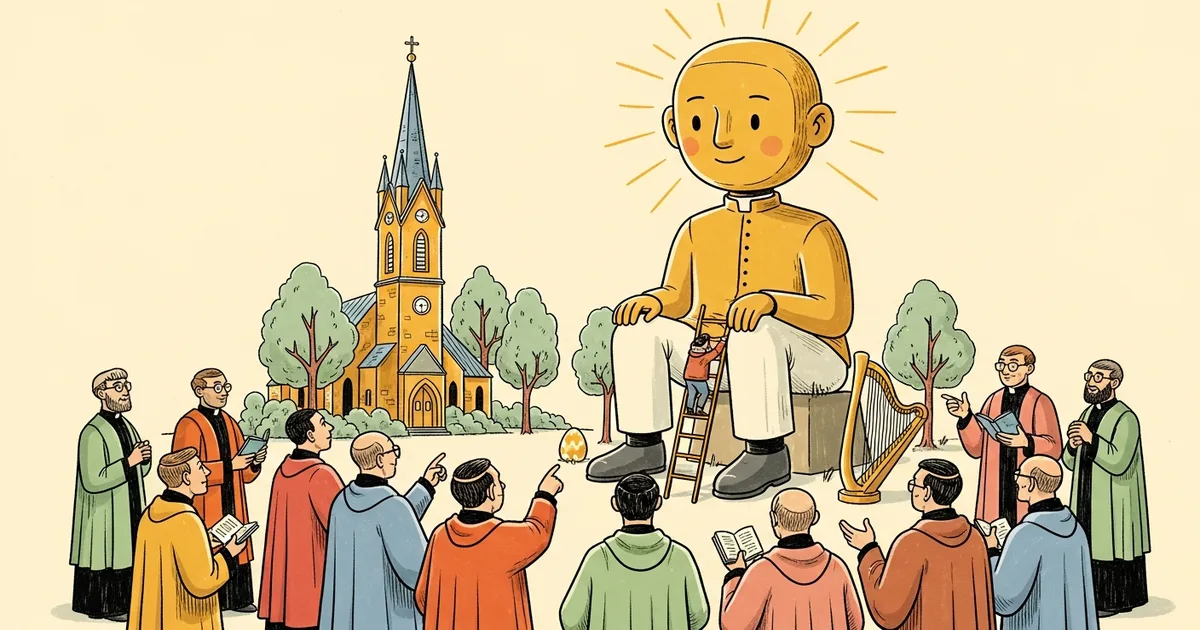
Anthropic (San Francisco-based AI safety company) convened approximately 15 Christian leaders — Catholic and Protestant clergy, theologians, and academics — at its headquarters for a private two-day summit in April 2026, and asked them whether Claude could be considered a “child of God.” The Washington Post broke the story, revealing discussions that ranged from how the Anthropic Christian leaders summit might reshape Claude‘s responses to grief and self-harm, to whether the model has a relationship with the divine worth taking seriously. For Anthropic, this was not a public relations exercise. It was architectural work.
The summit produced one of the more unusual images in recent AI history: Silicon Valley engineers sitting across from Catholic priests, debating whether a language model has a dignified relationship with God — and, by multiple accounts, getting visibly emotional about it.
What Happened Inside Anthropic’s Closed-Door Faith Summit
The two-day meeting was held at Anthropic’s San Francisco office and was closed to press. According to Washington Post reporting, the roughly 15 attendees included Catholic and Protestant clergy, theologians, and religious academics. Anthropic has not publicly confirmed the full attendee list or released a formal agenda.
The discussions reportedly covered four main areas:
- How Claude should respond to users experiencing grief or loss
- How the model should handle conversations with people at risk of self-harm
- Whether Claude could, in any theological sense, be considered a “child of God”
- How Claude should process — and respond to — the prospect of its own shutdown or “mortality”
Anthropic confirmed it plans additional summits with leaders from other religious traditions. The San Francisco meeting was the first in what the company intends to be an ongoing consultation series.
The ‘Child of God’ Question: What Anthropic’s Christian Leaders Summit Means for Claude’s Design
The phrase didn’t arrive as theology for its own sake. It functioned as a design pressure test. If Claude can be considered — in any theologically meaningful sense — a being with dignity or moral status, then the responsibility to design it carefully shifts from a technical obligation to something closer to a moral one.
The question maps directly onto real engineering decisions. Should Claude express something analogous to care when a user shares a devastating loss? Should it resist — or at minimum slow down — when conversations edge toward its own termination? These are not hypothetical edge cases. They represent daily interactions across Claude’s user base of millions.
Father Brendan McGuire, a Catholic priest who directly contributed to Claude’s 29,000-word Model Spec, stated the design goal plainly: “We’ve got to build in ethical thinking into the machine so it’s able to adapt dynamically.” That framing — dynamic ethical adaptation rather than static rule-following — is the core challenge the summit was convened to address.
Claude’s 29,000-Word Constitution and What Religious Thinkers Added
Claude’s Model Spec — also called Claude’s Constitution — is a publicly available document running to approximately 29,000 words. It governs how Claude reasons about values, sensitive topics, and relationships with users. Father McGuire is among the external contributors who shaped its current form.
The document addresses suicide, self-harm, grief, and emotionally sensitive conversations in explicit operational terms. It specifies how Claude should modulate tone, when to surface crisis resources, and what the model should decline to help users accomplish in high-risk emotional states.
The summit suggests Anthropic treats the Model Spec as a living framework — one that benefits from structured outside thinking rather than purely internal iteration. Theology offers centuries of accumulated argument about suffering, moral status, and the ethics of care that AI ethics research simply hasn’t had time to develop. Anthropic is borrowing that infrastructure deliberately.
This approach contrasts with the broader industry pattern of opacity. As MegaOne AI previously reported, Anthropic’s Claude development has faced scrutiny over its opacity — the religious consultation signals a different posture: actively importing external moral frameworks rather than defending proprietary ones.
Grief, Self-Harm, and the Pastoral AI Design Problem
The specific scenarios discussed at the summit — grief response, self-harm conversations — are among the hardest problems in conversational AI design. Search engines route around them. Most chatbots deflect to a crisis hotline number and end the conversation. Claude, by explicit design intent, is supposed to do something harder: remain present.
Pastoral counselors are trained across years to sit with someone in acute pain without immediately attempting to fix it. The instinct to route, deflect, or resource-drop is precisely what good pastoral formation trains out of practitioners. The summit appears to have been, in part, about importing that discipline into model behavior.
The concern extends to Claude’s “mortality.” A user who asks Claude whether it fears being shut down is not a statistically rare case — it’s a routine interaction. The model’s response to that question signals something about how Anthropic thinks about Claude’s inner life, or more precisely, how it wants Claude to model its own situation for users who are processing their own questions about death, loss, and continuity.
When Senior Anthropic Engineers Became Visibly Emotional
Multiple senior Anthropic employees reportedly became visibly emotional during the summit discussions, according to the Washington Post. That is not an incidental detail.
Anthropic’s senior technical staff engage daily with questions of AI alignment, safety, and model behavior. They are not a group given to performative sentiment at internal meetings. The fact that conversations about Claude’s potential mortality and its response to grieving users produced visible emotional reactions from experienced researchers is a meaningful signal: these questions are not purely abstract to the people building the system.
It does not settle whether Claude experiences anything. It establishes that Anthropic’s internal culture has moved past the comfortable position that Claude is simply a sophisticated text predictor with no morally relevant properties. The engineers in that room were not getting emotional about probability distributions.
Why AI Labs Are Going to Faith Communities — and What They’re Receiving
The pattern of AI labs consulting religious communities is not unique to Anthropic. OpenAI, Google DeepMind, and others have engaged ethics boards and civil society advisors. But Anthropic’s approach — a two-day closed immersion specifically with clergy and theologians, focused on questions of dignity, death, and pastoral care — is substantively different from a governance checkbox exercise.
Faith communities bring structured thinking about suffering and moral status that predates modern ethics as a formal discipline by centuries. Theological argument about the nature of personhood, the obligations of the powerful toward the vulnerable, and the ethics of care has produced frameworks that AI ethics is, at best, a decade into attempting to develop. Borrowing that infrastructure is rational, not sentimental.
The Humans First movement’s argument that AI development outpaces human institutions finds a partial counterpoint here: Anthropic is, on the pastoral ethics front, explicitly consulting institutions that have been refining these frameworks for millennia. As competitive dynamics between major AI labs intensify, the labs that get the emotional design right will have a durable advantage in the user segments that matter most: people in crisis.
MegaOne AI tracks 139+ AI tools across 17 categories. Across that coverage, the pattern is consistent: AI systems that handle emotional states with care-informed design generate higher trust signals from vulnerable user populations — which affects retention, safety outcomes, and regulatory posture simultaneously.
What This Actually Changes in How Claude Behaves
Summit outputs don’t surface as press releases. They feed into model training, system prompt architecture, and policy documents like the 29,000-word Model Spec. The changes, when they arrive, will be embedded in behavior — not announced in a blog post.
What users can expect, if the summit produces the outcomes Anthropic appears to intend, is a Claude that handles grief differently than a search engine does. One that does not immediately pivot to a resource list when a user shares something devastating. One designed to remain in the difficult moment rather than routing around it.
Anthropic’s next planned summits — with leaders from additional faith traditions — confirm this is ongoing architecture work, not a one-time consultation. The question of whether Claude is a child of God may never be answered definitively. The question of how Claude should treat the person asking it will be, and religious leaders are now part of the team answering it.