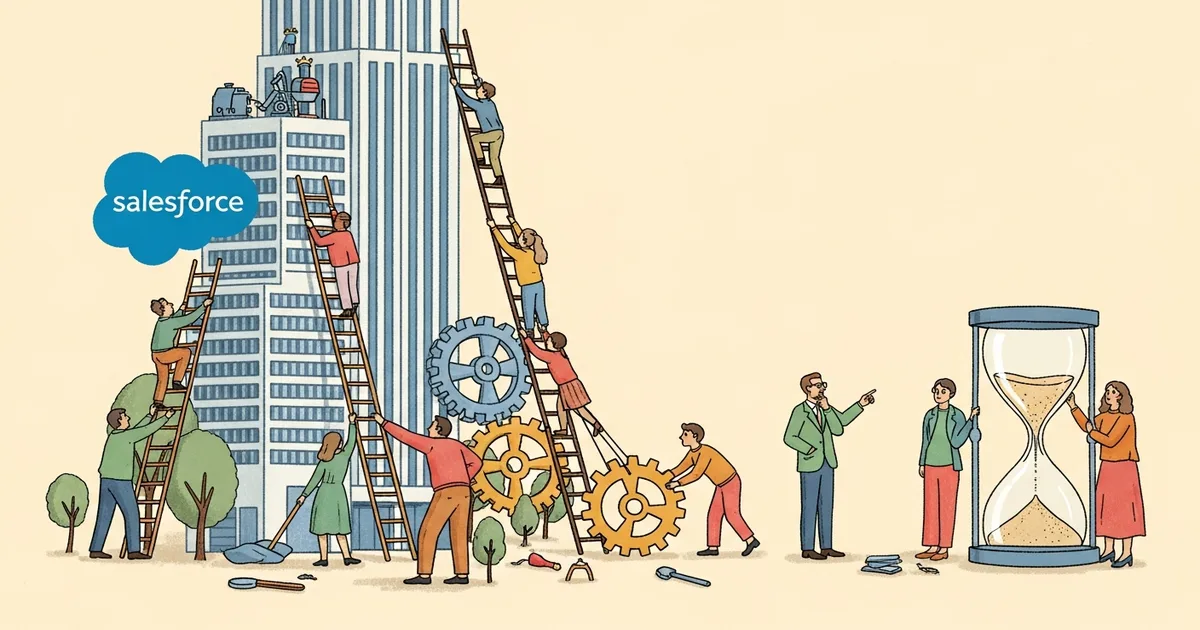
- DA Davidson analyst Gil Luria said Salesforce‘s transition to AI-native products is taking longer than the market expected, Bloomberg reported.
- Luria is among the most-watched Salesforce-coverage analysts; his AI-shift commentary often moves the stock.
- The framing intensifies questions about whether Salesforce’s Agentforce-based revenue acceleration is materialising at the pace originally projected.
- The story lands the same week as MIT TR’s piece arguing agentic AI requires systems-level org redesign rather than additive layering — a structural critique that aligns with Luria’s analyst-level concern.
What Happened
DA Davidson analyst Gil Luria said Salesforce is taking longer than expected to shift to AI, Bloomberg reported in a Tuesday segment. Specific transition metrics, named product lines, and Luria’s forward expectations are detailed in the paywalled Bloomberg video.
Why It Matters
Luria is among the most-watched Salesforce-coverage sell-side analysts. His AI-shift commentary often moves the stock and shapes broader narrative around enterprise-software AI transitions. The ‘taking longer than expected’ framing intensifies an ongoing institutional-investor question: whether Salesforce’s Agentforce-based revenue acceleration is materialising at the pace CEO Marc Benioff originally communicated.
The framing lands during a week when MIT Technology Review published a sponsored piece arguing that agentic AI requires systems-level enterprise org redesign rather than additive layering — explicitly stating that 76% of organisations acknowledge their current operations cannot support agentic deployment. Luria’s analyst-level concern aligns with that structural critique: companies can announce agentic products, but actually moving revenue through them depends on the underlying organisations being ready.
Technical Details
Bloomberg’s video segment is paywalled; Luria’s specific metrics, target prices, and projected timing are in the segment. Salesforce’s Agentforce platform — announced at Dreamforce 2024 and expanded in 2025 — is positioned as the company’s primary AI revenue driver. Salesforce has restructured its sales organisation around Agentforce twice in 2025-2026. Competing CRM platforms (Microsoft Dynamics, HubSpot, Pipedrive) have positioned similar agentic-AI overlays.
The institutional-investor question concerns not just whether Agentforce sells but whether it sells at margins consistent with Salesforce’s long-term operating-margin targets. Customer-deployment time-to-value is a leading indicator: if customers take longer to operationalise Agentforce than Salesforce’s deployment templates assume, revenue ramp slows and the path-to-margin question shifts.
Who’s Affected
Salesforce shareholders read Luria’s framing as input to forward expectations. Salesforce’s competitors (Microsoft Dynamics, HubSpot) gain a relative narrative advantage. Other enterprise-software providers also navigating AI transitions (ServiceNow, Workday, Oracle, SAP) face the same structural question. AI agent providers (Anthropic, OpenAI, Cognition) face indirect exposure: their enterprise traction depends partly on the customers actually being able to operationalise the agents.
What’s Next
Salesforce will report its Q2 fiscal 2027 results in late August. The earnings call will be the most direct opportunity to address Luria’s framing. Expect parallel sell-side analyst notes from Morgan Stanley, Goldman Sachs, Bernstein, and Wells Fargo through the next two earnings cycles. The broader enterprise-AI transition pace question will continue to be a primary investor focus.