- Salesforce shares have fallen 28 percent since January 2026 as investors weigh whether AI agents could erode the company’s per-seat licensing model.
- CEO Marc Benioff told the Wall Street Journal that AI strengthens Salesforce’s competitive position, citing data security and compliance risks of homegrown alternatives.
- Only 23,000 of Salesforce’s 150,000 customers have adopted Agentforce since its late 2024 launch, with uneven results across deployments.
- Salesforce introduced a new proprietary metric, the “Agentic Work Unit,” reporting 2.4 billion AWUs — a 57 percent increase — though the figure was published for the first time, making historical comparison impossible.
What Happened
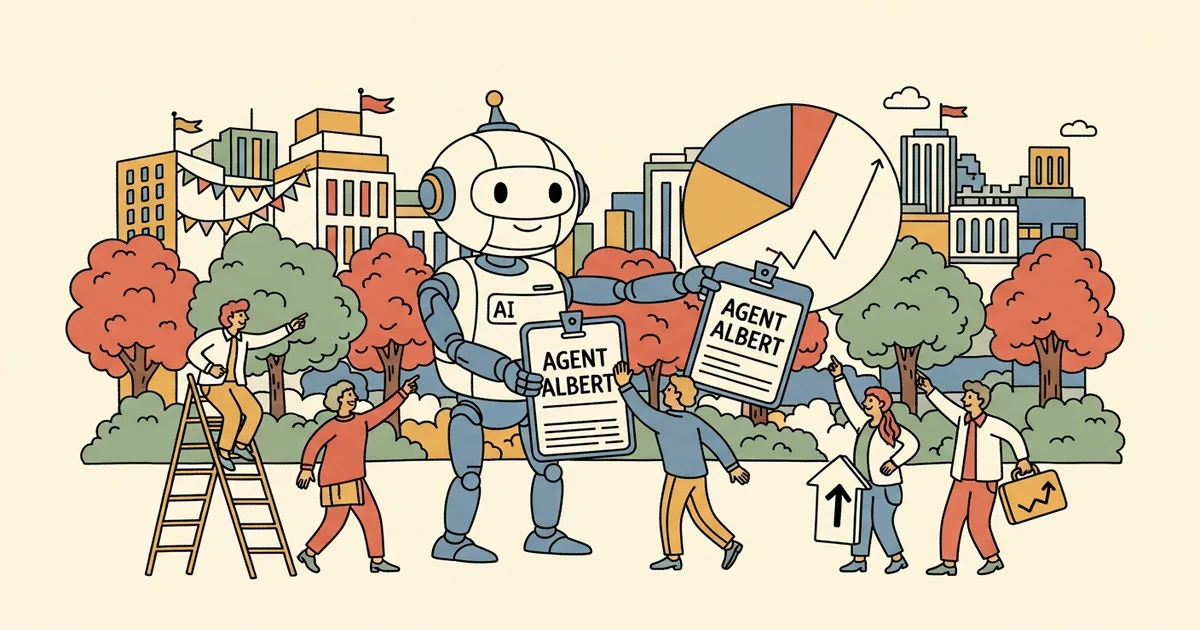
Salesforce CEO Marc Benioff told the Wall Street Journal that investor fears about AI making enterprise software obsolete misread the market, and disclosed a new AI product codenamed “Agent Albert,” slated for release by the end of 2026. The announcement, reported by The Decoder, came as Salesforce stock has fallen 28 percent since the start of 2026. Benioff characterized the so-called “SaaSpocalypse” thesis — the idea that AI will allow companies to replace enterprise SaaS with custom-built alternatives — as getting the opportunity backwards.
Why It Matters
The “SaaSpocalypse” concern rests on two pressures: AI agents reducing headcount and thus seat licenses, and AI-assisted development enabling companies to build their own software instead of paying for it. Salesforce’s per-seat CRM model makes it a direct target of this thesis, and its stock decline reflects the market’s uncertainty about the durability of that revenue base. Benioff’s counter-argument — that homegrown AI solutions carry unacceptable data security and compliance risks — is aimed squarely at enterprise buyers already operating under regulatory constraints.
Technical Details
Agentforce, which launched in late 2024, has been adopted by 23,000 of Salesforce’s 150,000 customers, roughly 15 percent of the installed base. Performance data from live deployments is mixed. Education publisher Pearson reported a 40 percent increase in customer inquiries resolved automatically. Jewelry retailer Pandora told the Journal that the system cannot produce reliable recommendations when customer requests are vague — a significant limitation for conversational commerce use cases.
Agent Albert, described as Agentforce’s successor, is designed to analyze users automatically and take actions without being prompted, representing a more autonomous operating model than the current product. Salesforce has not disclosed technical specifications or pricing. To quantify AI’s business contribution, Salesforce introduced a new metric called the “Agentic Work Unit” (AWU), which the company says captures how AI translates into concrete outcomes such as resolved inquiries. Its most recent quarterly report logged 2.4 billion AWUs, a 57 percent increase — though this was the first time the company published the figure, making industry benchmarking or trend analysis impossible.
Who’s Affected
Enterprise buyers running Salesforce’s CRM and customer service platform face the most direct impact, both from Agentforce’s current performance gaps and from the as-yet-undisclosed pricing for Agent Albert. Salesforce’s 150,000 business customers span financial services, retail, and healthcare — sectors with the compliance requirements Benioff is using to defend the platform’s value proposition. Microsoft and ServiceNow, which embed AI agents in competing enterprise platforms, face the same per-seat revenue scrutiny from investors and analysts.
What’s Next
Agent Albert is expected to ship by the end of 2026, with no confirmed release date or pricing structure disclosed. The AWU metric will face analyst pressure in future earnings calls, given the absence of historical baselines against which to evaluate the 57 percent growth claim. Agentforce’s current 15 percent adoption rate — roughly 18 months after launch — will serve as a baseline for measuring whether demand accelerates before Agent Albert arrives.