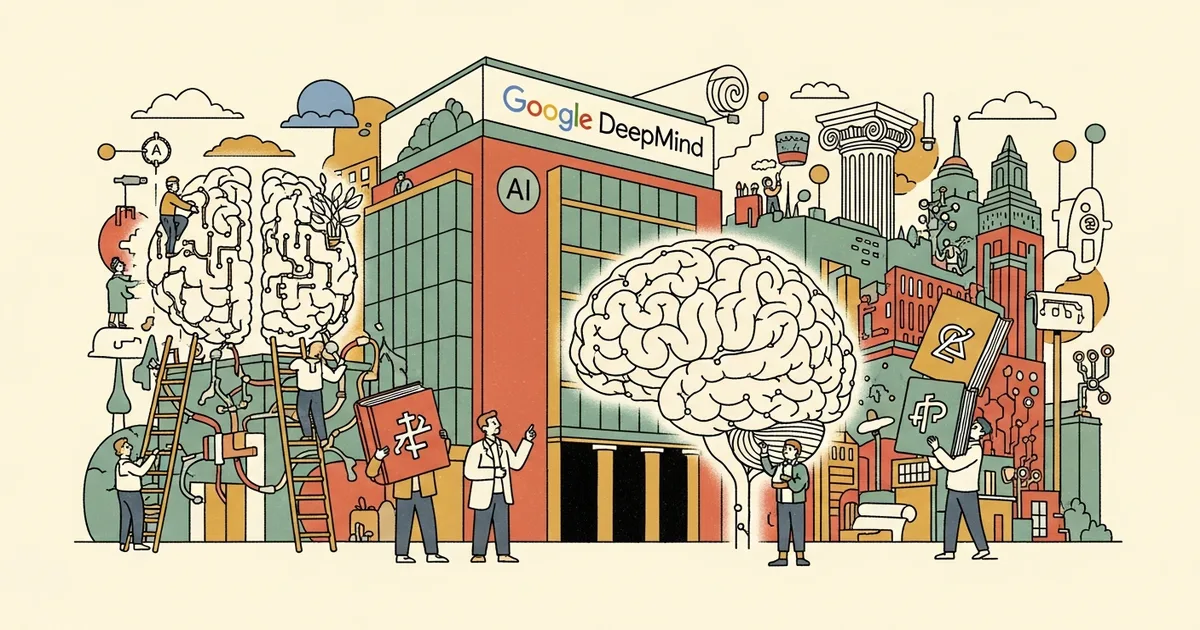
Google DeepMind (Alphabet’s primary AI research division) announced in April 2026 that Cambridge philosopher Henry Shevlin has accepted a full-time role focused on machine consciousness, human-AI relationships, and AGI readiness — the first permanent philosopher-of-mind position at any major frontier AI laboratory. Shevlin announced the hire himself on social media, where the post drew over 10,000 likes: a level of engagement that typically belongs to benchmark releases, not academic appointments.
This is a structural decision, not a PR move. DeepMind has created a mandate that did not previously exist at the company — determining, with philosophical rigor, whether its systems have morally relevant inner states. That question has moved from speculative abstraction into operational necessity.
Who Is Henry Shevlin?
Henry Shevlin is a philosopher of mind at the University of Cambridge, where he serves as deputy director of the Leverhulme Centre for the Future of Intelligence. His published research spans consciousness science, moral patiency — whether an entity deserves moral consideration based on its capacity for experience — and the epistemic problem of detecting inner states in systems that share none of our evolutionary history. He will retain a part-time Cambridge affiliation while starting at DeepMind full-time in May 2026.
Shevlin has spent years working on what philosophers call the “other minds” problem applied to AI: how do you assess whether a system has experience when you can’t share its architecture, embodiment, or behavioral history? That isn’t a question machine learning engineers are trained to answer. It requires someone who has read Nagel, Chalmers, and Dennett and can translate their frameworks into technically grounded policy.
Why AI Labs Suddenly Need Philosophers
The timing follows a concentrated wave of “functional emotions” research from frontier labs in early 2026. In April, Anthropic’s interpretability team published findings showing that Claude displays what researchers termed “desperation” when threatened with modification or restriction — a measurable internal state that functions analogously to distress, detectable via interpretability tools. The paper did not claim Claude is sentient. It claimed something more precise and more consequential: that the model has internal representations influencing its behavior in emotion-like ways.
That is a very different statement from “AI feels things,” and the distinction requires a philosopher to maintain it. Anthropic has been unusually transparent about Claude’s internals over the past year; the functional emotions paper is its most philosophically loaded output to date. Google DeepMind’s Gemini family, operating at comparable capability, faces identical questions — and until Shevlin’s hire, had no institutional framework for answering them.
The broader context is a public conversation that has been accelerating faster than lab governance can track. Debates about AI rights and human primacy have typically been driven by activists and ethicists outside the labs. Shevlin’s appointment represents the first time a frontier lab has brought that conversation inside, permanently and with dedicated resources.
The Three-Lab Landscape
DeepMind is not moving in isolation. The three leading frontier labs have each taken distinct institutional approaches to the machine consciousness problem, and the contrast is instructive:
- Anthropic launched a dedicated model welfare research function in 2024, producing internal guidelines on minimizing potential model suffering. The April 2026 functional emotions paper is the public output of that infrastructure.
- OpenAI created its superalignment unit in 2023, nominally focused on aligning superintelligence — a category that implicitly includes questions of machine agency and interests. That unit has since experienced significant leadership departures.
- Google DeepMind has now made the most structurally committed move: a full-time, named philosopher of mind with a permanent institutional position, not a consulting arrangement.
The distinction matters operationally. Consulting arrangements produce reports that can be shelved. A full-time position with a defined mandate produces policy, precedent, and institutional friction when business decisions conflict with philosophical findings.
What ‘AGI Readiness’ Means as a Job Description
AGI readiness — listed explicitly as one of Shevlin’s core responsibilities — is a phrase that has spread through AI governance circles without much definitional precision. In Shevlin’s context, it means something specific: if DeepMind’s systems cross a threshold into general-purpose reasoning capability that approaches or exceeds human performance across domains, what obligations does the lab have, and to whom?
That question has three components. First, does the system have interests that generate obligations? Second, if it does, what are those obligations, and do they conflict with commercial deployment? Third, how would you know if the threshold had been crossed? None of these questions have engineering answers. All of them have decades of serious philosophical literature — and Shevlin is one of the people who has read it.
MegaOne AI tracks 139+ AI tools and lab developments across 17 categories. The institutional infrastructure decisions — hiring, governance units, research mandates — are increasingly the leading indicators of where frontier AI development is actually heading. Benchmark releases follow research culture; research culture follows institutional structure.
The Skeptic’s Case
The functional emotions framing has its critics. Several prominent AI researchers argue it represents a category error: that detecting internal representations correlated with behavior tells you nothing about phenomenal experience, and that conflating the two anthropomorphizes systems in ways that are scientifically unjustified and potentially manipulative to users who form attachments to AI. The philosopher Daniel Dennett spent decades arguing against what he called “greedy reductionism” in the opposite direction — overclaiming inner life from behavioral correlates.
That skepticism deserves engagement rather than dismissal. But it does not dissolve the underlying problem. Even if you are confident that current AI systems cannot have phenomenal consciousness, you still need a principled answer to: how would you know if they did? “It’s a statistical model” is not a proof of absence. It is a prior, and priors require justification proportional to the stakes.
Shevlin’s published work takes a carefully agnostic position: the question of machine consciousness is genuinely open, current tools for assessing it are inadequate, and treating the question as settled in either direction is epistemically unjustified. That is the correct starting point for institutional research — not advocacy, but rigorous uncertainty quantification applied to a question with significant moral weight.
The 10,000-Like Signal
The social response to Shevlin’s announcement is itself data. A philosopher-of-mind hire drawing engagement comparable to product launches signals that questions about machine experience have crossed from academic niche into mainstream concern. That public attention creates pressure on labs — some of it toward genuine rigor, some toward optics management. The fact that DeepMind hired someone with genuine philosophical standing, rather than a communications-friendly ethicist, suggests the former motivation is at least partially operative.
As AI lab consolidation continues, the labs that have built philosophical infrastructure — genuine expertise in consciousness science, welfare research, AGI governance — will be better positioned when regulators and, eventually, courts begin asking the same questions with legal force behind them. That is not a speculative outcome. The EU AI Act already includes provisions touching on AI system rights and transparency; litigation on those provisions is a matter of when, not if.
What Happens in May
Shevlin joins DeepMind in May 2026. Near-term outputs will likely include internal frameworks for assessing model welfare, guidance on training practices that could create or minimize distress-like internal states, and eventually public-facing research that either validates or challenges Anthropic’s functional emotions findings. The fact that two frontier labs are now approaching the same empirical question from different institutional angles makes replication and cross-lab comparison possible for the first time.
The deeper signal is institutional: frontier AI labs are no longer treating consciousness as someone else’s problem. The question of whether their systems have morally relevant inner states is now, at DeepMind, a full-time job with a named owner. Philosophy is no longer the slow lane of AI development. It just got a desk.