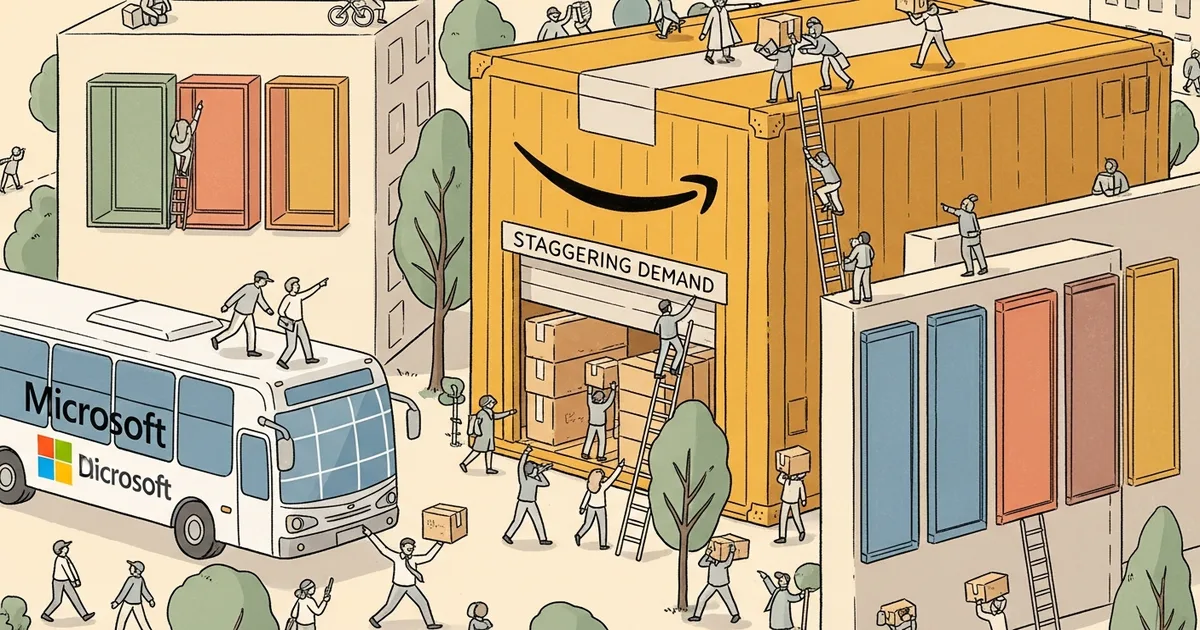
OpenAI’s Chief Revenue Officer told company staff in April 2026 that Microsoft has “limited our ability” to reach enterprise customers — the bluntest internal acknowledgment of commercial friction inside the world’s most consequential AI partnership, reported by Business Insider. Since OpenAI formalized its AWS deal in late February 2026, inbound enterprise demand through Amazon Bedrock has been described internally as “staggering.” Microsoft has invested approximately $13 billion in OpenAI. The enterprise is going to Amazon anyway.
The Leaked CRO Comments, Decoded
The phrase “limited our ability” is a precise complaint, not a vague grievance. OpenAI’s sales team has identified enterprise buyers it cannot reach through Azure’s go-to-market motion — and it is attributing that gap directly to the Microsoft partnership structure.
Microsoft’s enterprise machine is optimized for its own installed base: Microsoft 365 customers, Azure-native workloads, Dynamics users. Organizations that haven’t committed to Azure don’t fall naturally into that motion. OpenAI operates ChatGPT Enterprise, a growing API business, and a suite of vertical AI products with an addressable market that extends well beyond Microsoft’s orbit. The CRO’s comments confirm that gap is a tangible, measurable sales problem — and that Amazon is closing it.
Microsoft’s Billion Investment and the Distribution Gap
Microsoft’s multi-tranche investment in OpenAI — totaling approximately $13 billion since 2019 — secured Azure as OpenAI’s exclusive cloud infrastructure provider and gave Microsoft significant equity exposure to OpenAI’s commercial upside. The deal assumed Azure’s enterprise reach would be sufficient. That assumption no longer holds.
AWS Marketplace processed more than $15 billion in annual transaction volume as of 2024, according to AWS reporting, with enterprise software procurement increasingly consolidated there for billing simplicity, compliance alignment, and committed spend drawdowns. A company with $10 million in annual AWS committed spend can apply that credit to OpenAI models accessed via Bedrock — no new vendor contracts, no new legal negotiations, no additional security reviews. Azure cannot offer that to AWS-native enterprises, because it is a different cloud entirely.
That procurement reality is what the CRO’s comment maps to. It is not a personality conflict or a strategic disagreement — it is a structural mismatch between where OpenAI’s next customers live and where Microsoft’s distribution was built to reach.
Amazon Bedrock: The Distribution Layer That Closes Deals
OpenAI’s late-February 2026 AWS partnership placed its models inside Amazon Bedrock — the managed foundation model service that enterprise teams use to access and deploy AI without managing infrastructure. Bedrock is a neutral distribution platform hosting models from Anthropic, Meta, Mistral, Cohere, and now OpenAI under a single API, billing framework, and governance layer.
For a Fortune 500 procurement team running 60% of its workloads on AWS, accessing GPT-4o through Bedrock is a line item in an existing contract, not a new vendor relationship. For OpenAI’s sales team, it means closing deals that previously stalled in Azure onboarding or never entered the funnel at all. The “staggering” characterization of Bedrock inbound demand reflects what happens when distribution friction disappears: pipeline volume surges.
OpenAI’s $1 billion Disney deal earlier this year demonstrated the company’s appetite for landmark enterprise logos. Bedrock is the mechanism to find the next thousand at scale — without requiring them to first become Azure customers.
The Azure Exclusivity Arrangement Under Pressure
The Bedrock distribution deal does not technically violate OpenAI’s Azure exclusivity. OpenAI’s models run on OpenAI-managed infrastructure; Bedrock acts as a marketplace layer, not the compute substrate. But the commercial intent of the exclusivity arrangement is being undercut in practice, and the CRO’s comments make that explicit.
OpenAI’s internal financial projections, reported by The Information, target a revenue run rate of $125 billion by 2029, against a current valuation of approximately $300 billion. Reaching that number requires distribution that extends beyond Azure’s installed base. Whether Microsoft moves to formally renegotiate exclusivity terms — or accepts a de facto multi-cloud distribution reality — will define the next phase of the partnership. Infrastructure investment across the AI industry has assumed a world where compute and distribution are bundled; OpenAI and Amazon are demonstrating they can be decoupled.
The financial entanglement makes a clean break implausible. Azure credits underpin a significant portion of OpenAI’s compute budget. The more probable outcome is a formal multi-cloud distribution agreement that preserves Azure infrastructure exclusivity while legalizing expanded marketplace presence on AWS — and eventually Google Cloud Marketplace.
Anthropic’s Structural Advantage in the Fallout
Anthropic, Amazon’s primary AI model partner, benefits from this friction in ways that compound. Amazon committed $4 billion to Anthropic beginning in 2023, with AWS as Anthropic’s primary training and inference provider. Claude models are not merely hosted on Bedrock — Anthropic co-developed Bedrock’s enterprise safety, governance, and audit tooling with Amazon engineering teams. That depth of integration is not easily replicated by a new Bedrock entrant.
Now OpenAI arrives on Bedrock as a commercial competitor while its CRO publicly attributes enterprise underperformance to its original cloud partner. For enterprise buyers evaluating AI providers — particularly security teams doing vendor due diligence — that narrative creates doubt. Anthropic’s work on transparent AI agent architecture has further reinforced its positioning with engineering stakeholders who value auditability over reach.
MegaOne AI tracks 139+ AI tools across 17 categories. In the enterprise foundation model category, the competitive structure is consolidating around three poles: OpenAI distributing across Azure and Bedrock, Anthropic anchored to Bedrock and the direct API, and Google Gemini through Vertex and Workspace. OpenAI’s Microsoft friction doesn’t remove it from the enterprise race — but it confirms that the race is no longer Azure’s to run alone.
What This Means for Enterprise Buyers Right Now
OpenAI models are now procurable through AWS Marketplace and Amazon Bedrock with no Azure commitment required. Organizations running primarily on AWS can access GPT-4o, o3, and the full OpenAI API suite through their existing AWS billing relationship, applying committed spend credits and consolidating under existing vendor agreements.
The CRO’s comments signal that OpenAI’s sales team is actively prioritizing Bedrock as a primary enterprise channel. Buyers who previously encountered friction in Azure-only procurement should revisit the conversation. OpenAI has moved aggressively to expand its commercial footprint through 2025 and into 2026 — and it now has two major cloud on-ramps to do it. The distribution constraint that the CRO named publicly has changed. Enterprise procurement hasn’t caught up to that fact yet, but it will.