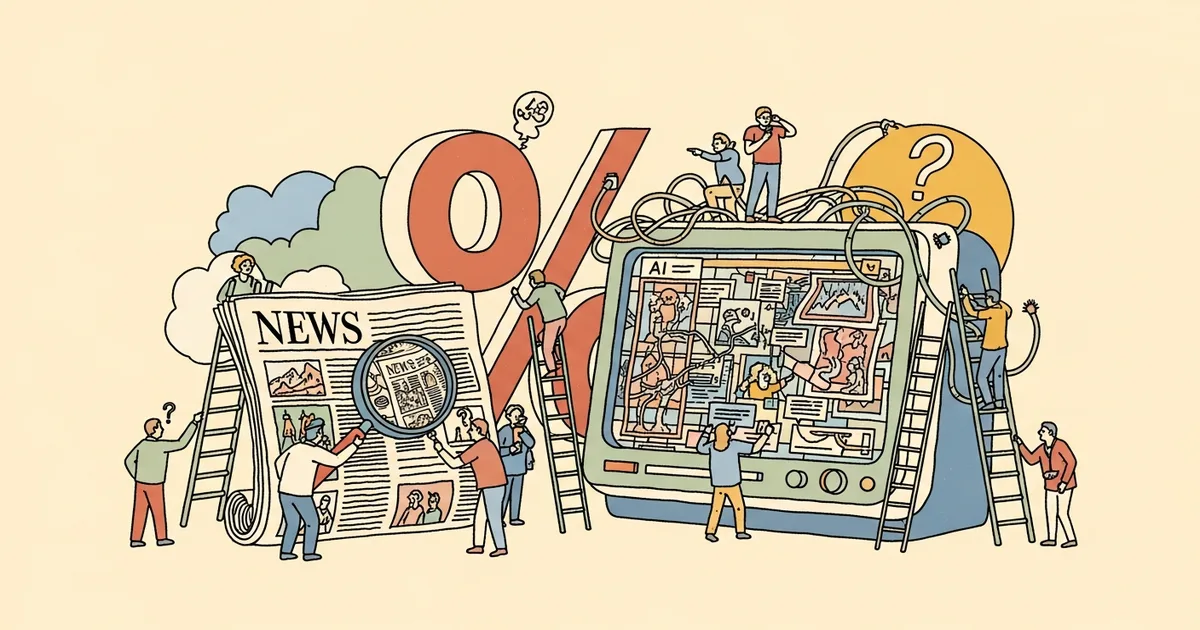
AI chatbots including ChatGPT and Claude misrepresent news content in approximately 45 percent of cases when users rely on them as search tools, according to research findings highlighted in a Consumer Reports analysis. The investigation examines a growing disconnect between how users treat AI chatbots — as factual information retrieval systems — and how the underlying technology actually works — as statistical text generators that predict plausible word sequences.
The core problem is architectural rather than a bug to be fixed. Large language models generate responses by predicting the most likely next token in a sequence, not by looking up verified facts in a database. This means a chatbot delivers incorrect information with the same linguistic confidence as correct information — there is no internal mechanism that distinguishes between accurate statements and plausible-sounding fabrications. The 45 percent misrepresentation rate for news content is particularly concerning because news queries carry an implicit expectation of factual accuracy that the technology cannot guarantee.
The types of errors range from subtle to significant. Chatbots may attribute statements to the wrong source, conflate details from multiple stories, invent quotes that were never made, or present outdated information as current. In some cases, the models generate entirely fabricated news events that never occurred — a phenomenon researchers call hallucination. Unlike traditional search engines that return links to source material, chatbots present synthesized answers without citations, making it difficult for users to verify claims or trace information back to its origin.
The findings arrive as AI companies increasingly position their chatbots as alternatives to traditional search. OpenAI’s ChatGPT with browsing, Google’s Gemini with AI Overviews, and Perplexity AI have all marketed their products as superior information retrieval tools. The research suggests this framing sets user expectations that the technology cannot reliably meet, particularly for news content where accuracy is not optional.
Consumer Reports recommends that users cross-reference chatbot responses with primary sources, treat AI-generated summaries as starting points rather than authoritative answers, and remain skeptical of chatbot responses that lack citations. For publishers and news organizations, the 45 percent error rate raises questions about the long-term impact of AI-mediated news consumption on public understanding of current events — particularly as younger demographics increasingly use chatbots as their primary news interface.