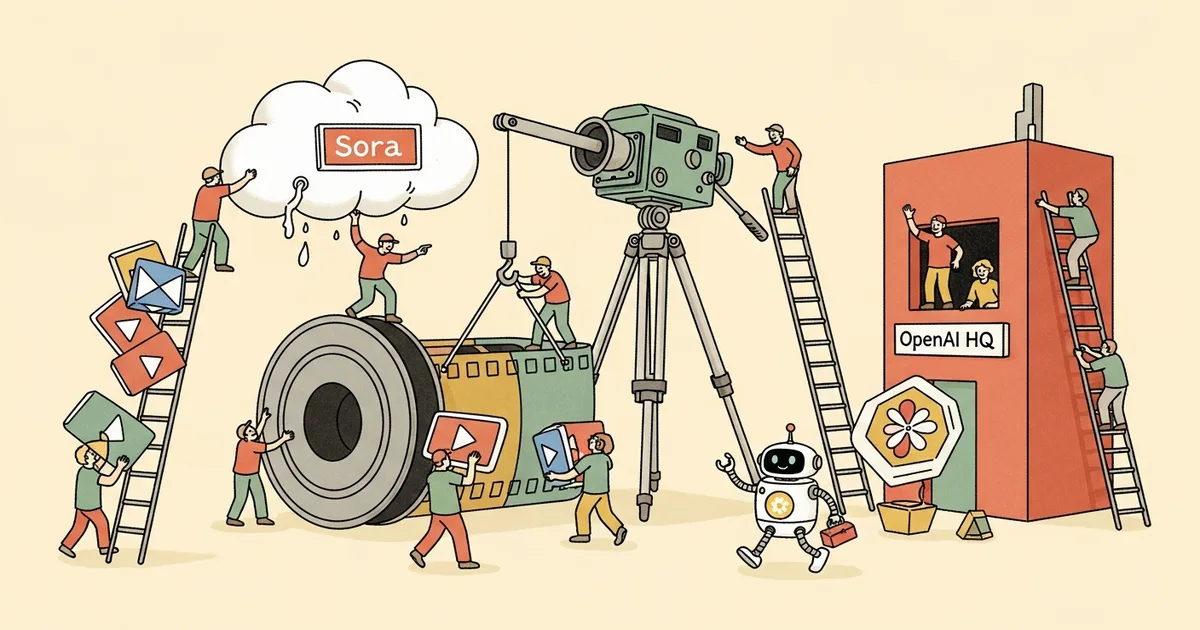
On March 24, 2026, OpenAI announced it will shut down its Sora AI video-generation platform, ending a product that had been publicly available for less than a year and dissolving a major partnership with The Walt Disney Company. The announcement appeared on OpenAI’s official X account and was reported by NBC News journalists Steve Kopack, Jared Perlo, and Daniel Arkin.
- OpenAI announced on March 24, 2026 that it is shutting down its Sora AI video-generation app and API.
- The closure dissolves Disney’s planned three-year partnership and $1 billion investment in OpenAI.
- OpenAI cited the need to reallocate scarce computing resources toward coding and text-generation tasks ahead of an expected IPO.
- The second-generation Sora app, released in September 2025, had briefly topped the iOS App Store’s Photo and Video category before attracting copyright and deepfake concerns.
What Happened
OpenAI announced on March 24, 2026 that it is shutting down its Sora AI video-generation platform, ending a product that had been publicly available for less than a year and marking a full exit from the AI video market the company had entered in 2024. “We’re saying goodbye to Sora,” the company wrote on X. “We’ll share more soon, including timelines for the app and API and details on preserving your work.” NBC News, which broke the story, described the announcement as “surprising” given Sora’s recent commercial launch and high-profile corporate partnerships.
Why It Matters
The Sora shutdown reflects a strategic retreat from resource-intensive consumer AI products as OpenAI prepares for a public stock offering, with competitive pressure mounting from Anthropic’s Claude models, which have gained substantial traction among enterprise customers and software engineers by focusing exclusively on text and code generation. Anthropic has deliberately avoided image and video generation entirely.
In the entertainment and creative industries, Sora’s closure ends a product that had prompted sustained debate at major studios since 2024. Actors’ unions, screenwriters, and studio executives had raised concerns about licensing, synthetic media policies, and contract protections for human performers in response to Sora’s ability to generate realistic character footage from simple text prompts.
According to reporting by The Wall Street Journal, OpenAI executives acknowledged the company cannot pursue “everything at once,” citing chip supply constraints as a specific limiting factor in sustaining video generation at scale. OpenAI has raised $110 billion in funding and reached a reported valuation of $730 billion, with a public offering anticipated later in 2026.
Technical Details
OpenAI first introduced Sora in 2024 as a text-to-video model, and in September 2025 released a second-generation version that added three upgraded capabilities: higher-resolution video output, integrated audio generation, and more accurate physics simulation — enabling more realistic depictions of motion and object behavior in generated footage.
The standalone Sora app became the most-downloaded application in the iOS App Store’s Photo and Video category within 24 hours of its September 2025 launch. Users generated videos of recognizable fictional characters including Lara Croft, Mario, and Pikachu. Copyright law experts and researchers focused on synthetic media raised concerns about the ease of creating realistic depictions of protected characters and real people without authorization.
The economic rationale for the shutdown centers on compute intensity. Video generation requires substantially more GPU resources per output than text or code generation. By redirecting those resources, OpenAI can address chip supply bottlenecks that had already forced the company to impose usage limits on Sora during periods of peak demand.
Who’s Affected
The most immediate consequence of the shutdown is the dissolution of OpenAI’s partnership with The Walt Disney Company, which had announced in December 2025 a three-year licensing agreement and a planned $1 billion investment to bring Disney characters to the Sora platform, with Disney pledging to become a “major customer” of OpenAI’s services. A Disney spokesperson confirmed the deal will not proceed. “We respect OpenAI’s decision to exit the video generation business and to shift its priorities elsewhere,” the spokesperson said.
Developers and businesses currently building on the Sora API are also affected. OpenAI has not specified deprecation dates but stated it will share timelines and provide tools for users to preserve previously generated content before access ends.
What’s Next
OpenAI has not yet published specific end dates for the Sora consumer app or API, but the company stated it will release shutdown timelines and provide mechanisms for users to export and retain content created on the platform before access is terminated. No details have been provided about enterprise-scale content libraries built on the service.
Computing resources freed from Sora are expected to be redirected toward OpenAI’s coding and enterprise text-generation products, which carry higher margins and align more directly with the commercial use cases driving Anthropic’s recent growth. OpenAI has not indicated whether it plans to re-enter the video generation market following its IPO.