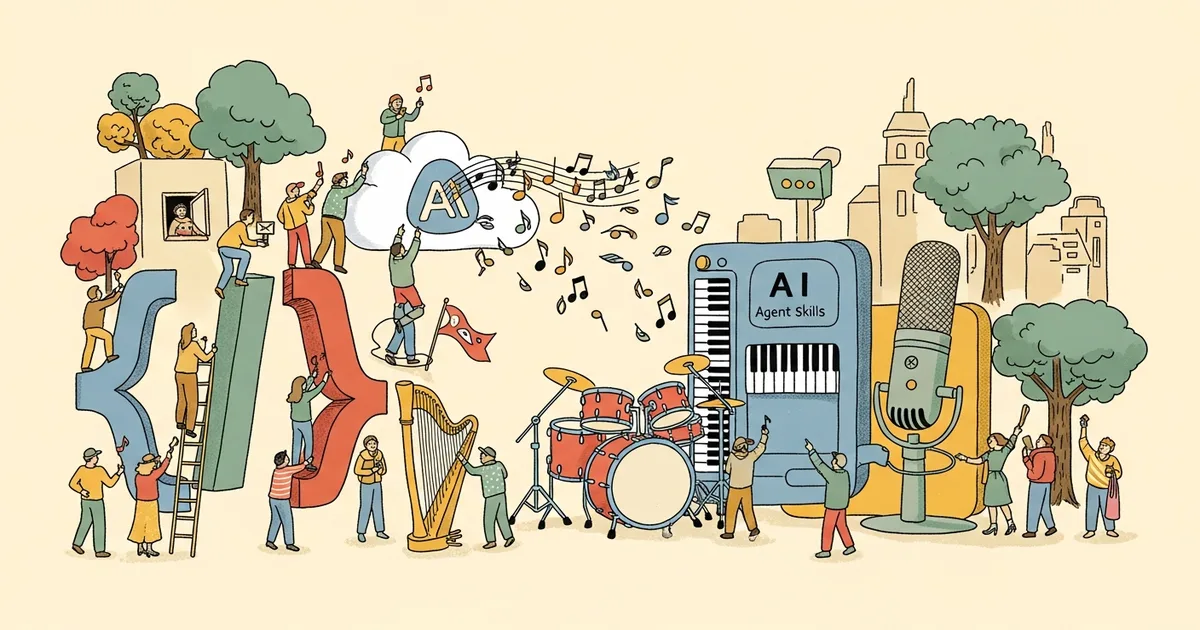
MiniMax, the Shanghai-based multimodal AI lab, open-sourced three Music Skills for AI agents on April 14, 2026 — available now via MMX-CLI — giving any Claude Code agent the ability to compose original tracks, sing in a custom voice persona, and curate playlists from a single line of text, at no API cost.
This marks the first time music generation has been packaged as open-source, composable agent skills. Until now, adding music to an AI agent workflow meant integrating Suno‘s commercial API ($8–$24/month for commercial licensing), Udio’s proprietary endpoints, or ElevenLabs‘ voice synthesis tiers — none designed for in-agent, programmatic use. MiniMax changes that calculus entirely.
The Three MiniMax Music Skills, Defined
MiniMax shipped three discrete skills, each handling a different layer of the music pipeline:
Track Generation converts a text prompt into a complete audio track. The agent automatically determines the appropriate mode — original composition, instrumental-only, or cover arrangement — based on prompt content. A prompt like “upbeat lo-fi hip-hop for a product demo, 90 seconds” produces a finished track without additional configuration.
Persona Singing assigns a voice identity to the agent and produces sung output in that persona. This isn’t a preset voice selector — it’s a character-level voice definition, letting developers build agents with consistent vocal identities across sessions. A podcast host agent can now sing its own branded intro.
Playlist Curation generates contextual track sequences based on mood, activity, or narrative arc. The skill handles both track selection from a provided library and generative filling when no source material exists.
The MMX-CLI and Claude Code Integration
All three skills are invokable via MMX-CLI, MiniMax’s open-source command-line interface, which integrates directly with Claude Code’s tool system. The workflow is a single prompt: the agent receives the instruction, calls the appropriate Music Skill via MMX-CLI, and returns the generated output — audio file or playlist manifest — without leaving the agent session.
This is architecturally significant. Claude Code agents can now treat music generation as a native capability alongside web search, file editing, and code execution. Anthropic’s expanding agent infrastructure has made Claude Code increasingly extensible — MiniMax’s open-source skills are a direct beneficiary of that architecture.
The integration requires no API key registration beyond the initial MMX-CLI setup. For developers already running Claude Code locally, the addition is essentially zero-friction.
Why Open-Sourcing Music Generation Changes the Stack
Music generation has been the last major media format locked behind proprietary commercial APIs. Text generation went open-source with Llama and Mistral. Image generation followed with Stable Diffusion and Flux. Video generation is mid-transition. Music, until MiniMax’s minimax music skills open source release on April 14, remained dominated by closed platforms with no self-hosting path.
Suno charges $8/month for commercial use of generated tracks, with output volume capped by subscription tier. Udio operates on a credit-based model with no self-hosting option. ElevenLabs, while dominant in voice synthesis, prices its music and audio features for enterprise clients — not individual developers building agents on a timeline that doesn’t accommodate per-generation billing.
MiniMax’s release removes three specific barriers simultaneously: cost per generation, API rate limits, and licensing ambiguity. Tracks generated through the open-source skill carry no commercial restriction from the generation platform itself — only the underlying model license applies.
The One-Line Prompt Workflow
The practical workflow requires no configuration overhead. An instruction like “generate a 60-second cinematic intro for a tech podcast” triggers the Track Generation skill. The agent parses intent, selects the appropriate composition mode, and returns an audio file — no intermediate steps, no explicit format specification required.
The auto-mode selection does meaningful work that most APIs push onto the developer. Standard music generation tools require explicit flags — instrumental, vocal, cover — which creates friction when music is one step in a longer agent workflow rather than the primary task. MiniMax’s skill manages that classification internally, which is a genuinely useful design decision for agent-native use.
For Persona Singing, a developer defines the voice identity once in agent configuration. Every subsequent singing call inherits that identity — the mechanism that makes consistent branded audio possible at the agent level, which no commercial API currently offers as a first-class feature.
Use Cases That Now Cost Nothing
Three production-ready applications emerge immediately:
- Podcast production: An agent that researches, writes, and publishes audio content can now generate custom theme music and transitions in the same pipeline, eliminating a separate music licensing step.
- Product demos: Agents building product walkthroughs or demo videos can score them automatically — branded, consistent, and free of stock music license concerns.
- Agent companions with voice identity: The Persona Singing skill enables agents to maintain a recognizable vocal presence. A companion app can sing greetings, narrate content musically, or maintain audio brand consistency across all user interactions.
Game development is an adjacent category with clear upside. NPC agents with generative singing capability, procedural in-game music derived from narrative context, and dynamic soundtrack curation based on player state are all tractable with these three skills combined — and the cost floor is zero.
What MiniMax Gets From This
MiniMax is executing a deliberate developer acquisition strategy — the same playbook that made Stability AI dominant in image generation before the field diversified. Open-source music skills build ecosystem presence at the agent framework level, not the end-user level. Enterprise clients who build internal agents on MMX-CLI become natural targets for MiniMax’s commercial model tiers and fine-tuning services.
MegaOne AI tracks 139+ AI tools across 17 categories — music generation is one of the fastest-moving verticals in 2026. Being the open-source default in that vertical compounds over time in ways that paid-API positioning cannot match. OpenAI’s aggressive ecosystem strategy makes open-source positioning an increasingly viable counter for labs without equivalent distribution infrastructure.
What These Skills Don’t Cover
The release handles generation and curation. It excludes mastering, mixing controls, and stem separation — capabilities that matter for professional audio production but not for the primary agent use cases. Output is production-ready for digital contexts — podcasts, demos, in-app audio — without additional post-processing.
Playlist Curation requires a local track library or previously generated tracks as inputs. It does not connect to licensed streaming catalogs. That’s a licensing constraint no open-source release can resolve, and MiniMax hasn’t tried to.
These are real limits, not blockers. Developers integrating music into agent workflows are building pipelines where audio is one output among several — not mastering suites.
If you’re running Claude Code agents today, the path is immediate: install MMX-CLI, invoke Track Generation with a single prompt, and test output quality against your use case. The cost is zero, the architecture is composable, and every week you wait is a week competitors spend building audio-native agent workflows you’ll need to catch up to.