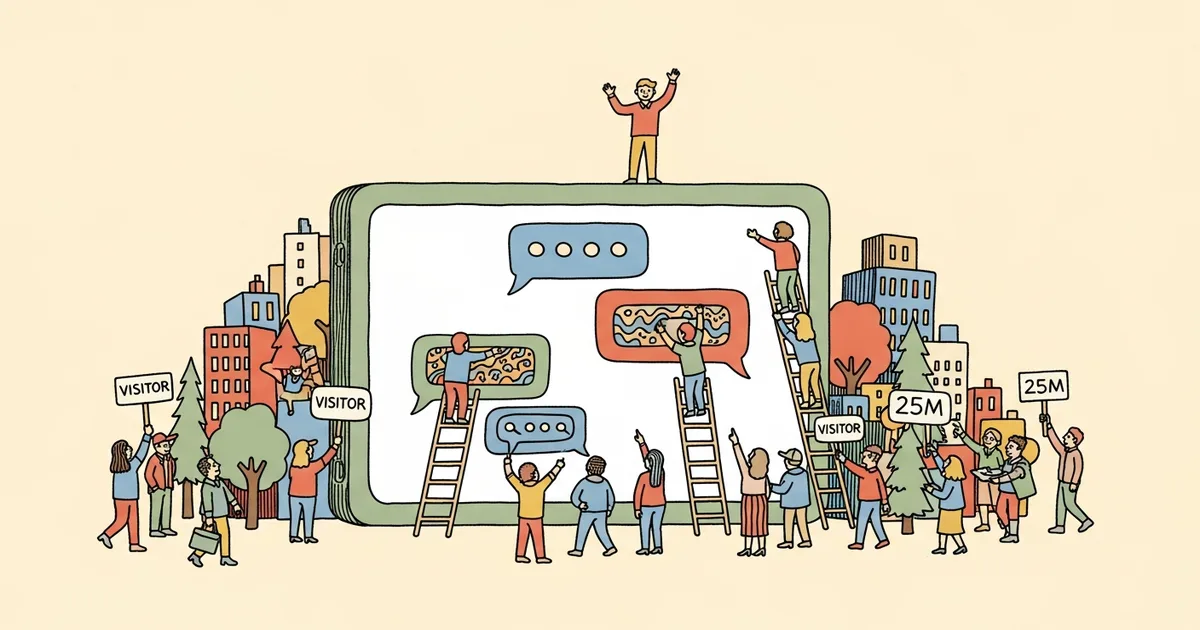
Youraislopbores.me — the youraislopbores AI chatbot staffed entirely by human volunteers — recorded 25 million unique visitors and 280 million total hits in under 30 days after launch in April 2026. Mihir Maroju, a 17-year-old high school graduate from Puducherry, India, built it with no venture capital, no press outreach, and no paid acquisition. There is no language model behind any of it.
The site’s name is taken verbatim from a meme. That is not incidental — it is the entire thesis.
How the Youraislopbores AI Chatbot Actually Works
Users visit the site, submit a prompt for text or an image, and receive a response from a human volunteer. The interface is deliberately minimal — clean enough to read as a standard LLM chatbot. What arrives varies from deadpan AI mimicry to deliberate absurdism, depending on which volunteer pulled the queue item.
Image requests yield whatever the respondent felt like producing: a pencil sketch, a crudely edited stock photo, or something entirely disconnected from the prompt, delivered with confident AI-style copy. The structural joke — that users cannot always tell whether a bad response is bad AI or a bad human — lands because it is not always obvious. That ambiguity is not a flaw in the premise. It is a commentary on where LLM output quality currently sits.
Maroju described the mechanics as a volunteer routing system with a queue that matches prompts to available humans. Average response times run several minutes — slower than any production LLM by an order of magnitude. Users waited anyway.
The Traffic Numbers Are Not Noise
25 million unique visitors in 30 days places youraislopbores.me in the monthly traffic bracket of established mid-sized news publications. For comparison, the average venture-backed SaaS product takes 14 to 18 months to reach one million users. This site hit 25x that figure with a single developer and zero paid acquisition.
The 280 million total hits figure implies a return visit rate well above standard web benchmarks. Users did not bounce after one prompt. They came back, submitted additional requests, shared screenshots, and watched others’ prompts get answered — a spectator dynamic that any chatbot running on a deterministic LLM structurally cannot generate. The unpredictability of human respondents is itself a draw.
Traffic analysis based on social media tracking indicates the site peaked following high-volume posts on Reddit’s r/ChatGPT and r/mildlyinfuriating, where screenshots of the most absurd human responses circulated as independent content. The site became a content source for other platforms — a viral distribution loop that funded startups spend years failing to engineer deliberately.
Who Mihir Maroju Is
Maroju is 17 and had just finished high school when he launched the site from Puducherry, a coastal city in southeastern India formerly known as Pondicherry. He built youraislopbores.me independently. His own account of the outcome is understated: “I didn’t really expect it to be so addictive.”
The technical execution is not trivial. A volunteer routing system, a responsive front end, and infrastructure stable enough to absorb hundreds of millions of requests without collapsing is real engineering work. That a recently graduated high school student did it independently either reflects well on self-taught engineering capability or poorly on how over-engineered equivalent funded products tend to be. Possibly both.
The “AI Slop” Meme, For Anyone Who Missed It
“Your AI Slop Bores Me” spread widely through 2024 and accelerated through 2025 as shorthand for collective exhaustion with AI-generated content — the uncanny smoothness of LLM prose, the six-fingered hands in generated images, the corporate-neutral register that sounds like it was focus-grouped by nobody in particular.
“AI slop” as a cultural category crystallized around specific, recognizable patterns: LinkedIn posts indistinguishable from each other regardless of author, customer service bots that acknowledge your frustration in three different ways before doing nothing about it, news aggregators padded with AI summaries that omit the one detail that mattered. AI has penetrated consumer products deeply enough that the homogenization became impossible to miss in ordinary daily use.
By naming the site after the meme, Maroju embedded the cultural critique in the URL itself. Every visit is an implicit vote against the thing being mocked.
Why Humans Pretending to Be AI Is Funnier Than the Reverse
The conventional axis of AI comedy runs one direction: pointing out where LLMs fail to pass as human — the stilted phrasing, the hallucinated citations, the refusals that misread obvious context. Youraislopbores.me inverts it entirely. The joke is humans trying, and sometimes succeeding too accurately, at imitating machines.
When a volunteer responds with “As an AI language model, I cannot fulfill this request, but I have generated a 600-word summary of why the image you requested falls outside my operational parameters,” the comedy operates on two registers simultaneously. It parodies LLM hedging behavior accurately enough to be recognized instantly, and the instant recognition reveals how thoroughly those patterns have been absorbed by ordinary users. People laugh because they have read that sentence — or something structurally identical to it — from actual AI systems more times than they can count.
This is cultural critique at maximum efficiency. The growing Humans First movement has articulated the same frustration in more formal registers — manifestos, product positioning, editorial policies against AI-generated copy. Maroju expressed the identical argument with a domain name and a volunteer queue.
Consumer Fatigue Is Now a Measurable Market Signal
The traffic numbers are revealed preference data, not survey responses. 25 million users chose to interact with a deliberately inferior product — slower, less reliable, and more chaotic than any production LLM — because the inferiority was the feature. That is a meaningful signal about what people actually want versus what the industry assumes they want.
Corroborating data points have been accumulating. Substack newsletters that explicitly label themselves as human-written have reported above-average subscriber growth rates throughout 2025. Platforms that added AI-assisted content creation features have documented declining engagement on AI-generated posts relative to native content. The AI video generation market — despite sophisticated tools from ElevenLabs, HeyGen, and Synthesia — faces persistent consumer resistance rooted in the uncanny quality of AI presenters rather than any technical shortcoming.
The mechanism is straightforward. Two years of exponential AI content production have saturated every major distribution channel. When everything is generated, the generated-ness recedes as a distinguishing trait — it just reads as noise. Human-made content, with its visible imperfections and specific point of view, reads as signal against that background.
What This Tells Product Teams Building on LLMs
The AI industry’s prevailing benchmark has been Turing Test framing — making AI indistinguishable from human. Youraislopbores.me’s numbers suggest the consumer premium has begun to invert. Distinguishability from AI is now a feature worth advertising, not a limitation to apologize for. “Written by a human” is tracking toward the same semantic function as “organic” or “handmade” — a quality marker that commands a price premium precisely because the industrial default has shifted in the opposite direction.
This does not mean LLMs are losing commercial ground. OpenAI’s enterprise agreements and comparable B2B contracts demonstrate the automation case for large organizations remains intact. The backlash is concentrated in consumer-facing contexts — entertainment, social interaction, cultural participation — where authenticity signals matter and homogeneity is a product failure, not a neutral outcome.
MegaOne AI tracks 139+ AI tools across 17 categories, and the pattern is consistent: tools that surface human editorial voice or genuine unpredictability retain engagement better than tools that optimize for smooth, frictionless output. Smoothness has become associated with inauthenticity. Friction, in the right quantities, is now a feature.
For product teams: youraislopbores.me’s data suggests users are not uniformly pro-AI or anti-AI. They are responsive to unpredictability and bored by sameness. The products that hold attention in 2026 are those that use AI invisibly for infrastructure while surfacing something — editorial voice, human perspective, deliberate imperfection — that justifies a return visit.
Maroju did not build a movement. He built a joke that 25 million people were already waiting to laugh at. The industry should probably figure out why.