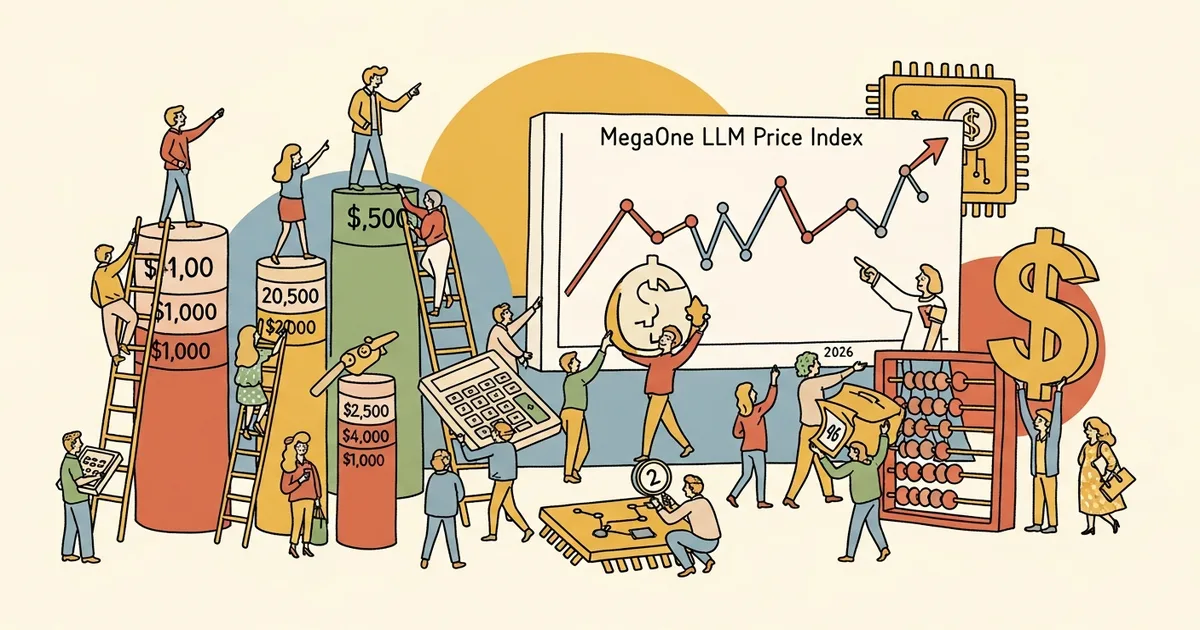
- MegaOne’s LLM Price Index tracks live pricing for 536 models; output-token prices span $0.03 to $600 per million — a roughly 20,000x spread.
- The index covers 212 proprietary and 164 open-weight models with published pricing, and the two groups now meet at the same $0.03 price floor.
- The market has split into a premium “reasoning” tier ($120-$600 per million output tokens) and a commodity “workhorse” tier ($5-$50).
- OpenAI’s o1-pro sits at the ceiling at $600 per million output tokens — 20,000 times the price of the cheapest usable models.
As of August 2026, MegaOne’s LLM Price Index tracks live pricing for 536 large language models, and the single most important fact about the market is its sheer dispersion: output-token prices run from $0.03 to $600 per million tokens. That is a 20,000-fold spread for what buyers often treat as one product category. The average sits near $10 per million output tokens, but the average is misleading — the market has fractured into distinct tiers that serve entirely different jobs.
The market has split into two tiers, not one
There is no longer a single “LLM price.” There are two markets. The premium reasoning tier — the “Pro” and high-end models built for hard, multi-step problems — runs from roughly $120 to $600 per million output tokens. The workhorse tier, where the vast majority of real production traffic actually runs, sits between $5 and $50. Buying decisions that treat these as substitutes will overpay by an order of magnitude or ship an underpowered agent, depending on which direction the mistake runs.
The ceiling: 0 per million tokens
OpenAI’s o1-pro anchors the top of the index at $150 input and $600 output per million tokens. Below it, a cluster of reasoning-tier models sits between $168 and $180 output: OpenAI’s GPT-5.5 Pro, GPT-5.4 Pro, and GPT-5.2 Pro, alongside Anthropic’s Claude Opus 4.6 (Fast) at $150. These prices are not arbitrary — they reflect the compute cost of extended reasoning, and they are the reason batch and cached-input pricing exists. GPT-5.5 Pro’s batch tier, for instance, halves the output price to $90. If a workload can tolerate latency, the batch tier is the single largest lever on cost at the frontier.
The workhorse tier is where the real money is spent
Most production applications never touch the reasoning tier. They run on models like GPT-5.5 at $5 input and $30 output, or Anthropic’s Claude Opus 4.8 (Fast) and the newer Claude Opus 5 (Fast) at $10 input and $50 output — all with context windows around one million tokens. This is the tier that matters for agent economics, because agents burn tokens across many steps, and a $30-versus-$50 output price compounds fast over a long tool-calling chain. The token efficiency of a model — how many output tokens it needs to finish a task — often matters more than its headline per-token price.
The floor has collapsed to three cents
At the bottom of the index, output prices reach $0.03 per million tokens — models like Meta’s Llama Guard 3 8B and Mistral Nemo. What is striking is that open-weight and proprietary models now meet at the same floor: the cheapest open-weight model and the cheapest proprietary model are both priced at $0.03 output. The collapse of the price floor, driven largely by Chinese and open-weight labs, is the defining pricing story of 2026 — and it is why frontier labs are increasingly defending margin at the reasoning tier rather than the commodity tier.
How to use the index
The practical takeaway is to price by tier and by task, not by brand. For high-stakes reasoning where a wrong answer is expensive, the $120-$600 tier is justified; for everything else — classification, extraction, routing, most chat — the $5-$50 workhorse tier delivers the vast majority of the value at a fraction of the cost, and the sub-$1 open-weight tier handles bulk work. MegaOne’s LLM Price Index maintains these 536 prices live, with the historical trend that shows the floor falling quarter over quarter. The models change monthly; the tier structure is what to plan around.