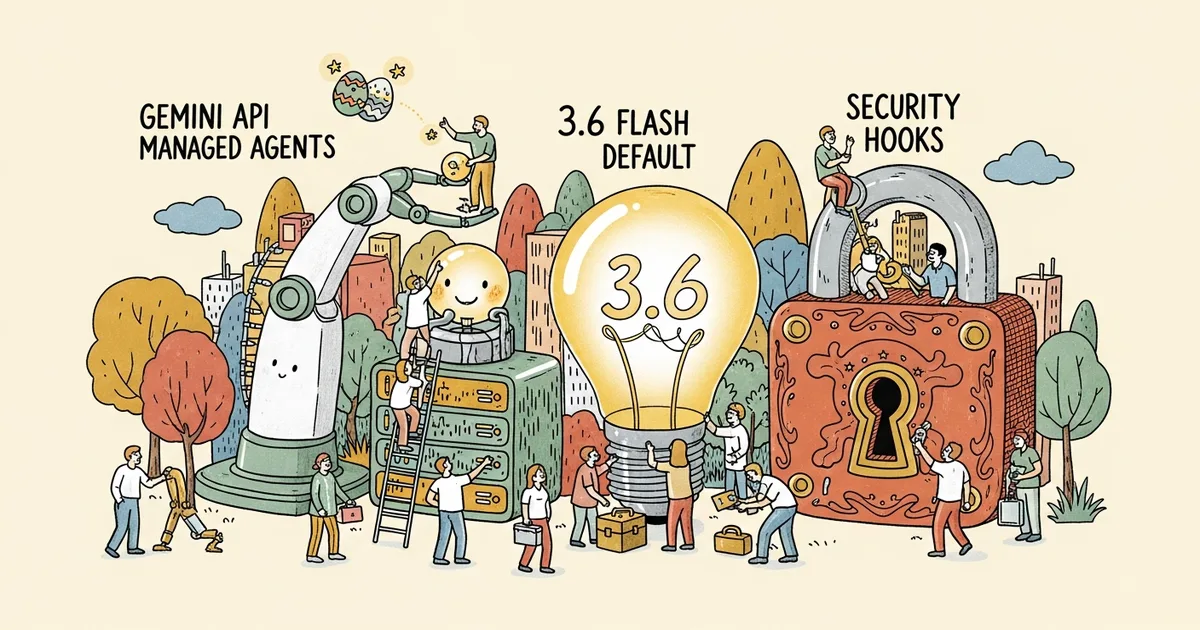
- Managed Agents in the Gemini API now default to Gemini 3.6 Flash, with no code changes required.
- New environment hooks let developers run custom scripts to block, lint, or audit an agent’s tool calls before or after execution inside the sandbox.
- Google also added budget controls, scheduled triggers, and free-tier access.
- A single API call coordinates reasoning, code execution, package installation, file management, and web retrieval inside an isolated cloud sandbox.
What Happened
Google updated Managed Agents in the Gemini API with a new default model, environment hooks, and free-tier access, according to a July 28, 2026 post by Google DeepMind’s Philipp Schmid and Mariano Cocirio. The update builds on a prior release that introduced background tasks and remote MCP server integration.
Why It Matters
The headline addition is a governance layer for agentic tool use. As AI agents gain the ability to run code and modify files autonomously — the same capability behind recent security incidents — the environment hooks give developers a programmatic way to inspect and veto individual tool calls before they run, rather than trusting the model’s judgment alone.
Technical Details
The antigravity-preview agent now runs Gemini 3.6 Flash by default, picked up automatically on the next interaction; developers can override via agent_config.model to select Gemini 3.5 Flash or the lower-cost 3.5 Flash-Lite. Environment hooks are configured in an .agents/hooks.json file and fire on pre_tool_execution or post_tool_execution events, with a matcher field supporting regular expressions to target specific tools or catch everything with a wildcard. In Google’s example, a “security-gate” runs a gate.py script before every code_execution or write_file call — if it returns a deny decision, the tool call is skipped and the reason is passed into the model’s context — while an “auto-format” group runs a linter after every tool finishes. Hooks also support HTTP handlers that POST to an external endpoint. A single Interactions API call coordinates reasoning, code execution, package installation, file management, and web retrieval inside an isolated cloud sandbox.
Who’s Affected
The update targets developers building agents on Gemini, particularly those who need auditability and guardrails around autonomous tool calls. The budget controls and free-tier access lower the barrier for experimentation, while the hooks address the security and compliance concerns that have grown as agents take on code execution and file writes without a human in the loop.
What’s Next
The release continues Google’s build-out of managed, server-side agents that run in a hosted sandbox rather than on the developer’s machine. With models like 3.6 Flash pitched on token efficiency and the new hooks pitched on control, the practical question is whether developers adopt the managed-agent model over self-hosted agent frameworks — a trade of infrastructure control for Google-run orchestration and built-in guardrails.