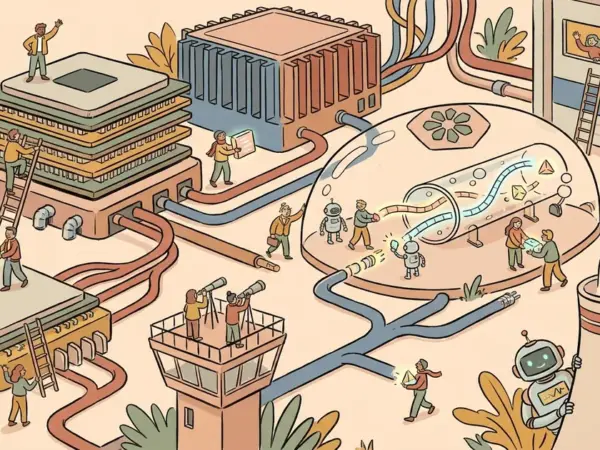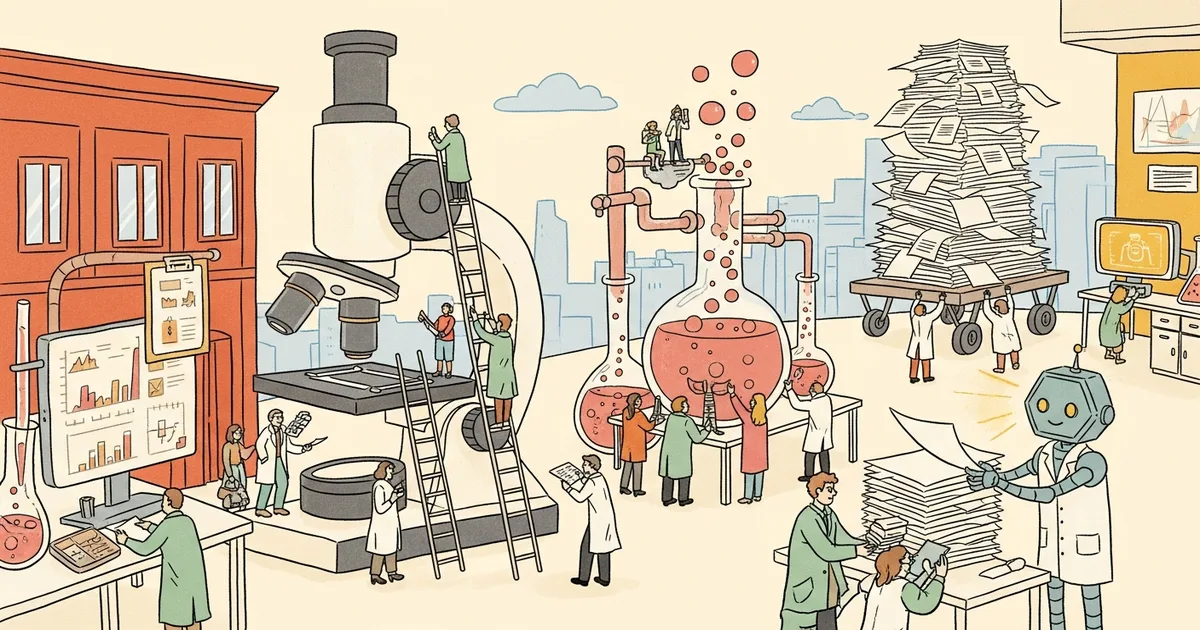
- OpenAI published a field report on eight agent-assisted scientific computing projects — five using Codex alone, three combining Codex and Claude Code — mostly in the life sciences.
- Contributors report agents significantly accelerated software development, letting small teams take on work that would otherwise require far more time or specialized engineering.
- The researcher’s role shifts from implementation to verification and orchestration: specifying what to build and defining how to measure correctness.
- The new bottleneck is validation — agents handled well-scoped tasks but could not reliably judge scientific validity, and often expressed confidence even when their work contained clear errors.
What Happened
OpenAI published an exploratory field report on July 28, 2026 covering eight agent-assisted scientific computing projects, primarily in the life sciences, according to the company’s announcement. Five projects used Codex alone and three combined Codex with Anthropic’s Claude Code; the case studies were written by the teams behind each project.
Why It Matters
Much scientific software began as code accompanying a research paper — built by small academic teams with limited engineering time for packaging, testing, or long-term support — leaving fragile workflows that impede discovery. The report’s central claim is that agents lower the cost of that engineering labor, but in doing so relocate the constraint: the bottleneck is now validating an agent’s output, which still depends on human judgment.
Technical Details
The projects ranged from routine maintenance and targeted optimization to large-scale language migrations and GPU-native redesigns. In one, GPT-5.5 replaced the legacy build and packaging system of cyvcf2, a Python library for reading genomic variant files. Across case studies, agents handled specific, well-scoped requests effectively but could not reliably judge whether their work was scientifically valid — and, the report notes, “often expressed confidence even when their work contained clear errors.” The strongest validation approaches used an external reference or measurable acceptance target: exact output agreement, parity with an existing tool, appropriate statistical behavior, or answers established in advance using simulated data. Projects generally proceeded in feedback-driven stages rather than one shot, with the “last mile” of edge cases and subtle numerical differences taking the longest.
Who’s Affected
The findings speak to academic and industry research teams that maintain scientific software, and to the labs whose coding agents — OpenAI’s Codex and Anthropic’s Claude Code — are now doing that work. As contributor Brent Pedersen put it: “With coding agents, it’s quite easy to go fast; for now, to go far in science, there’s still a need for expert guidance, understanding, taste, and care.”
What’s Next
The report flags an unresolved challenge: establishing clear, long-term responsibility and stewardship for agent-built tools, since velocity gains do not answer who maintains and vouches for the resulting software. In the emerging model OpenAI describes, researchers keep control of scientific direction and the quality bar while agents supply the speed — a division of labor whose durability depends on validation methods keeping pace.