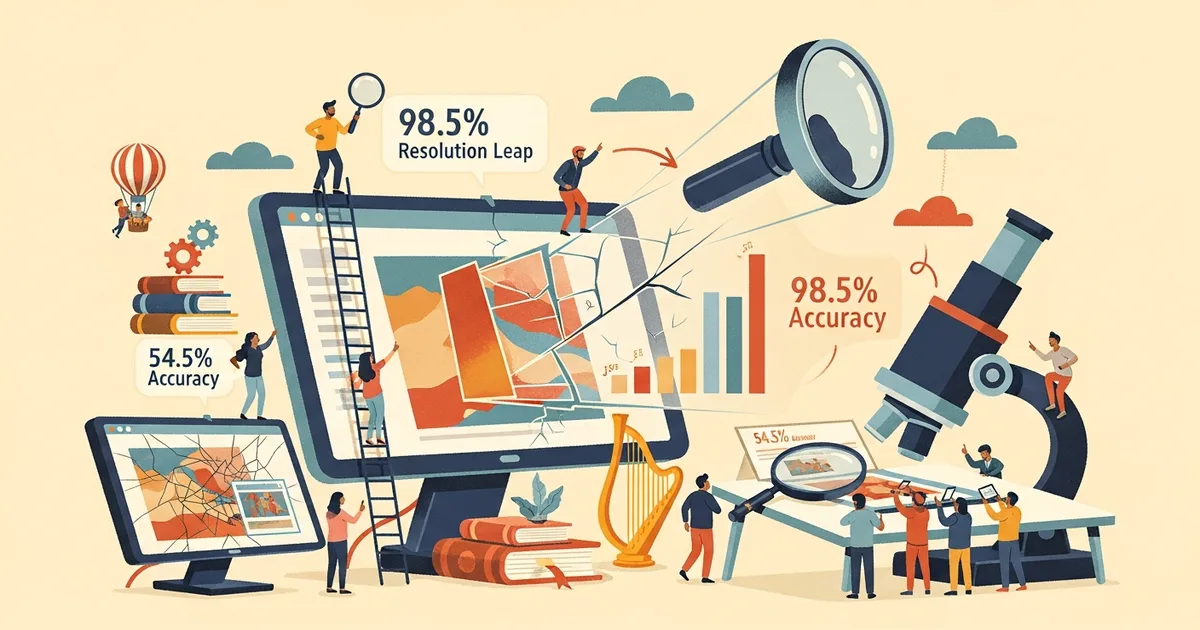
Anthropic’s Claude Opus 4.7, released April 21, 2026, ships with the largest vision upgrade in the company’s model history: maximum image resolution rises from 1,568 pixels (1.15 megapixels) to 2,576 pixels (3.75 megapixels), a 3.3x increase in total pixel count. The result is a model that scores 98.5% on the XBOW Visual Acuity benchmark for screenshot interpretation — up from 54.5% on Opus 4.6. That 44-point jump is the most significant single-generation computer-use accuracy improvement from any major model in 2026, and it arrives alongside a coordinate system redesign that eliminates a class of bugs that has plagued computer-use agent developers for two years.
The Resolution Numbers: 1.15MP to 3.75MP
The resolution ceiling for Claude models held at 1,568 pixels on the longest edge through Opus 4.6. Opus 4.7 raises that to 2,576 pixels — a 64% increase in linear resolution that compounds to a 3.3x increase in total pixel information. Pixel count scales with the square of linear dimension, which is why a number that sounds incremental on a single axis becomes substantial in practice.
Opus 4.7 is the first Claude model with native high-resolution image processing support. At 1.15 megapixels, a standard 1,920 × 1,080 screenshot gets downsampled before the model processes it — text below roughly 12px loses definition, small UI elements blur, and status indicators become ambiguous. At 3.75 megapixels, Opus 4.7 processes that screenshot at close to native resolution. The difference between a “Save” button and a “Save As” button, or a checkbox labeled “Send notifications” versus “Send all notifications,” becomes reliably distinguishable.
1:1 Coordinate Mapping: The Developer Friction That’s Finally Gone
Prior Claude models used an internal coordinate reference frame that did not correspond directly to actual screen pixels. When Opus 4.6 output a coordinate like (800, 450), the correct screen coordinate required multiplying by a display scale factor — a conversion developers had to implement manually in every computer-use agent they built. Getting that factor wrong produced silent failures: clicks landing on adjacent UI elements, form fields incorrectly targeted, navigation buttons missed by 30–40 pixels.
Opus 4.7 eliminates the scale-factor requirement entirely. Coordinate outputs now map 1:1 to actual pixel positions. A click instruction for pixel (1,240, 890) targets pixel (1,240, 890) on the screen — no client-side math required. This removes an entire layer of error-prone glue code and makes agent behavior predictable across display configurations. It is a change independent of the resolution increase that compounds with it.
XBOW Visual Acuity: 54.5% to 98.5% in One Generation
The XBOW Visual Acuity benchmark measures a model’s ability to correctly interpret UI elements, text, and spatial relationships from screenshots — the core input task for every computer-use agent. Opus 4.6 scored 54.5%. Opus 4.7 scores 98.5%.
The asymmetry of that gap is what makes it practically significant. A 54.5% accuracy rate means the model misidentifies nearly half of all screenshot elements. In a 10-step computer-use workflow where each step requires accurate screenshot interpretation, per-step accuracy of 54.5% compounds to roughly a 0.2% probability of completing all 10 steps correctly — making multi-step autonomous workflows functionally unreliable without a human checkpoint at every action. At 98.5% per-step accuracy, a 10-step workflow succeeds approximately 86% of the time. That is the distance between a demo and a deployable product.
XBOW specifically isolates screenshot acuity from downstream task reasoning, which makes it a clean signal for what the resolution upgrade directly improves. The 44-point jump is the largest single-generation improvement Anthropic has published on this benchmark, and represents the largest computer-use accuracy leap from any major frontier model in 2026, according to Anthropic’s release documentation.
What This Means for Computer-Use Agent Deployments
Computer-use agents — AI systems that operate desktop and web software by observing screenshots and issuing mouse/keyboard commands — have been bottlenecked by vision accuracy since their commercial introduction. Anthropic’s Claude Computer Use preview launched in late 2024 with enough accuracy to demonstrate the concept; it did not have enough accuracy to run in production without supervision. That calculus changes with a 98.5% XBOW score.
Workflows that previously required human checkpoint verification every 3–5 actions can now run longer autonomous sequences with materially higher confidence. Tools in the growing ecosystem of visual-interface automation — including autonomous exploration agents built on reliable visual parsing — now have a substantially more capable vision substrate. MegaOne AI tracks 139+ AI tools across 17 categories; computer-use is one of the fastest-accelerating verticals in 2026.
The 1:1 coordinate fix compounds the accuracy improvement in a way that matters for production. An agent that correctly identifies a UI element at 98.5% accuracy but then miscalculates its position due to scale-factor errors still fails. Eliminating both failure modes simultaneously — misidentification and mislocation — is what makes Opus 4.7’s upgrade actionable rather than just benchmark-notable.
The Token Cost Tradeoff
Higher resolution is not free. Anthropic’s API tokenizes images proportionally to pixel count. A 3.75-megapixel image at Opus 4.7’s maximum resolution consumes roughly 3.3x as many input tokens as the same image processed at 1.15 megapixels. For agents running at high frequency — continuous UI monitoring, browser automation, persistent desktop observation at scale — this differential compounds quickly.
The practical approach is resolution tiering: route simple UI element detection tasks (large buttons, primary navigation, standard form fields) to lower-resolution inputs where 1.15MP processing is sufficient. Reserve 3.75MP for text-dense interfaces, fine-print documents, or complex layouts where coordinate precision is critical. Anthropic’s API accepts explicit image size parameters, so this tiering is implementable at the application layer without model switching.
The cost decision is context-specific. An agent making 100 screenshot observations per hour faces meaningful token cost inflation at maximum resolution. An agent making 10 targeted observations per workflow — reading a contract, filling a complex enterprise form, navigating a multi-step approval UI — will find the accuracy improvement justifies the overhead. The rule of thumb: optimize cost for high-frequency observation, optimize accuracy for high-consequence actions.
Opus 4.7 vs. GPT-5.4 on Computer Use
OpenAI’s GPT-5.4 is Opus 4.7’s primary frontier competitor for computer-use deployments in April 2026. Direct XBOW comparisons are unavailable — OpenAI does not publish results on the XBOW benchmark, and the OSWorld and WebVoyager evaluations OpenAI uses cover different task distributions. Cross-benchmark mapping is directional at best; treat any direct score comparison with skepticism.
On the specification level: Opus 4.7’s 2,576px resolution ceiling exceeds GPT-5.4’s supported image resolution for computer-use tasks by a material margin, providing more pixel information per screenshot at equivalent input. The 1:1 coordinate mapping is a structural architectural difference — developers working with GPT-5.4’s computer-use API report the same scale-factor correction requirements that Anthropic has now eliminated natively. That is a developer experience gap that shows up in integration complexity and debugging time, independent of raw accuracy numbers.
As consolidation accelerates across the AI infrastructure layer, computer-use accuracy is emerging as a primary enterprise differentiation metric. Anthropic’s development velocity on agentic capabilities has been aggressive throughout 2026; the 44-point XBOW improvement is the most concrete benchmark evidence of that pace.
Drop the scale-factor correction code. Tier resolution to task complexity. Budget for 3.3x token overhead on high-resolution inputs. Opus 4.7’s computer-use accuracy at 98.5% clears the threshold where autonomous multi-step workflows are worth deploying in production — and that changes the build decisions for every team working in this space in 2026.