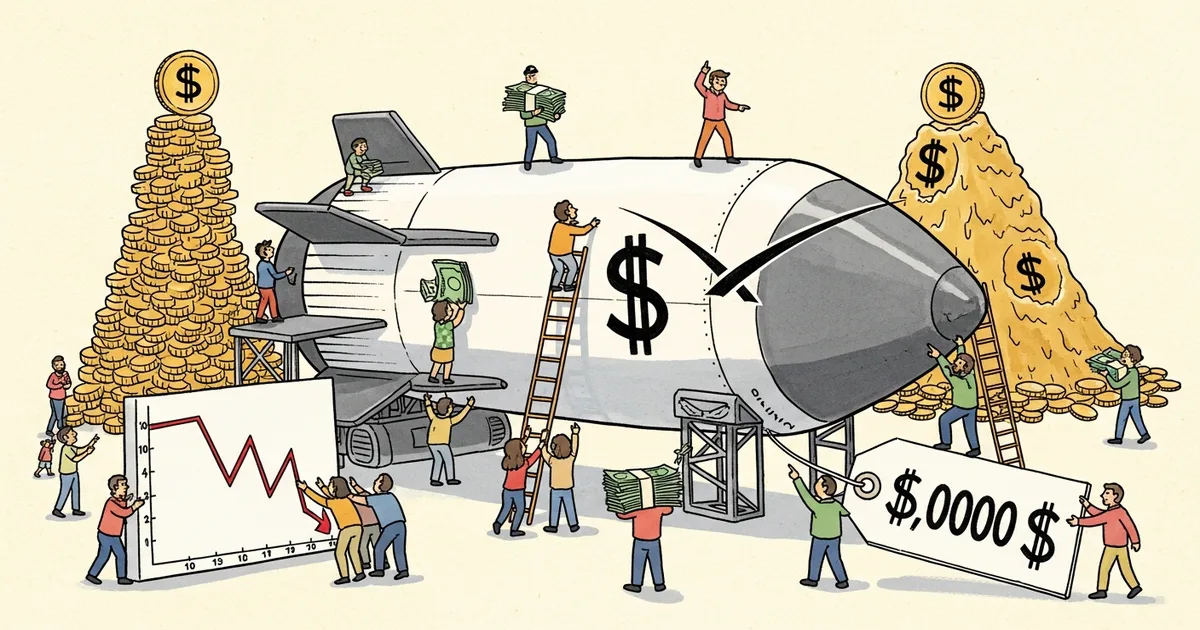
SpaceX‘s preliminary prospectus, circulated May 20, 2026, reveals a company losing money fast while seeking the highest valuation in IPO history. The numbers: $18.67 billion in consolidated 2025 revenue, a $4.94 billion net loss for 2025, a $4.28 billion net loss in Q1 2026 alone, and $6.58 billion in adjusted EBITDA.
At a $1.75 trillion target, SpaceX would trade at roughly 94x 2025 revenue — a multiple that demands scrutiny.
The revenue-multiple math
| Company | Revenue multiple |
|---|---|
| SpaceX (target) | ~94x revenue |
| Anthropic ($965B) | ~20x ($47B run rate) |
| NVIDIA | ~25x revenue |
SpaceX is effectively asking investors to pay roughly four times what Anthropic’s investors paid at a $965 billion valuation on a revenue-multiple basis — while losing more money.
The bull case
The optimistic read rests on three assets: Starlink’s 7,000-plus satellites generating recurring revenue, the Starship program opening heavy-lift launch economics, and the xAI/Grok AI portfolio folded in post-merger. Each is a category leader; together they justify a growth multiple no legacy aerospace name could claim.
The bear case
The skeptical read is simpler: a $4.28 billion quarterly loss and concentrated governance risk. Elon Musk runs Tesla, SpaceX, xAI, and X simultaneously — four demanding companies under one CEO. A 94x revenue multiple leaves no room for execution stumbles.
What the prospectus says about AI
The consolidated revenue includes xAI post-merger, so AI is now structurally inside SpaceX’s financials rather than a side bet. That ties the launch-and-satellite business to the same AI-infrastructure spending cycle driving the rest of the sector — and to the same June 12 listing that will reprice AI-adjacent megacaps.
The number to anchor on is 94x. If SPCX holds near $1.75 trillion, the market is pricing Starship and Starlink growth as near-certain — and Q1’s $4.28 billion loss as a phase, not a pattern.