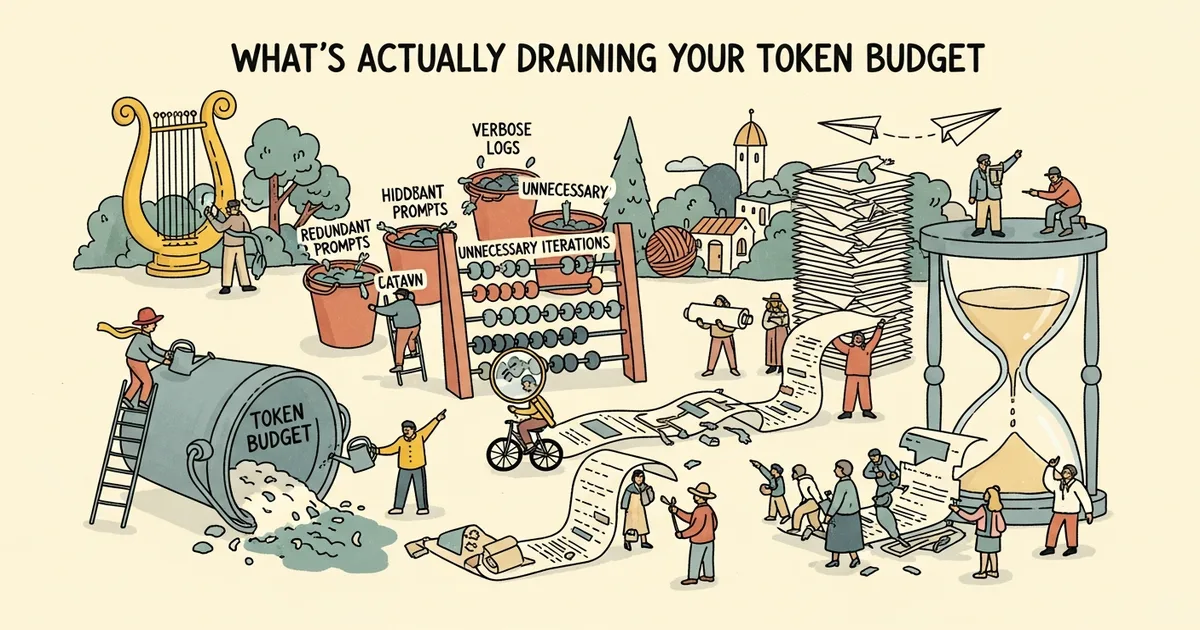
Anthropic’s Claude Code, the agentic AI coding tool released commercially in 2025, added a /usage command in early 2026 that surfaces granular token consumption data — and the numbers it exposed are forcing a fundamental rethink of how development teams budget for agentic AI work. Developer analysis in April 2026 shows that parallel subagent sessions, cache misses on resumed conversations, and large-repository context ingestion combine to multiply actual costs 3x to 8x above naive estimates. Claude Code is the first AI coding tool to disclose its internal cost structure this transparently, and that transparency is both a competitive risk for Anthropic and an unexpected gift for cost-conscious engineering teams.
The three cost drivers account for an estimated 70–80% of unexpected token consumption in production workflows. Understanding them — and the optimization techniques that counteract them — is now essential knowledge for any team spending more than $200 per month on Claude Code.
What the /usage Command Actually Shows
The /usage command surfaces cumulative token statistics broken down by session: input tokens consumed, output tokens generated, cache writes, and cache reads. For most developers running it for the first time, the cache hit rate is the first shock.
A well-optimized agentic session should show a cache hit rate above 85%. In practice, developers are reporting rates between 40–60%, meaning 40–60% of input tokens are being charged at the full uncached rate — approximately 10x higher than the cached rate under Anthropic’s current pricing structure. Cache reads on Claude Sonnet 4.6 run at roughly $0.30 per million tokens; uncached input runs at $3.00 per million. The gap between a cache-warm workflow and a cache-cold one is not marginal — it is the difference between a sustainable unit economics model and a quietly catastrophic one.
The breakdown covers three distinct categories: the primary agent session, spawned subagents, and tool calls. Each category has a different cost profile and a different remediation strategy.
The Three Biggest Claude Code Subagent Token Costs
Parallel subagents, session cache misses, and whole-codebase ingestion are the primary drivers of inflated token spend. They often occur simultaneously, compounding the damage.
1. Parallel Subagents: Full Context Duplication per Branch
When Claude Code dispatches parallel subagents — running simultaneous research and implementation tasks, or splitting a refactor across multiple agents — each subagent carries its own complete context. The same system prompt, codebase snapshot, and conversation history is replicated across every parallel branch.
A developer running four parallel subagents on a 50,000-token codebase context does not spend 50,000 tokens on context. They spend approximately 200,000 tokens on context alone, before any work begins. Each subagent also generates output that feeds back into subsequent context, compounding the cost further. A four-agent parallel workflow processing a medium-sized repository can consume 2–3 million tokens in a single session — approximately $6–9 at Sonnet 4.6 pricing — before a single line of production code is committed.
The subagent architecture is one of the most powerful features in Claude Code’s toolset, as covered in Anthropic’s earlier work on agent architecture. But that power has a direct, measurable cost that the /usage command now makes impossible to ignore.
2. Cache Misses: The Five-Minute Cliff
Anthropic’s prompt cache has a five-minute TTL (time-to-live). Any session resumed after five minutes — including sessions paused overnight, across meetings, or between IDE context switches — loses its entire cached context and must re-ingest everything from scratch at full input pricing.
For a large-repository session that has accumulated 100,000 tokens of context, a single cache miss costs an additional $0.30 in input tokens at Sonnet 4.6 rates. That is roughly the cost of ten fresh, fully-cached sessions. Developers resuming paused sessions multiple times daily pay this penalty repeatedly — often without realizing it, because the token cost is invisible until /usage surfaces it.
Cache writes carry a slight premium over uncached reads as well, meaning the act of re-warming a cache after a miss incurs a write cost on top of the full uncached input cost. The TTL cliff is among the most counterintuitive cost structures in any developer tool currently on the market.
3. Large-Repository Ingestion: 150,000 Tokens Before the First Output
Claude Code reads repository files into context aggressively. On repositories above 10,000 lines of code, a complex multi-file task can ingest 80,000–150,000 tokens of source files before generating a single token of output. Operations like codebase-wide refactoring, cross-file dependency analysis, and test suite generation are particularly expensive.
A single test generation pass across a 50-file Python project has been documented at 180,000+ input tokens — approximately $0.54 at current Sonnet 4.6 rates, before any iteration or follow-up. Teams running these operations multiple times per day on active codebases are accumulating costs that no flat-subscription mental model can adequately prepare them for.
How This Compares to Cursor, Copilot, and Codex
Claude Code’s cost transparency has no direct equivalent in competing AI coding tools. GitHub Copilot, Cursor, and OpenAI Codex all abstract away token consumption behind flat subscriptions or undisclosed per-request structures, making comparative unit economics analysis structurally impossible for users.
| Tool | Cost Visibility | Per-Operation Breakdown | Cache Transparency | Real-Time Usage |
|---|---|---|---|---|
| Claude Code | Full token detail via /usage | Input, output, cache separate | Yes — hits vs. misses | Yes |
| Cursor | Request count only | No | No | Limited |
| GitHub Copilot | None (flat subscription) | No | No | No |
| OpenAI Codex | API-level only (external tooling required) | Partial | No | No |
Cursor’s Pro tier at $20/month caps “fast requests” without defining what a fast request is or disclosing its token equivalent. GitHub Copilot Enterprise at $39/user/month provides zero per-operation visibility. Developers using these tools cannot calculate cost-per-task or build optimization models — the opacity is a structural feature for the vendors, since it prevents cost-based competitive comparisons.
Claude Code’s transparency is an unusual commercial decision. Exposing per-operation token costs allows developers to calculate exactly what each workflow costs, compare it against alternatives, and optimize against measurable targets. The industry’s broader trajectory toward undisclosed costs — visible in OpenAI’s tool ecosystem strategy — makes Anthropic’s choice notably divergent.
Anthropic’s Official Optimization Recommendations
Anthropic has published guidance addressing the three cost drivers identified above. The core recommendations map directly to the architectural roots of each problem.
Reduce parallel subagent concurrency. For most development tasks, running two subagents concurrently rather than four reduces context duplication by 50% with minimal throughput impact. Sequential subagent workflows — where output from one agent seeds the next — cost significantly less than fully parallel approaches for tasks with natural dependencies.
Warm caches before large operations. Structuring sessions so large-context operations run within a single five-minute cache window prevents TTL-driven re-ingestion. For extended refactoring sessions, keeping the Claude Code terminal active maintains cache warmth. A simple no-op command every four minutes is sufficient to reset the TTL and avoid the 10x input penalty.
Chunk large-file operations. Rather than ingesting an entire codebase at once, limiting operations to the files actually needed for a given task reduces input token volume significantly. Using Claude Code’s file filtering and path-targeting capabilities — rather than allowing the agent to self-select context — consistently reduces per-task input by 30–60%, according to developer-reported benchmarks.
Use /compact on long sessions. Claude Code’s /compact command compresses conversation history, trading some context fidelity for a significant reduction in rolling context size. For iterative debugging loops that accumulate dense output history, compact mode reduces total session costs by 35–45% in documented developer workflows.
Cutting Your Token Burn Rate by 50% or More
Combining Anthropic’s recommendations with techniques developed by the Claude Code developer community, teams have documented consistent burn rate reductions of 50–70% without measurable quality degradation on equivalent tasks.
The highest-leverage changes, ranked by impact:
- Reduce parallel subagents from 4+ to 2 — estimated 40–50% reduction in context duplication costs on parallelized workflows
- Implement cache-warm sessions before high-cost operations — eliminates cache miss penalties, saving $0.20–0.40 per major operation on large repositories
- Target specific files rather than whole-codebase operations — reduces per-task input tokens by 30–60%
- Run /compact on sessions exceeding 20 turns — reduces rolling context by 35–45%
- Batch small tasks into single sessions — amortizes the context setup cost across multiple operations instead of paying it repeatedly
A development team processing 500 tasks per month at an average unoptimized cost of $2 per task spends $1,000 per month. Applying the full optimization stack brings per-task cost to approximately $0.60–0.80, reducing total monthly spend to $300–400. At enterprise scale — 10,000 tasks per month — that gap is $12,000–14,000 in monthly savings.
What This Reveals About the Economics of Agentic Coding
The /usage data is reshaping how engineering teams model AI coding costs. The flat-subscription mental model — inherited from GitHub Copilot’s autocomplete-era design — breaks down the moment agentic workflows are introduced.
Simple suggestion tools operate at low, predictable token volumes. Agentic tools that spawn subagents, maintain long context across sessions, and execute multi-step plans are structurally different. The cost difference is not linear — it is architectural. A Copilot suggestion might consume 2,000 tokens. A Claude Code agent resolving a complex bug across five files might consume 200,000. These are not the same category of tool, priced as though they were.
MegaOne AI tracks 139+ AI tools across 17 categories, and the cost-transparency gap between Claude Code and its direct competitors is among the most structurally significant differences in the current AI coding landscape. As agentic capabilities become standard across the industry — driven by competitive pressure and rising developer expectations — the question of who bears the underlying infrastructure cost will become a defining commercial issue for every vendor in the space.
The teams building on raw API access have always faced this reckoning directly. The /usage command is bringing it to the much larger population of developers using packaged AI coding tools for the first time. That population needs new mental models for cost, new tooling for monitoring, and new workflow patterns for optimization. The good news: those patterns are now documented, measurable, and actionable.
Any team spending more than $200 per month on Claude Code should run /usage at the end of the next five working sessions, benchmark their cache hit rate, and compare it against the 85% threshold. A rate below 60% indicates workflow-level architectural changes are warranted. The optimization stack outlined above is implementable in a single afternoon — and the teams that systematize it now carry a compounding cost advantage as agentic coding volumes continue to scale through 2026.