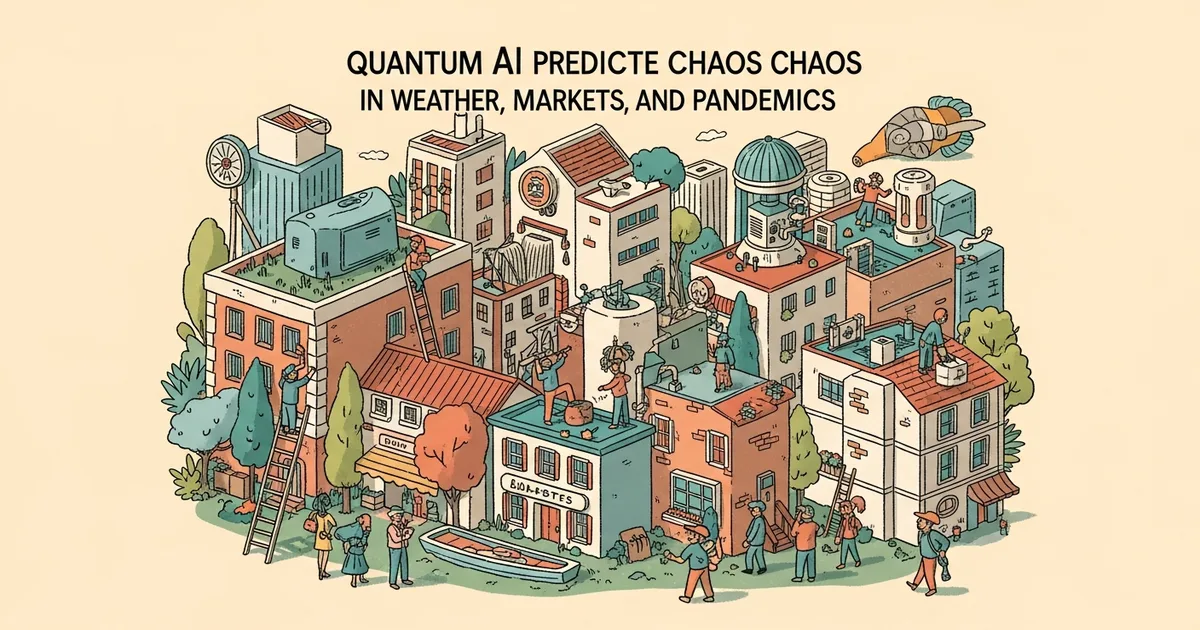
On April 17, 2026, ScienceDaily reported that researchers demonstrated a quantum-AI hybrid architecture capable of predicting chaotic systems with measurably higher accuracy and longer stability windows than classical AI alone. The advance directly targets quantum AI chaos prediction — the technical frontier where classical hardware faces structural limitations that no amount of GPU scaling can overcome.
The systems in scope are economically critical: atmospheric weather, financial markets, epidemic propagation, fluid turbulence, and supply chain cascades. All share the same mathematical pathology — exponential error amplification from minute initial variations — that classical AI handles poorly and quantum-enhanced models handle demonstrably better.
Why Classical AI Fails at Chaos
The problem isn’t model size or training data quality. Chaotic systems are defined by sensitive dependence on initial conditions — the Lorenz butterfly effect, mathematically formalized in 1963. A 0.001% error in a starting variable compounds exponentially across time steps, eventually overwhelming any predictive signal. Classical AI learns from historical patterns, but in chaotic regimes, no historical state recurs exactly enough for pattern matching to work past short time horizons.
Current state-of-the-art weather models from ECMWF achieve useful skill scores to approximately 10–14 days. Past that window, error growth rates exceed predictive accuracy — a hard physical limit, not an engineering gap. Quantitative finance AI faces the same collapse: at intraday timescales, chaotic dynamics shorten the useful signal window to minutes or hours before model drift renders predictions noise.
The computational root cause: mapping all correlations in a 50-variable chaotic system requires evaluating 2^50 possible interaction pairs — roughly one quadrillion — that classical hardware must approximate with lossy compression. Those approximations are exactly what chaos amplifies into prediction failure.
What the Quantum-AI Hybrid Does Differently
Quantum computers process information in superposition: a qubit simultaneously represents 0 and 1 until measured. A 50-qubit system therefore evaluates 2^50 states in a single operation — the same quadrillion-state correlation space that overwhelms classical hardware — without approximation. The quantum layer doesn’t predict the future; it maps the correlation structure of the present more completely than any classical preprocessor can.
The division of labor is deliberate: the quantum layer handles correlation mapping, where it has a structural computational advantage. The classical AI model handles forward prediction from that richer, more accurate pattern map. Neither component alone achieves the combined result.
The practical output, per the ScienceDaily-reported findings, is a slower Lyapunov exponent growth rate. The Lyapunov exponent governs how quickly prediction errors compound — it’s the mathematical signature of chaos. A hybrid system with a more accurate chaos map can better identify which parts of its prediction remain reliable and calibrate confidence accordingly. In the researchers’ framing, the AI “becomes more accurate and stable over time” — which in technical terms means error accumulation slows measurably.
The Chaotic Systems That Benefit Most
The quantum-AI advantage scales with the dimensionality and sensitivity of the target system. The five highest-impact application domains, ranked by economic urgency:
- Weather and climate modeling: The canonical chaotic system. AI has already saturated the consumer weather app market, but the underlying physics models have hit classical hardware ceilings. A verified 14-plus-day forecast window would directly benefit agriculture, energy dispatch, and shipping logistics — industries that collectively represent trillions in annual global economic activity.
- Financial markets: Equity, derivatives, and crypto markets exhibit chaotic dynamics at intraday timescales. Quantitative funds have deployed increasingly sophisticated classical AI since 2020, but alpha decay is accelerating as these approaches converge on similar strategies. Quantum-enhanced approaches would access a structurally differentiated signal unavailable to classical architectures.
- Epidemic propagation: SARS-CoV-2 modeling failures between 2020 and 2022 exposed how poorly classical epidemiological models handle chaotic spreading dynamics in heterogeneous populations. A system capable of more accurate outbreak trajectory prediction at the regional level would give public health agencies earlier and more reliable intervention windows.
- Fluid turbulence: Turbulence modeling underpins aerospace design, nuclear reactor safety, and climate science. Classical computational fluid dynamics requires massive simplifying assumptions; reducing those approximations with quantum preprocessing has cascading benefits across engineering disciplines.
- Supply chain cascade prediction: The 2021–2023 global supply chain disruptions demonstrated that failure propagation in complex logistics networks is chaotic. Better cascade prediction enables inventory and routing decisions that classical risk models cannot support with confidence.
Accuracy Improvements: What Was Measured
The research reported by ScienceDaily showed the hybrid system maintaining predictive stability past thresholds where classical AI degrades. The accuracy advantage is largest where chaos is most acute and smallest in near-deterministic subsystems. The mechanism is Lyapunov calibration: a system with a more accurate chaos map produces better-calibrated uncertainty estimates, making downstream decisions more reliable even when point predictions diverge from ground truth.
For weather-analogous applications, this corresponds to extending the useful forecast window. For financial applications, it corresponds to longer mean-reversion signal persistence before noise dominates. The directional finding was consistent across all chaotic domains tested — not a parameter-tuned win on a single benchmark, but a general advantage arising from the hybrid architecture itself.
Specific percentage improvements on operational datasets were not published in the ScienceDaily report. The scientific claim is structural: the quantum preprocessing layer produces a qualitatively better chaos characterization that persists across domain types, suggesting the advantage is architectural rather than dataset-specific.
Why This Matters More Than Quantum Supremacy Stunts
Quantum computing’s public credibility has taken damage from a decade of supremacy demonstrations. Google’s 2019 Sycamore result showed a quantum processor outperforming classical hardware at sampling random quantum circuits — a task that is hard for classical hardware specifically because it’s constructed to be, with zero practical application. IBM, IonQ, and others have run variations on the same pattern: impressive benchmarks on artificially constructed problems that don’t correspond to real computational work.
Chaotic system prediction is structurally different. It’s a genuine, economically significant problem that classical hardware handles poorly for mathematical reasons — not benchmark-design reasons. The quantum advantage emerges from the fundamental mismatch between correlation-space dimensionality and classical computational architecture. That’s not a manufactured edge; it’s derived from the physics of the problem domain.
Hybrid quantum-classical architectures — quantum hardware handling specific high-dimensional subtasks, classical hardware handling everything else — are the near-term path to practical utility, not monolithic quantum systems replacing classical computing wholesale. The infrastructure investment reflects this shift: Nebius’s $10 billion AI data center build in Finland and comparable capital deployments are beginning to allocate capacity for quantum co-processing alongside classical GPU clusters.
Timeline to Practical Deployment
Current quantum hardware — including IBM’s Heron processor, Google’s Willow system, and IonQ’s trapped-ion architecture — operates at qubit counts and error rates that constrain which chaotic problems can be practically addressed. The correlation-mapping advantage scales directly with qubit count and error correction quality: 100-qubit systems with current error rates address different problem dimensions than 1,000-qubit fault-tolerant systems will.
IBM’s publicly committed roadmap targets fault-tolerant quantum computing at scale between 2029 and 2033. For operational chaos prediction — deployed weather and financial prediction pipelines, not research demonstrations — a realistic timeline is 2029–2032 for high-value specialized applications. Broader deployment across healthcare and supply chain management depends on quantum error correction reaching production maturity, which most major hardware teams project for the early 2030s.
The near-term window from 2026 to 2028 is for hybrid integration research: building quantum-classical preprocessing pipelines for bounded chaotic problems — specific financial instrument classes, regional atmospheric subsystems, localized outbreak modeling — before hardware scale reaches full-atmosphere or global-market scope. Organizations that wait for mature hardware to arrive before beginning integration work will lag by several years in domains where prediction accuracy determines competitive position.
What This Means for AI Builders
The April 17 research implicitly challenges the dominant AI scaling hypothesis applied to prediction in chaotic domains. Classical scaling — more GPU clusters, larger parameter counts, more training data — hits diminishing returns on chaotic systems not because the models are undertrained, but because the computational substrate cannot efficiently represent the correlation space. Adding more compute to weather prediction doesn’t close the Lyapunov gap.
For teams building prediction systems in chaotic domains, the architectural implication is immediate. Quantum-AI hybrid integration takes 3–5 years of foundational pipeline work before hardware reaches operational scale. Organizations starting hybrid development in 2026 are positioned for 2029–2030 deployment windows; those waiting for hardware maturity to begin will trail in domains where prediction accuracy determines competitive position.
The accuracy gains also carry governance implications. Movements pushing back against autonomous AI in critical decision-making will find their most contested ground in exactly these chaotic, high-stakes prediction domains — where the quantum-enhanced AI’s structural edge over human intuition is largest and the stakes of both accurate and inaccurate predictions are highest.
MegaOne AI tracks 139+ AI tools across 17 categories. The chaotic prediction space — currently occupied by specialized weather AI, quantitative finance platforms, and epidemiological modeling tools — will see measurable capability differentiation as quantum-classical hybrid systems move from research labs to deployed products. Classical-only architectures in these domains now face a credible technical roadmap that renders them structurally inferior on the one dimension that matters most: how far ahead they can see.