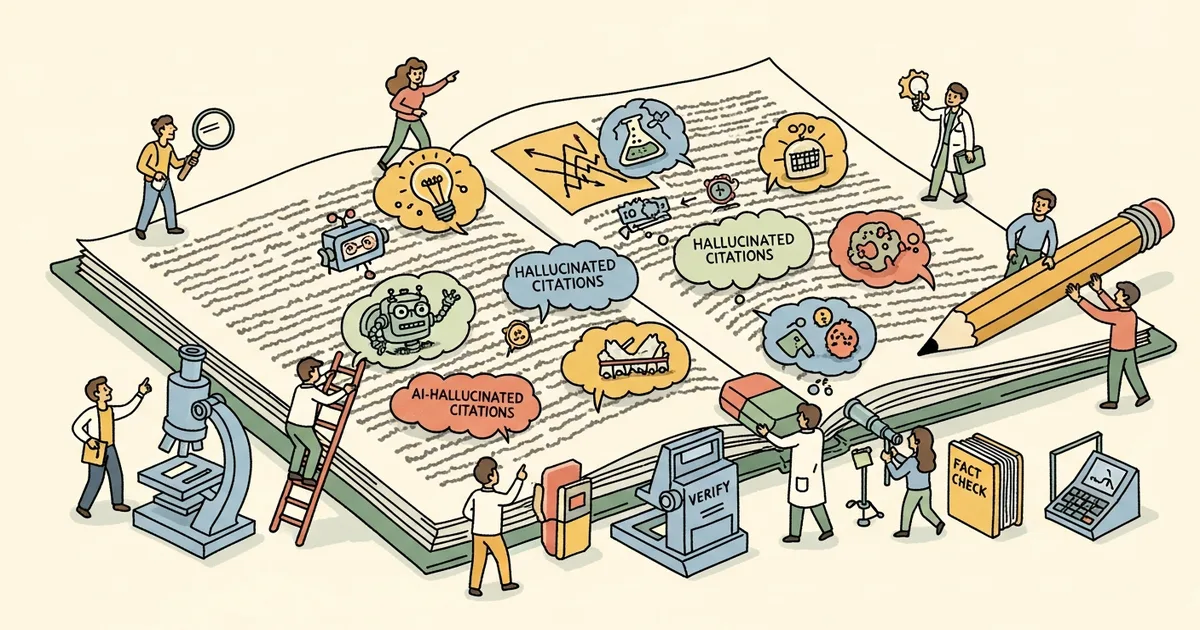
- Columbia University-led researchers audited 2.47 million biomedical papers and 97.1 million references, finding 4,046 fabricated citations across 2,810 papers.
- Fabricated-citation rate held at ~4 per 10,000 papers through 2023 but climbed to 51.3/10K by end-2025 and 56.9/10K in early 2026 — over 12x the baseline.
- The study, led by Maxim Topaz and published in The Lancet, attributes the spike to widespread LLM use (with caveats for paper mills and other causes).
- Researchers call for automated reference checks before publication; arXiv has already introduced one-year author bans.
What Happened
The rate of fabricated references in biomedical papers has increased more than twelvefold since 2023, according to a Columbia-led study published in The Lancet. The audit covered 2.47 million biomedical papers and 97.1 million references in PubMed Central, January 2023 through February 2026. The team was led by Maxim Topaz.
Why It Matters
The fabricated citations are particularly risky in review articles that shape clinical guidelines. Practicing physicians and guideline committees rely on the cited literature to update standards of care; when the underlying citations don’t exist, the chain breaks. Beyond the immediate clinical risk, the finding is among the cleanest empirical demonstrations of how generative AI is degrading scholarly publishing as a knowledge infrastructure.
The result lands alongside arXiv’s recently introduced one-year author ban for submissions with unchecked LLM-generated content — described by computer-science section chair Thomas Dietterich as a “one-strike” policy.
Technical Details
Out of 97.1 million references checked, 4,046 were flagged as fabricated, spread across 2,810 papers. A reference counted as fabricated if its listed title could not be found in any of four major databases: PubMed, Crossref, OpenAlex, and Google Scholar. Throughout 2023, the rate held steady at about 4 fabricated references per 10,000 papers. Starting in mid-2024, the rate climbed sharply — 51.3 per 10,000 by end of 2025 and 56.9 per 10,000 in the first seven weeks of 2026.
The authors suspect an obvious link to language models like ChatGPT, which took off in late 2022. Since biomedical papers typically take 100-200 days from submission to publication, AI-generated text would not show up in PubMed Central at scale until mid-2024 — exactly when the rate began climbing.
Who’s Affected
Clinicians using literature reviews to inform care decisions face a polluted information base. Editors at biomedical journals must implement detection workflows. Authors using LLM assistance face higher responsibility for verification. Publishers — Elsevier, Springer Nature, Wiley, BMJ — face procedural-process redesign. Patient-advocacy groups, regulators (FDA, EMA, MHRA), and clinical-guideline-issuing bodies face the deepest downstream risk if fabricated citations have shaped issued guidelines.
What’s Next
The Columbia team calls for automated reference checks before publication and retroactive screening of already-published papers. Major publishers and preprint servers will need to adopt these workflows. Industry tools for automated reference verification exist (Scite, Inciteful, Crossref Similarity Check) but are not universally deployed. Expect policy responses from major medical journals through the second half of 2026.
Related Reading
- Why You Shouldn’t Leave Model Selection on Default in Copilot or Gemini
- OpenAI Q1 2026: −122% Adjusted Operating Margin on $5.7B Revenue, 905M Weekly ChatGPT Users
- OpenAI Targets September IPO with Goldman Sachs and Morgan Stanley as Lead Bankers
- Chatbots Struggle With News Accuracy and Sourcing Ahead of U.S. Midterms, Bloomberg Reports