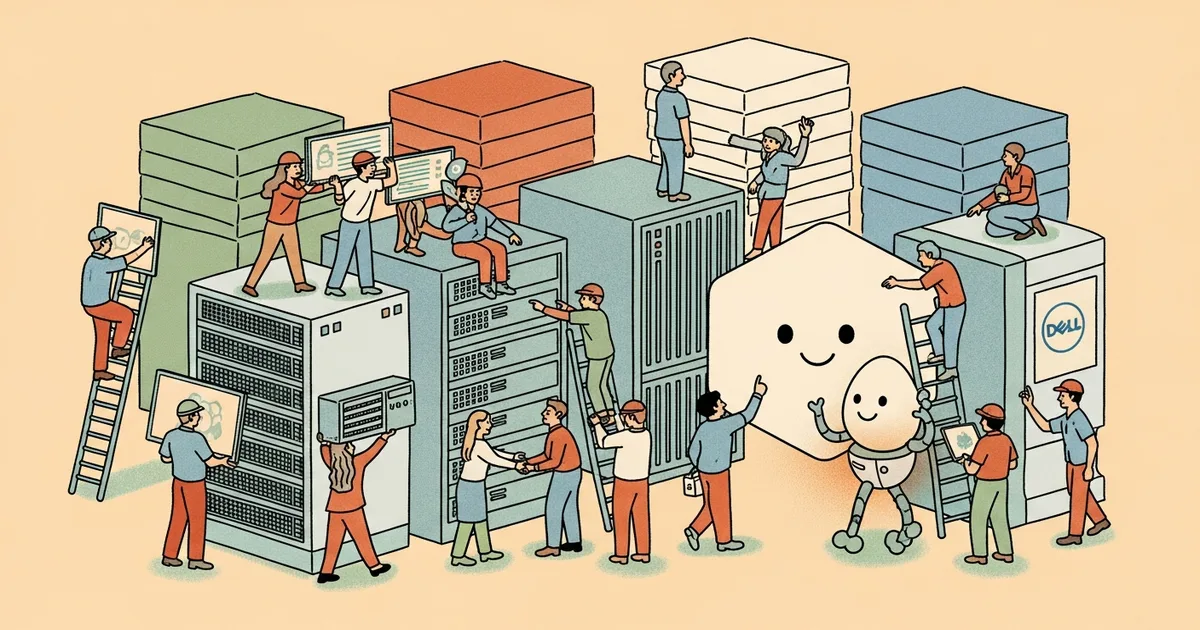
- OpenAI and Dell Technologies announced a partnership to deploy Codex across hybrid and on-premise enterprise environments.
- The collaboration connects Codex with the Dell AI Data Platform (data storage/governance) and Dell AI Factory (AI workloads).
- More than 4 million developers now use Codex weekly, per OpenAI — making it one of OpenAI’s fastest-growing enterprise products.
- The partnership will also explore connecting Codex, ChatGPT Enterprise, and other API solutions with Dell AI Factory.
What Happened
OpenAI and Dell Technologies are collaborating to deploy Codex in hybrid and on-premise enterprise environments, OpenAI announced on Monday. Codex will connect with the Dell AI Data Platform — which many businesses use to store, organise, and govern enterprise data on-premises — and Dell AI Factory, which businesses use to power AI workloads.
Why It Matters
The partnership extends Codex into the deployment surface where most large enterprises actually keep their proprietary code and data: their own infrastructure, not the public cloud. OpenAI has historically been a cloud-first vendor. The Dell partnership is the first major productised step into hybrid and on-premise enterprise environments — addressing a procurement constraint that has been a friction point for regulated industries (financial services, healthcare, government, defence) where cloud-only AI deployment is restricted by policy or contract.
The move is also a competitive response. Anthropic’s Claude is available via AWS Bedrock and Google Cloud Vertex AI, with deployment options inside customer-controlled cloud environments. Microsoft’s Copilot stack is integrated with Azure Arc for hybrid deployments. OpenAI’s prior limitation to cloud-only deployments was a competitive disadvantage with regulated customers.
Technical Details
Codex usage is one of OpenAI’s fastest-growing enterprise products, with more than 4 million weekly developers per OpenAI’s announcement. Use cases span code review, test coverage, incident response, and reasoning across large repositories. Codex is also expanding beyond coding — teams are beginning to use Codex-powered agents to gather context across tools, prepare reports, route product feedback, qualify leads, write follow-ups, and coordinate work across business systems.
The Dell partnership connects Codex with the Dell AI Data Platform — the on-premise data-store and governance layer used by Dell enterprise customers. The companies will also explore how Codex, ChatGPT Enterprise, and other API-based solutions can interface with Dell AI Factory to prepare data, manage systems of record, run tests, and deploy AI applications integrated with hybrid or on-premise Dell infrastructure.
Who’s Affected
Dell enterprise customers gain a productised path to deploy OpenAI’s coding-agent stack inside their own infrastructure. Regulated industries — financial services, healthcare, government, defence — gain access to Codex without violating data-residency or sovereignty requirements. Anthropic, Google DeepMind, and Microsoft Copilot face a competitor with deeper integration into one of the largest enterprise-infrastructure vendors. Hardware competitors to Dell — Hewlett Packard Enterprise, Lenovo, Cisco UCS — face the question of whether to pursue similar partnerships with OpenAI or its competitors.
What’s Next
OpenAI did not disclose general availability timing or specific Dell-product SKU integration milestones. The companies will iterate on Codex–Dell AI Factory interfaces, with broader product disclosure expected through 2026’s enterprise-conference circuit. Greg Brockman’s recent product consolidation under his leadership at OpenAI is consistent with the Dell partnership: ChatGPT, Codex, and the API are being positioned as a unified platform that needs to deploy across both cloud and on-premise surfaces.