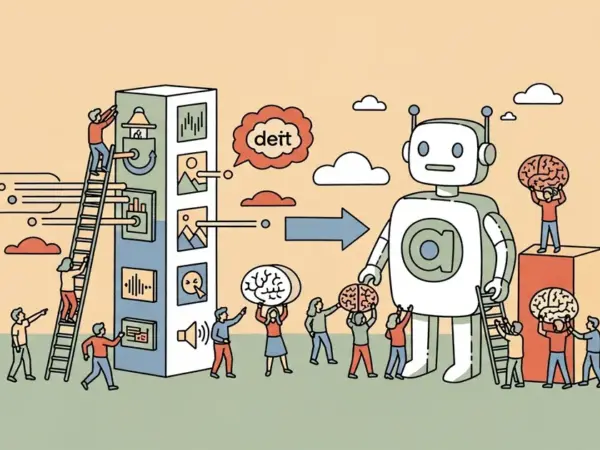
- Meta introduced Autodata on May 1, 2026, an agentic framework designed to turn AI models into autonomous data scientists for high-quality training-data creation.
- The release was reported by MarkTechPost; the source URL returned a CAPTCHA challenge during research, so detailed technical specifics should be verified against Meta’s official documentation.
- The framing positions training-data generation as a target for agent automation — a category that has been dominated by manual data labeling, rule-based synthesis, and crowdsourced platforms.
- If validated by independent reproduction, Autodata represents Meta’s bet that closed-loop synthetic data generation can become a primary alternative to human-labeled datasets at frontier-model scale.
What Happened
Meta released Autodata on May 1, 2026, an agentic framework that lets AI models act as autonomous data scientists for training-data creation. The release was covered by MarkTechPost; during research, the MarkTechPost source returned a CAPTCHA challenge, so technical specifics beyond the headline framing are best confirmed against Meta’s official Autodata documentation directly.
Why It Matters
Training data has emerged as the gating constraint on frontier-model improvement. Frontier labs have publicly acknowledged that the supply of high-quality human-curated text on the open web is being consumed faster than it grows, and synthetic data has been an active research direction across OpenAI, Anthropic, Google DeepMind, and Meta. Most synthetic-data work to date has used hand-tuned generation pipelines, with humans designing the prompts, validation rules, and quality filters. Autodata’s framing — agents acting as “autonomous data scientists” — extends agent automation into the data-engineering loop itself.
Technical Details
The detailed architecture, agent design, validation protocols, and benchmark results were not retrievable from the source URL during research due to a CAPTCHA challenge. The framing summarized publicly indicates Autodata operates as an agentic framework — meaning multi-step, tool-using AI agents with planning capabilities — applied specifically to the data-generation pipeline. The “autonomous data scientists” framing typically implies the agent system handles tasks including problem formulation, dataset design, generation, validation, and quality scoring with minimal human intervention per loop.
Open questions for independent evaluation include: which model family powers Autodata’s agents, the validation methodology used to ensure generated data is actually high-quality (a long-standing weakness in synthetic-data research), the licensing and openness of Autodata, and whether the framework targets internal Meta training pipelines or is intended for broader research community use.
Who’s Affected
Meta’s own AI training pipelines for Llama and downstream products are the most direct beneficiary if Autodata performs as framed. The synthetic-data research community gains a major new reference point. Data-labeling vendors — Scale AI, Surge AI, Labelbox, and the broader manual-curation industry — face a longer-term competitive question if agent-driven data generation matures: human-labeled data has been their core moat. Other frontier labs face implicit pressure to match the capability or publish their own equivalent frameworks.
What’s Next
Watch for Meta’s official Autodata blog post, technical report, and any open-source release. Independent reproduction of the framework’s claims — particularly around generated data quality compared to human-labeled baselines — will determine commercial impact. The next major Llama model release is the cleanest external test of whether Autodata’s training-data outputs translate into measurable model-quality gains.