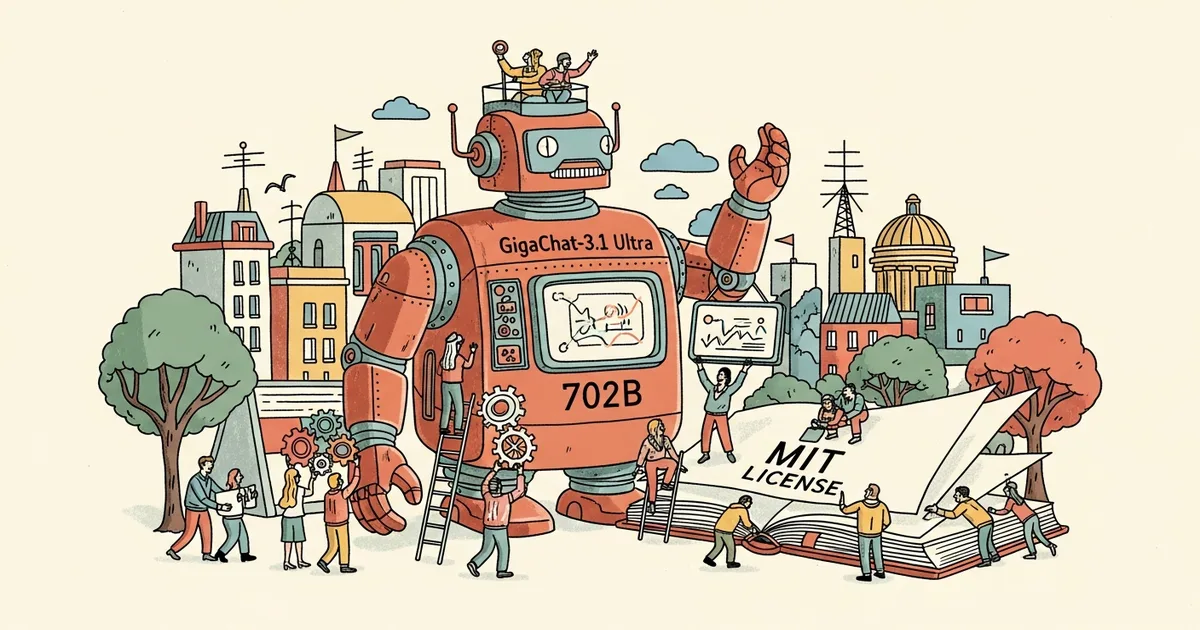
GigaChat-3.1-Ultra-702B and GigaChat-3.1-Lightning-10B, new open-weight mixture-of-experts language models, were released on Hugging Face on March 24 under an MIT license. The models, developed by the ai-sage research group, represent a notable entry from Russia’s AI ecosystem into the open-weight model landscape that has been dominated by Chinese (Qwen, DeepSeek) and American (Llama, Mistral) releases.
The Ultra variant uses a mixture-of-experts architecture with 702 billion total parameters, placing it in the same parameter class as Llama 3.1 405B and DeepSeek-V3 671B. The Lightning variant at 10 billion parameters with 1.8 billion active (a 10B-A1.8B configuration) targets edge deployment and resource-constrained environments. Both models are released under the MIT license — the most permissive open-source license available — allowing unrestricted commercial use, modification, and redistribution.
The release is significant for two reasons. First, Russia has been largely absent from the open-weight model competition, with most releases coming from US, Chinese, and European labs. GigaChat-3.1 demonstrates that Russian AI research has reached a scale and quality sufficient to compete in open releases. Second, the MIT license removes the usage restrictions that some competitors impose — Meta’s Llama requires acceptance of a community license, and some Chinese models carry conditions on military or surveillance use.
Early benchmark results show GigaChat-3.1 Ultra performing competitively on multilingual tasks, with particular strength in Russian, other Slavic languages, and code generation. English-language performance appears comparable to but slightly below frontier Western and Chinese models of similar scale. The Lightning variant’s small active parameter count makes it viable for inference on consumer GPUs with as little as 8GB of VRAM.
The model’s provenance raises questions for enterprise users in Western markets. While the MIT license imposes no legal restrictions, organizations subject to sanctions compliance may need to evaluate whether using Russian-developed AI models creates regulatory risk — a concern that does not apply to Chinese or European alternatives despite similar geopolitical complexities.