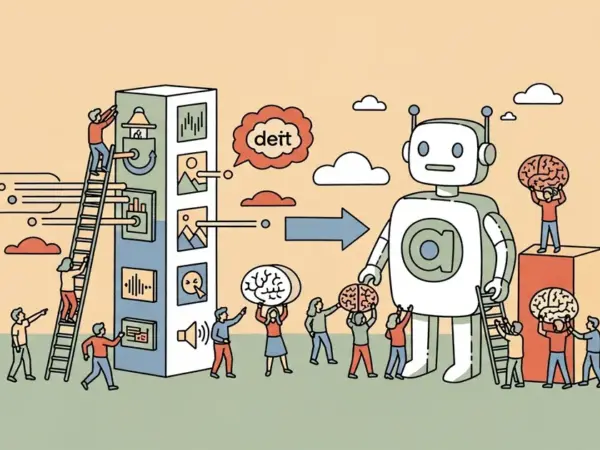
Chroma, the company behind the open-source vector database of the same name, released Context-1 on March 29, 2026 — a 20 billion parameter agentic search model built to act as a specialized retrieval subagent. Writing for MarkTechPost, Asif Razzaq reported that the model addresses a persistent failure mode in retrieval-augmented generation systems where oversized context windows increase costs, raise latency, and produce degraded reasoning over retrieved content.
- Context-1 is a 20B Mixture of Experts model fine-tuned from gpt-oss-20B using Supervised Fine-Tuning and Reinforcement Learning via CISPO, a staged curriculum optimization method.
- The model averages 2.56 tool calls per turn, operating through tools including
search_corpus(hybrid BM25 + dense vector search),grep_corpus(regex-based matching), andread_document. - Its Self-Editing Context feature executes a
prune_chunkscommand mid-search, achieving a pruning accuracy of 0.94 to remove irrelevant passages from the active context. - The model operates within a bounded 32k context window, maintaining retrieval quality on large corpora without requiring window expansion in a frontier model.
What Happened
On March 29, 2026, Chroma released Context-1, a 20 billion parameter agentic search model designed as a purpose-built retrieval subagent that decomposes complex queries into sequential sub-searches and passes resulting documents to a downstream frontier model for final answer generation, as reported by Asif Razzaq at MarkTechPost on the same date. The model is described as “a highly optimized scout” — not a general-purpose reasoning engine, but a component trained specifically to find supporting documents and hand them off rather than generate final answers itself.
Why It Matters
Context-1 targets a well-documented failure mode in production RAG systems where expanding context windows in frontier models leads to, as Razzaq writes, “higher latency, astronomical costs, and a ‘lost in the middle’ reasoning failure that no amount of compute seems to fully solve.” Prior agentic retrieval architectures have addressed multi-step search by relying on general-purpose frontier models to orchestrate retrieval alongside generation, without dedicated training for the retrieval subagent role itself. Context-1 represents a structural alternative: separating the retrieval function into a purpose-trained component and assigning generation to a separate downstream model.
Technical Details
Context-1 is fine-tuned from gpt-oss-20B, a Mixture of Experts architecture, using a two-stage process combining Supervised Fine-Tuning with Reinforcement Learning via CISPO — described in the MarkTechPost article as a staged curriculum optimization method. It runs inside a specific agent harness that gives it access to three tools: search_corpus, which implements hybrid BM25 plus dense vector search; grep_corpus, which supports regex pattern matching across a corpus; and read_document for full document retrieval.
When handling a complex query, Context-1 does not issue a single search request. It decomposes the high-level query into targeted subqueries and executes them — often in parallel — averaging 2.56 tool calls per turn. This iterative structure is the mechanism through which the model handles multi-hop reasoning tasks, where reaching a correct answer requires chaining multiple intermediate retrieval steps before a final answer is achievable.
The model’s most technically specific innovation is Self-Editing Context. As Context-1 accumulates documents across multiple turns, it proactively executes a prune_chunks command to discard passages that have become redundant or irrelevant to the narrowing search. Chroma reports a pruning accuracy of 0.94 for this operation — described as “soft limit pruning” — which keeps the active context lean and sustains retrieval quality within a bounded 32k context window even on large corpora. To train and evaluate this behavior, Chroma developed a synthetic benchmark dataset called context-1-data-gen, constructed to generate multi-hop reasoning tasks that require multiple sequential retrieval steps to reach ground truth answers.
Who’s Affected
Context-1 is most directly relevant to developers and engineering teams building production RAG pipelines that handle large document corpora, particularly where answering a query requires chaining several retrieval steps. Teams already using Chroma’s vector database have a natural integration path, as Context-1 is built to operate within the same retrieval infrastructure. The model also presents a concrete architectural option for AI platform teams evaluating whether to split retrieval and generation responsibilities across purpose-built components rather than delegating both to a single frontier model.
What’s Next
The MarkTechPost article does not include a product roadmap for Context-1 beyond the initial release. Open questions include how the model’s pruning accuracy of 0.94 generalizes to domains not represented in the synthetic context-1-data-gen training data, and whether the bounded 32k context window presents practical limitations in use cases requiring simultaneous retention of a large number of retrieved passages. Author details for Chroma’s internal research team were not available in the source material at time of publication.
Related Reading
- Anthropic Reportedly Testing Mythos, Described as Its Most Powerful AI Model Ever
- FDA Deploys Agentic AI Across All Employees, Reports 70 Percent Voluntary Adoption
- Russian AI Lab Releases GigaChat-3.1 Ultra 702B as Open-Weight Model Under MIT License
- AI Model Releases Hit Record Pace as Platforms Bundle Multiple Models to Fight Subscription Fatigue
- OpenAI Launches Safety Bug Bounty Program to Identify AI Abuse and Agentic Risks