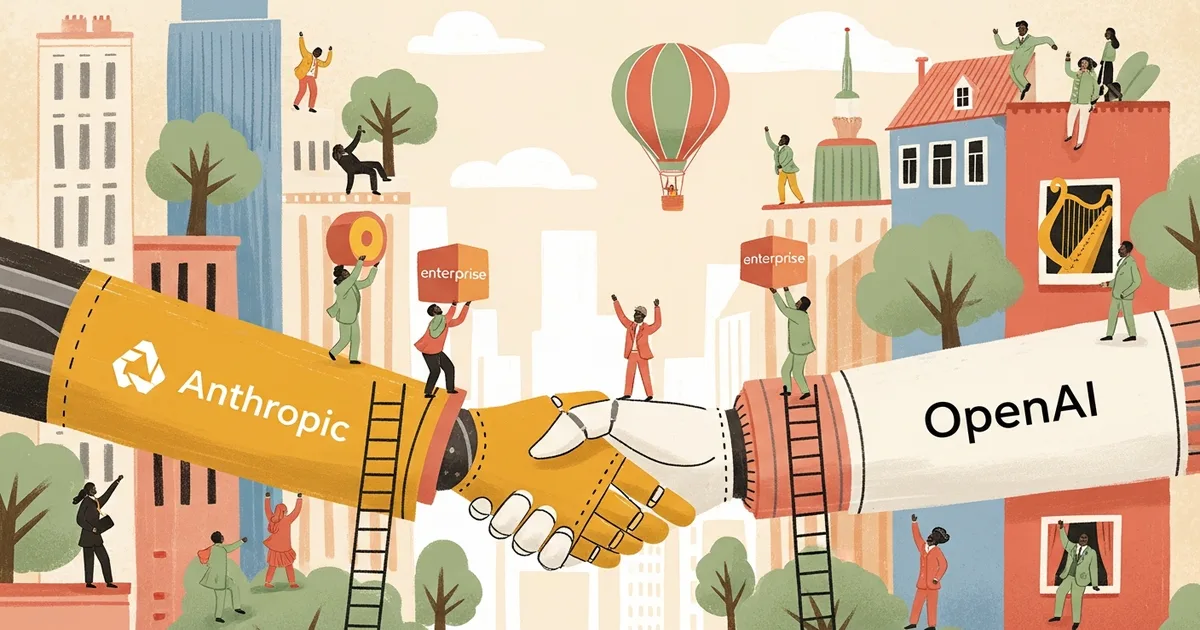
- Anthropic announced a joint venture on May 4, 2026 with Blackstone, Hellman & Friedman, and Goldman Sachs as founding partners — Wall Street Journal reports the entity is valued at $1.5 billion with $300 million commitments each from Anthropic, Blackstone, and H&F.
- Hours earlier, Bloomberg reported OpenAI is raising $4 billion at a $10 billion valuation for a parallel venture called The Development Company, backed by TPG, Brookfield, Advent, and Bain Capital.
- The two ventures share an identical playbook: raising from alternative asset managers to create new channels for enterprise AI deals via the forward-deployed engineer (FDE) model popularized by Palantir.
- No apparent investor overlap between the OpenAI venture and the Anthropic competitor, signaling a sharp partition of the alternative-asset capital pool.
What Happened
On May 4, 2026, Anthropic and OpenAI both announced new joint ventures focused on enterprise AI services within hours of each other. Anthropic’s announcement named Blackstone, Hellman & Friedman, and Goldman Sachs as founding partners, with backing from Apollo Global Management, General Atlantic, GIC, Leonard Green, and Sequoia Capital. The Wall Street Journal first reported the partnership and stated the new venture is valued at $1.5 billion, with $300 million committed each from Anthropic, Blackstone, and Hellman & Friedman.
Mere hours before Anthropic’s announcement, Bloomberg reported OpenAI was raising funds for a new venture called The Development Company, raising $4 billion from 19 investors against a $10 billion valuation. Named investors include TPG, Brookfield Asset Management, Advent, and Bain Capital. There is no apparent investment overlap between the OpenAI venture and Anthropic’s competitor.
Why It Matters
The simultaneous launches signal that both labs have arrived at the same conclusion about how to scale enterprise AI deployment: existing systems integrators (Accenture, Deloitte, PwC) and direct sales cannot keep up with demand, and forward-deployed engineering needs a new financial structure to scale. Both labs are using the playbook Palantir pioneered — embedding engineers inside customer organizations to build custom integrations rather than selling off-the-shelf products. The simultaneous launches also reveal a partition of alternative-asset capital: the major private-equity and asset-manager firms have aligned with one lab or the other, with no overlap between the named investor groups. That’s a structural choice that will shape enterprise AI access for the next several years.
Technical Details
The shared logic of the two ventures: raise capital from alternative asset managers to create new channels for enterprise AI deals. The ventures presumably get preferred sales access to their investors’ portfolio companies, while the investors capture more value from any resulting AI services contracts. The new capital allows more engineering resources per individual customer, embracing the forward-deployed engineer model.
Anthropic’s framing in its announcement: “An engagement might begin with the company’s engineering team sitting down with clinicians and IT staff to build tools that fit into the workflows that staff already use… Engagements like this will run across mid-sized companies across industries, each shaped by the people closest to the work.” The Anthropic venture explicitly targets mid-sized companies — community banks, mid-sized manufacturers, regional health systems — that lack the in-house resources to build and run frontier AI deployments themselves.
Krishna Rao, Chief Financial Officer of Anthropic, stated: “Enterprise demand for Claude is significantly outpacing any single delivery model. Our partnerships with the world’s leading systems integrators are central to how Claude reaches large enterprises. This new firm brings additional operating capability to the ecosystem and capital from leading alternative asset managers.” The Anthropic venture will become a member of the Claude Partner Network alongside Accenture, Deloitte, and PwC.
Both ventures launch as the underlying labs fundraise at unprecedented pace. OpenAI announced $122 billion in new funding at the end of March against an $852 billion valuation. TechCrunch reported last week that Anthropic is in the final stages of a $50 billion round at a $900 billion valuation.
Who’s Affected
Mid-sized enterprises across regulated industries — healthcare, financial services, manufacturing — gain dedicated AI deployment vehicles backed by major private-equity firms. Existing systems integrators face a competitive question: Accenture, Deloitte, and PwC remain in the Anthropic Partner Network, but the new Anthropic venture creates an alternative path that may compete with their delivery model on certain accounts. The aligned investor pools — Blackstone/H&F/Goldman/Apollo/GA/GIC/Leonard Green/Sequoia for Anthropic; TPG/Brookfield/Advent/Bain for OpenAI — gain preferred access to enterprise AI deployments at portfolio companies. Palantir, whose model both ventures are emulating, gains validation that the forward-deployed engineer approach scales beyond Palantir’s own footprint.
What’s Next
The first customer wins from each venture will be the cleanest external test. Watch for whether the ventures publicly announce specific deals — particularly cross-portfolio deals where, for example, a Blackstone-owned company adopts the Anthropic venture, or a Bain-owned company adopts the OpenAI Development Company. Both ventures’ staffing pace — how quickly they hire forward-deployed engineers — will indicate whether the model can scale fast enough to absorb the demand both labs cite. The non-overlap between investor pools also creates a longer-term question: if a major enterprise has both an OpenAI-aligned and an Anthropic-aligned investor on its cap table, which venture wins the deal?