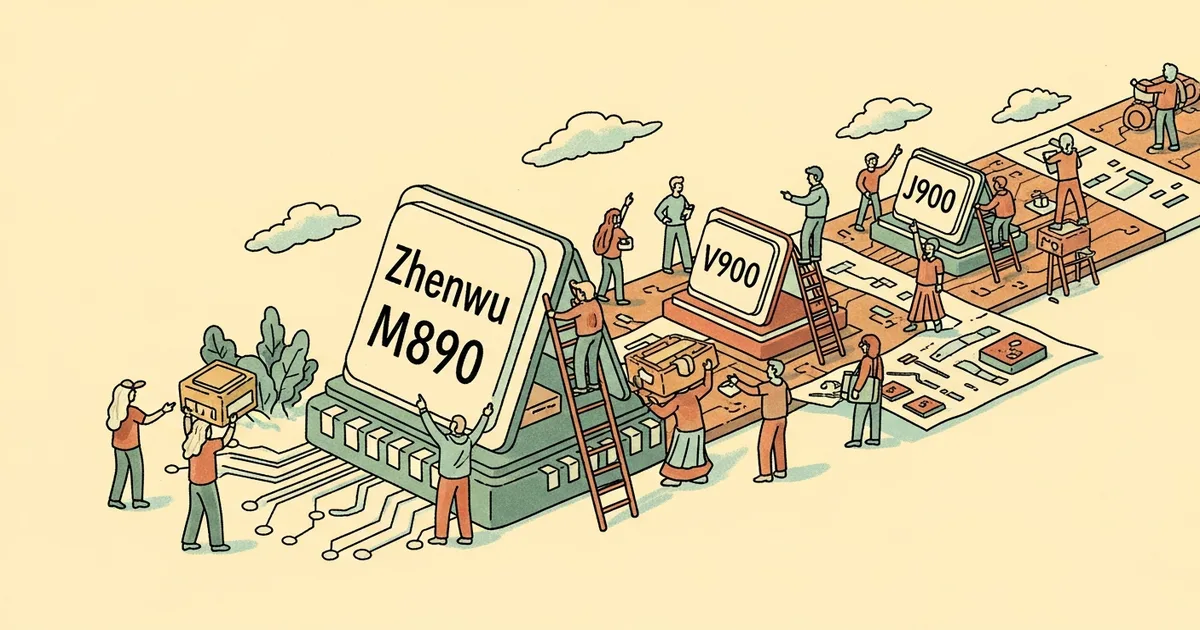
- Alibaba unveiled the Zhenwu M890 — an AI processor built specifically for AI agent workloads — developed by semiconductor subsidiary T-Head.
- The M890 delivers 3x the performance of its predecessor Zhenwu 810E, per Alibaba.
- A multi-year roadmap follows with V900 in Q3 2027 (~3x further performance gain) and J900 in Q3 2028.
- Alibaba’s architectural intent — purpose-built for agentic workloads, not standard inference — signals where the company expects enterprise AI compute to head.
What Happened
Alibaba has unveiled the Zhenwu M890, a new AI processor built specifically for AI agent workloads, paired with a multi-year silicon roadmap and a new large language model, AI News reported on Tuesday. The M890 was developed by Alibaba’s semiconductor subsidiary T-Head and delivers three times the performance of its predecessor, the Zhenwu 810E, per the company. Reuters first reported the chip announcement.
Why It Matters
The chip’s significance is less about the 3x performance jump than the architectural intent. The M890 is purpose-built for AI agents — workloads where software systems must retain long stretches of context, coordinate with other models in real time, and execute complex multi-step tasks with limited human intervention. Those demands, heavy on memory bandwidth and inter-model communication, are meaningfully different from what standard inference chips are optimised for.
The difference matters because it signals where Alibaba thinks AI compute is heading. The company is not designing around today’s dominant inference use case; it is building for the workload profile it expects to define enterprise AI over the next several years. Nvidia, the dominant incumbent in AI compute, has built its dominance around training and inference architectures that are increasingly under pressure as agentic workloads scale.
Technical Details
The Zhenwu roadmap continues with the V900 in Q3 2027 — expected to deliver another roughly 3x performance gain — followed by the J900 in Q3 2028. That is a deliberate, sustained cadence of in-house silicon upgrades that mirrors the tick-tock product cycles Nvidia has used to maintain its lead in AI accelerators.
The parallel to Huawei is direct. Huawei laid out a similar chip roadmap for its Ascend line last year, and both Alibaba and Huawei moves are explicit responses to US export controls limiting Chinese access to Nvidia’s most capable chips. The Chinese strategic-autonomy framing — building native AI silicon and models to reduce dependency on US infrastructure — has emerged as a primary policy goal at the State Council level.
Who’s Affected
Chinese AI labs — Alibaba Cloud, Baidu, ByteDance, DeepSeek, Moonshot, Zhipu — gain access to an agent-optimised compute substrate that bypasses Nvidia export restrictions. Nvidia faces direct competition in the Chinese market, where its H20 and H200 China-specific variants generate material but politically constrained revenue. Huawei’s Ascend roadmap gains a parallel competitive entry from Alibaba in the same agent-optimised silicon category. Western frontier labs (OpenAI, Anthropic, Google DeepMind) face the question of whether their model architectures take advantage of agent-optimised silicon as it becomes available outside the Nvidia stack. The broader US-China AI competition narrative gains another structural data point.
What’s Next
The Zhenwu M890 is now available in Alibaba’s own data centres; external availability and Alibaba Cloud customer-facing access have not been disclosed. The V900 is targeted for Q3 2027, the J900 for Q3 2028. Reuters’ underlying reporting included additional financial and customer details. Industry watchers should expect Huawei’s next Ascend announcement to follow shortly, with similar agent-optimised positioning.